




Construct a parallelogram PQRS in which \[QR = 6\]cm, \[PQ = 4\]cm and \[\left| \!{\underline {\,
{PQR} \,}} \right. = {60^ \circ }\].
Answer
 Verified
515.1k+ views
Hint: Here in this question belongs to the construction topic, given the length of two sides and one angle of parallelogram. As we know the parallelogram properties the opposite sides and opposite angles are always equal, we have to try to construct the parallelogram of given measurements by using a geometrical instrument, like centi-meter scale, compass with provision of fitting a pencil.
Complete step by step solution:
Consider the given question:
Given, the length of two sides and one angle of parallelogram PQRS i.e.,
\[QR = 6\]cm, \[PQ = 4\]cm and \[\left| \!{\underline {\,
{PQR} \,}} \right. = {60^ \circ }\].
As we know the property of parallelogram: The parallel or opposite sides and opposite angles of a parallelogram are equal.
To construct the parallelogram PQRS follow the below steps:
Steps of Construction:
First, draw a base line PQ of length 4 cm (i.e., \[PQ = 4\,cm\]) by using a centi-meter scale.

Draw a line QR of length 6 cm (i.e., \[QR = 6\,cm\]) from point Q at an angle of \[{60^ \circ }\] (i.e., \[\left| \!{\underline {\,
{PQR} \,}} \right. = {60^ \circ }\]) with the help of a protractor.
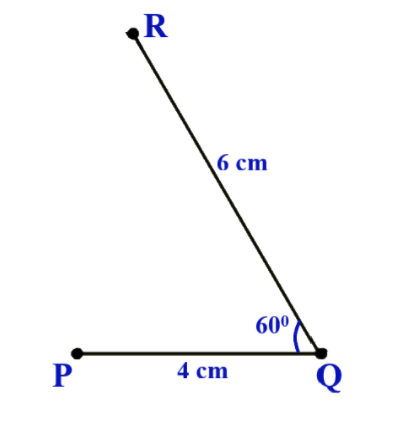
Now, draw the opposite sides by using a compass, take a length of radius 6 cm and make an arc by taking P as centre. Do the same by taking R as centre and length of 4 cm. Then join the arc intersection point to P and R and label it as S.
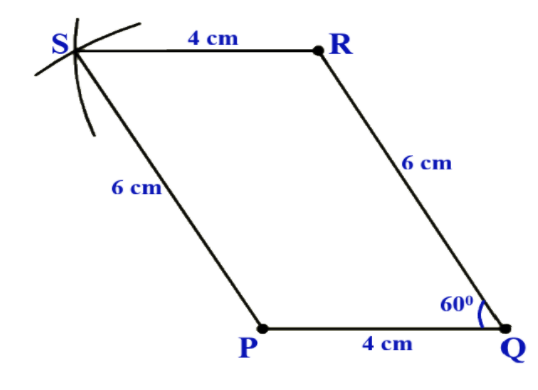
Hence, it’s a required construction of parallelogram PQRS.
Note: When doing construction handling the instruments carefully. Remember the parallelogram is a one of the types of quadrilateral, which has some basic properties like the opposite or parallel sides and the opposite angles are always equal otherwise the quadrilateral is not a parallelogram.
Complete step by step solution:
Consider the given question:
Given, the length of two sides and one angle of parallelogram PQRS i.e.,
\[QR = 6\]cm, \[PQ = 4\]cm and \[\left| \!{\underline {\,
{PQR} \,}} \right. = {60^ \circ }\].
As we know the property of parallelogram: The parallel or opposite sides and opposite angles of a parallelogram are equal.
To construct the parallelogram PQRS follow the below steps:
Steps of Construction:
First, draw a base line PQ of length 4 cm (i.e., \[PQ = 4\,cm\]) by using a centi-meter scale.
Draw a line QR of length 6 cm (i.e., \[QR = 6\,cm\]) from point Q at an angle of \[{60^ \circ }\] (i.e., \[\left| \!{\underline {\,
{PQR} \,}} \right. = {60^ \circ }\]) with the help of a protractor.
Now, draw the opposite sides by using a compass, take a length of radius 6 cm and make an arc by taking P as centre. Do the same by taking R as centre and length of 4 cm. Then join the arc intersection point to P and R and label it as S.
Hence, it’s a required construction of parallelogram PQRS.
Note: When doing construction handling the instruments carefully. Remember the parallelogram is a one of the types of quadrilateral, which has some basic properties like the opposite or parallel sides and the opposite angles are always equal otherwise the quadrilateral is not a parallelogram.
Recently Updated Pages
Master Class 8 Social Science: Engaging Questions & Answers for Success

Master Class 8 English: Engaging Questions & Answers for Success
Class 8 Question and Answer - Your Ultimate Solutions Guide
Master Class 8 Maths: Engaging Questions & Answers for Success
Master Class 8 Science: Engaging Questions & Answers for Success
Master Class 9 General Knowledge: Engaging Questions & Answers for Success
Trending doubts
What is BLO What is the full form of BLO class 8 social science CBSE
Citizens of India can vote at the age of A 18 years class 8 social science CBSE
Full form of STD, ISD and PCO
Advantages and disadvantages of science
Right to vote is a AFundamental Right BFundamental class 8 social science CBSE
What are the 12 elements of nature class 8 chemistry CBSE