




Ciliated organ of Muller is
(a) Velum
(b) Wheel organ
(c) Branchial sac
(d) None of the above
Answer
 Verified
606.6k+ views
Hint: This organ is found in the roof and sides of the oral cavity in lancelets as an epithelium. This organ is ciliated and borders the oral epithelium.
Complete answer:
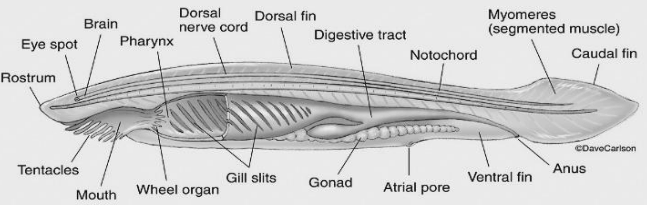
The wheel organ is the ciliated organ of Muller and is known to be a specialized epithelium. Muller organ is usually a swelling that is formed by the accumulation of scolopophore. The wheel organ is generally separated by a thin strip of margin cells. These cells are not ciliated like the ones found in the wheel organ but have large and dense cored vesicles.
The wheel organ is usually long and contains ciliated cells. It also contains dark, heterochromatic rich nuclei. Muller's organ is usually found in arthropods and insects belonging to the Acrididae family.
Additional information:
Wheel organ undergoes specialization dorsally to form the Hatschek's groove. This groove contains two types of ciliated cells.
The first type of cell secretes a dense and granular material. The granules are stored and released through the cell membrane into the body cavities filled with blood.
The other type of cells found in Hatschek's groove is rod-shaped and contains apical cellular regions. Here each cell contains one tall cilium which is generally surrounded by microvilli. These cells are often involved in the production of secretory material in the groove.
So, the correct answer is ‘Wheel organ’.
Notes:
One of the main functions of the wheel organ is to transport dissolved particles towards the mouth. As the oral cavity consists of cilia food particles are drawn by them for digestion.
Complete answer:
The wheel organ is the ciliated organ of Muller and is known to be a specialized epithelium. Muller organ is usually a swelling that is formed by the accumulation of scolopophore. The wheel organ is generally separated by a thin strip of margin cells. These cells are not ciliated like the ones found in the wheel organ but have large and dense cored vesicles.
The wheel organ is usually long and contains ciliated cells. It also contains dark, heterochromatic rich nuclei. Muller's organ is usually found in arthropods and insects belonging to the Acrididae family.
Additional information:
Wheel organ undergoes specialization dorsally to form the Hatschek's groove. This groove contains two types of ciliated cells.
The first type of cell secretes a dense and granular material. The granules are stored and released through the cell membrane into the body cavities filled with blood.
The other type of cells found in Hatschek's groove is rod-shaped and contains apical cellular regions. Here each cell contains one tall cilium which is generally surrounded by microvilli. These cells are often involved in the production of secretory material in the groove.
So, the correct answer is ‘Wheel organ’.
Notes:
One of the main functions of the wheel organ is to transport dissolved particles towards the mouth. As the oral cavity consists of cilia food particles are drawn by them for digestion.
Recently Updated Pages
Which will be the least stable resonating structure class 11 chemistry CBSE

How many 5 digit telephone numbers can be construc-class-11-maths-CBSE
How do you find the angle of the resultant vector class 11 physics CBSE
Draw labelled diagram of the following i Gram seed class 11 biology CBSE
What is the need and importance of classification class 11 biology CBSE
The way in which the sparrows expressed their sorrow class 11 english CBSE
Trending doubts
Find the value of the expression given below sin 30circ class 11 maths CBSE
1 Quintal is equal to a 110 kg b 10 kg c 100kg d 1000 class 11 physics CBSE
The teeth used for biting and cutting food are called class 11 biology CBSE
Frogs heart when taken out of the body continues to class 11 biology CBSE
Can anyone list 10 advantages and disadvantages of friction
Draw a diagram of a plant cell and label at least eight class 11 biology CBSE