




Chylomicrons are
(a) Micelles covered by a protein coat
(b) Droplets along with triglycerides
(c) Triglycerides along with monosaccharides
(d) Glycerol droplets formed in the intestine after digestion of fats
Answer
 Verified
645.3k+ views
Hint: They are the small particles that consist of fat and protein molecules present in the lower region of the stomach where various juices are produced and help in carrying fat molecules from one part of the body to the other.
Complete step by step answer:
Chylomicrons are the droplets of glycerol that are formed in the intestine region after the digestion of fats. It consists of lipoprotein particles with the triglycerides and proteins that help in transporting the lipids through the bloodstream to various parts of the body that are consumed through the diet.
- The chylomicrons originate from the endoplasmic reticulum of the cells.
- Chymicroms are the juices that are released from the small intestine after the digestion of fats.
- They are lipo proteinaceous in nature as their main function is to transport lipid molecules through water molecules into the bloodstream.
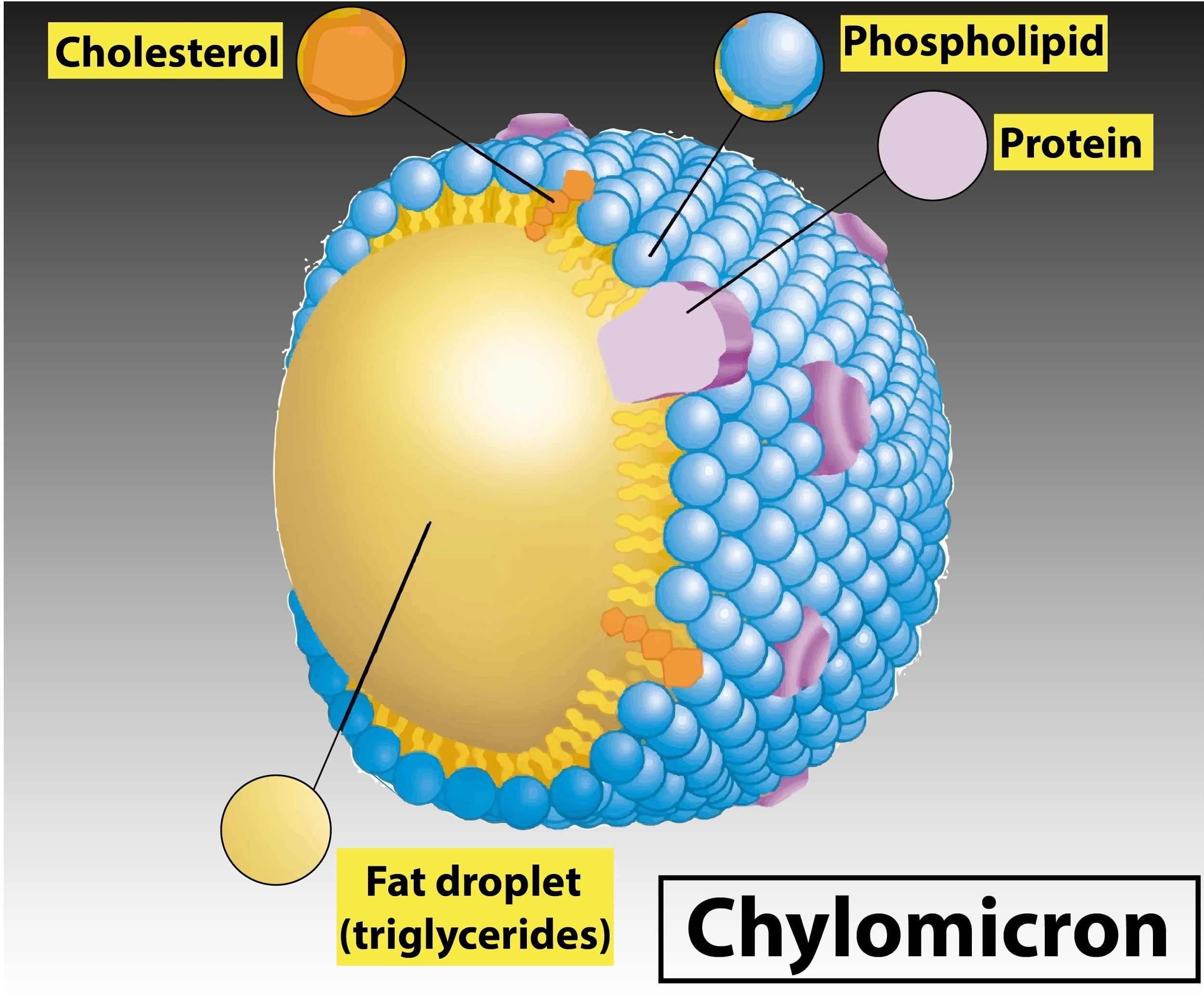
- It is observed that when the particles are of larger size than the lipids molecules will be higher in the amount in comparison to the protein molecules that are present outside the molecule.
- It is found that the relationship between the size and the density of the lipoprotein particles is inverse.
- The function of the chylomicron is to absorb these lipoprotein particles and then transfer them to the different tissues of the body.
- The lipoprotein lipase enzyme breaks down the triglycerides molecules into small molecules of fatty acids that can be absorbed easily by the tissues of the body.
- The fat molecules that are left will then be absorbed by the chylomicrons and are then absorbed by the liver.
So, the correct answer is ‘Glycerol droplets formed in the intestine after digestion of fats’.
Note: The term chylomicron was derived from the Greek word chylos, meaning juice, and micron, meaning small particles. The chylomicrons have three stages in their life cycles that include Nascent chylomicron, Mature chylomicron, and Chylomicron remnant. It was first shown by Henson in 1774 and was named by Gage and Fish in 1924.
Complete step by step answer:
Chylomicrons are the droplets of glycerol that are formed in the intestine region after the digestion of fats. It consists of lipoprotein particles with the triglycerides and proteins that help in transporting the lipids through the bloodstream to various parts of the body that are consumed through the diet.
- The chylomicrons originate from the endoplasmic reticulum of the cells.
- Chymicroms are the juices that are released from the small intestine after the digestion of fats.
- They are lipo proteinaceous in nature as their main function is to transport lipid molecules through water molecules into the bloodstream.
- It is observed that when the particles are of larger size than the lipids molecules will be higher in the amount in comparison to the protein molecules that are present outside the molecule.
- It is found that the relationship between the size and the density of the lipoprotein particles is inverse.
- The function of the chylomicron is to absorb these lipoprotein particles and then transfer them to the different tissues of the body.
- The lipoprotein lipase enzyme breaks down the triglycerides molecules into small molecules of fatty acids that can be absorbed easily by the tissues of the body.
- The fat molecules that are left will then be absorbed by the chylomicrons and are then absorbed by the liver.
So, the correct answer is ‘Glycerol droplets formed in the intestine after digestion of fats’.
Note: The term chylomicron was derived from the Greek word chylos, meaning juice, and micron, meaning small particles. The chylomicrons have three stages in their life cycles that include Nascent chylomicron, Mature chylomicron, and Chylomicron remnant. It was first shown by Henson in 1774 and was named by Gage and Fish in 1924.
Recently Updated Pages
Which will be the least stable resonating structure class 11 chemistry CBSE

How many 5 digit telephone numbers can be construc-class-11-maths-CBSE
How do you find the angle of the resultant vector class 11 physics CBSE
Draw labelled diagram of the following i Gram seed class 11 biology CBSE
What is the need and importance of classification class 11 biology CBSE
The way in which the sparrows expressed their sorrow class 11 english CBSE
Trending doubts
One Metric ton is equal to kg A 10000 B 1000 C 100 class 11 physics CBSE
Find the value of the expression given below sin 30circ class 11 maths CBSE
1 Quintal is equal to a 110 kg b 10 kg c 100kg d 1000 class 11 physics CBSE
Draw a diagram of nephron and explain its structur class 11 biology CBSE
10 examples of friction in our daily life
Proton was discovered by A Thomson B Rutherford C Chadwick class 11 chemistry CBSE