



Check whether the sides form a right angled triangle 65, 72, and 97?(Apply converse of Pythagoras theorem).
Answer
 Verified
625.8k+ views
Hint: According to the question given we have to check whether the sides form a right angled triangle 65, 72, and 97. So, first of all we have to we have to understand about the Pythagoras theorem which as explained below:
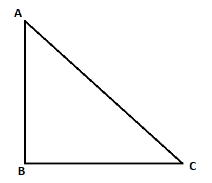
Where, ABC is a right angled triangle right angled at B or we can say that $\angle B = {90^\circ}$. Hence,
$ \Rightarrow A{C^2} = A{B^2} + B{C^2}$
Pythagoras theorem: According to Pythagoras theorem it can be applied for the right angle triangle and in the right angle triangle sum of square of its two is always equal to the square of hypotenuse which is the larger side of the given right angled triangle. We can also understand with the help of the diagram as given below:
So, with the help of Pythagoras theorem as explained above we can check Pythagoras theorem.
Complete step-by-step answer:
Step 1: First of all we have to draw a right angled triangle for which the sides are 65, 72, and 97
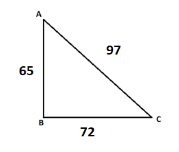
Step 2: Now, we have to apply the Pythagoras theorem as mentioned in the solution hint. Hence,
$ \Rightarrow A{C^2} = A{B^2} + B{C^2}$
On substituting all the sides in the expression above,
$
\Rightarrow {97^2} = {65^2} + {72^2} \\
\Rightarrow 9409 = 4225 + 5184 \\
\Rightarrow 9409 = 9409
$
Hence, with the help of Pythagoras theorem we have obtained that given triangle with sides 65, 72, and 97 the triangle is a right angled triangle.
Note: The Pythagoras theorem is a statement about triangles containing a right angle and area of the square built upon hypotenuse, Square of hypotenuse of a right triangle is equal to the sum of areas of the squares upon the remaining sides.
Where, ABC is a right angled triangle right angled at B or we can say that $\angle B = {90^\circ}$. Hence,
$ \Rightarrow A{C^2} = A{B^2} + B{C^2}$
Pythagoras theorem: According to Pythagoras theorem it can be applied for the right angle triangle and in the right angle triangle sum of square of its two is always equal to the square of hypotenuse which is the larger side of the given right angled triangle. We can also understand with the help of the diagram as given below:
So, with the help of Pythagoras theorem as explained above we can check Pythagoras theorem.
Complete step-by-step answer:
Step 1: First of all we have to draw a right angled triangle for which the sides are 65, 72, and 97
Step 2: Now, we have to apply the Pythagoras theorem as mentioned in the solution hint. Hence,
$ \Rightarrow A{C^2} = A{B^2} + B{C^2}$
On substituting all the sides in the expression above,
$
\Rightarrow {97^2} = {65^2} + {72^2} \\
\Rightarrow 9409 = 4225 + 5184 \\
\Rightarrow 9409 = 9409
$
Hence, with the help of Pythagoras theorem we have obtained that given triangle with sides 65, 72, and 97 the triangle is a right angled triangle.
Note: The Pythagoras theorem is a statement about triangles containing a right angle and area of the square built upon hypotenuse, Square of hypotenuse of a right triangle is equal to the sum of areas of the squares upon the remaining sides.
Recently Updated Pages
Basicity of sulphurous acid and sulphuric acid are

Master Class 12 Economics: Engaging Questions & Answers for Success
Master Class 12 Biology: Engaging Questions & Answers for Success
Master Class 11 English: Engaging Questions & Answers for Success
Master Class 11 Physics: Engaging Questions & Answers for Success
Master Class 11 Computer Science: Engaging Questions & Answers for Success
Trending doubts
What is BLO What is the full form of BLO class 8 social science CBSE
Citizens of India can vote at the age of A 18 years class 8 social science CBSE
Full form of STD, ISD and PCO
One cusec is equal to how many liters class 8 maths CBSE
Give me the opposite gender of Duck class 8 english CBSE
What are the methods of reducing friction. Explain