




Cells of which stage remain metabolically active but there is no longer proliferation?
A) G1 Phase
B) G2- Phase
C) G0- Phase
D) S Phase
Answer
 Verified
575.4k+ views
Hint: A cell cycle is a set of events that occur in a cell as it divides and grows. After that, the cell exits interphase, goes through mitosis, and completes its division. The daughter cells that result go through their own interphase and start a new round of the cell cycle.
Complete answer:
The process through which cells multiply and divide into two new cells is known as the cell cycle. G1, S, G2, and M are the phases of the cell cycle. The cell is in the G1 stage when it is prepared to divide. To accomplish this, the cell enters the S phase, during which it copies all of the DNA. DNA synthesis is denoted by the letter S.
The cell enters the G2 stage once the DNA has been duplicated and there is a complete additional set of all genetic material, where it organises and condenses the genetic material, or begins to condense the genetic material, and prepares to divide. M, which stands for mitosis, is the following step. The cell divides the two copies of the genetic material into the two daughter cells at this point.
After the M phase, cell division occurs, leaving two cells, and the cell cycle can resume. The G0 phase is often referred to as the quiescent phase. The cell is still metabolically active, but it is no longer proliferating. It is a resting stage for a cell in which the cell is neither dividing or preparing to divide and does not multiply unless the organism requires it.
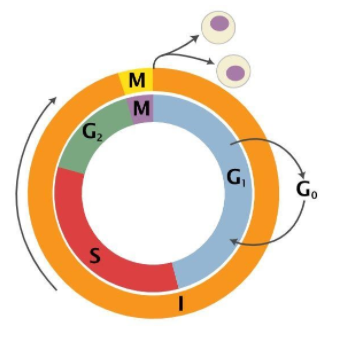
As a result, the correct answer is 'G0 phase.' Therefore the correct answer is option ‘C’.
Note: The cell cycle is the process through which cells, whether eukaryotes or prokaryotes, replicate and reproduce. It is beneficial to organisms in a variety of ways, but it mostly permits them to live. The cell cycle of prokaryotes, known as Binary Fission, permits them to live on by dividing into two new daughter cells.
Complete answer:
The process through which cells multiply and divide into two new cells is known as the cell cycle. G1, S, G2, and M are the phases of the cell cycle. The cell is in the G1 stage when it is prepared to divide. To accomplish this, the cell enters the S phase, during which it copies all of the DNA. DNA synthesis is denoted by the letter S.
The cell enters the G2 stage once the DNA has been duplicated and there is a complete additional set of all genetic material, where it organises and condenses the genetic material, or begins to condense the genetic material, and prepares to divide. M, which stands for mitosis, is the following step. The cell divides the two copies of the genetic material into the two daughter cells at this point.
After the M phase, cell division occurs, leaving two cells, and the cell cycle can resume. The G0 phase is often referred to as the quiescent phase. The cell is still metabolically active, but it is no longer proliferating. It is a resting stage for a cell in which the cell is neither dividing or preparing to divide and does not multiply unless the organism requires it.
As a result, the correct answer is 'G0 phase.' Therefore the correct answer is option ‘C’.
Note: The cell cycle is the process through which cells, whether eukaryotes or prokaryotes, replicate and reproduce. It is beneficial to organisms in a variety of ways, but it mostly permits them to live. The cell cycle of prokaryotes, known as Binary Fission, permits them to live on by dividing into two new daughter cells.
Recently Updated Pages
Write any three differences between metals and nonmetals class 10 social science CBSE

Amit standing on a horizontal plane finds a bird flying class 10 maths CBSE
Two circles of radii 5 cm and 3 cm intersect at two class 10 maths CBSE
Solve the following i John and Jivanti together have class 10 maths CBSE
What is the relation between orthocenter circumcentre class 10 maths CBSE
Two plane mirrors are inclined at 70circ A ray incident class 10 physics CBSE
Trending doubts
Explain the Treaty of Vienna of 1815 class 10 social science CBSE
Which country is known as "The land of Fire and Ice"?
1 GB equals how many MB?
10 examples of evaporation in daily life with explanations
What is the full form of POSCO class 10 social science CBSE
Which is the hottest planet in the Solar system A Earth class 10 social science CBSE