




Why is the cell membrane called the fluid mosaic?
Answer
 Verified
549k+ views
Hint: Fluid mosaic model is also explained as quasi fluid in which proteins are embedded in the lipid bilayer. The cell membrane consists of various molecules which float along with all the lipids in the membrane.
Complete Answer:
Plasma membrane is also called the cell membrane. Fluid mosaic model of plasma membrane:
The fluid mosaic model of the plasma membrane was proposed by S.J. Singer and Garth L. Nicolson in 1972.
The plasma membrane contains the components like phospholipids, cholesterol, proteins, and carbohydrates
These all components of the plasma membrane give the membrane a fluid character.
The proportions of the components of the plasma membrane that are proteins, carbohydrates, lipids vary with the cell type.
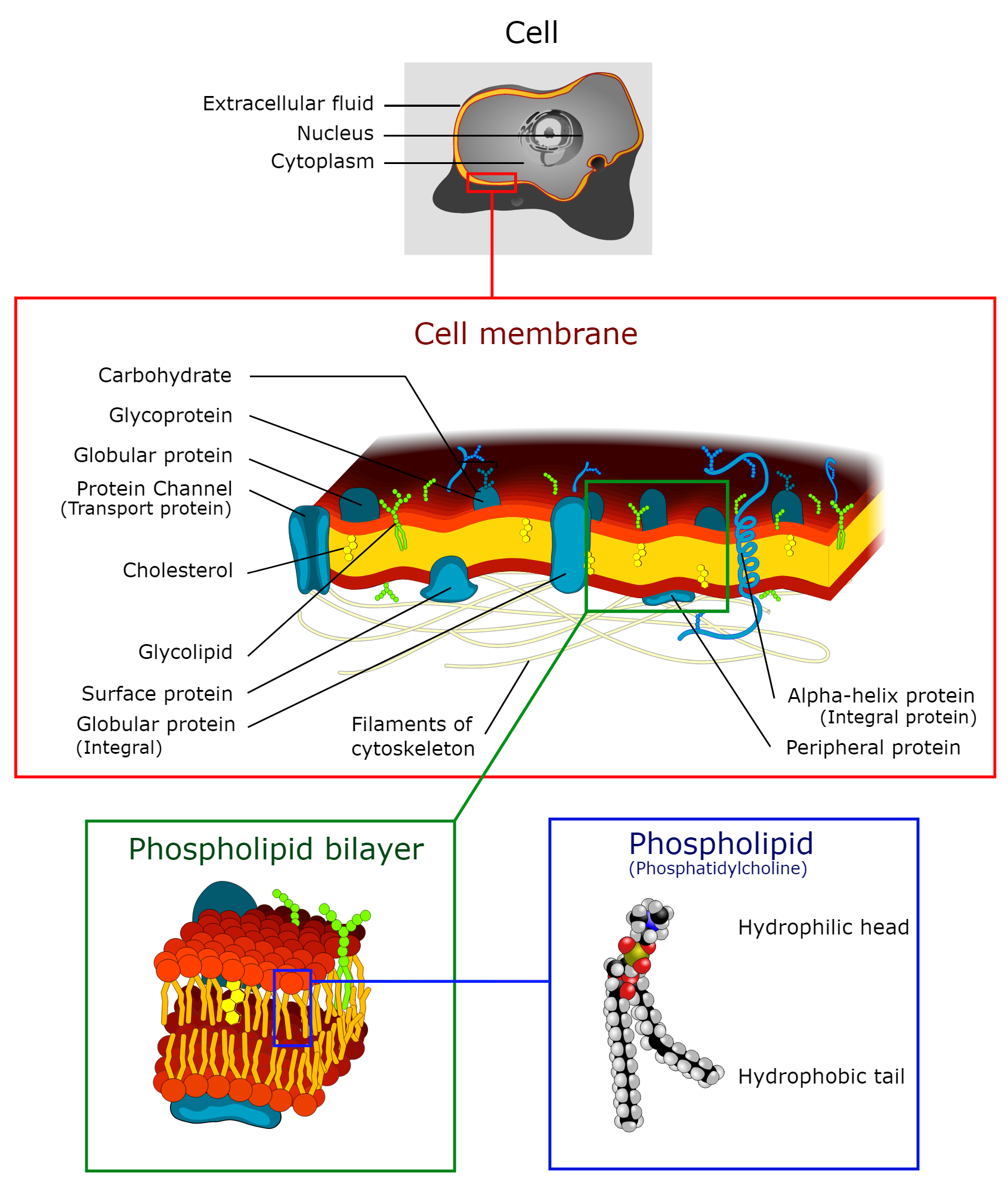
Components of the plasma membrane:
There are the three components of the plasma membrane:
A. Phospholipids
B. Proteins
C. Carbohydrates
1. Phospholipids:
Phospholipids are the class of lipids that are present in the plasma membrane. A phospholipid is a molecule that consists of glycerol, two fatty acids, and one phosphate-linked head group. They are amphoteric in nature which means that they have a polar or hydrophilic head and a no-polar or hydrophobic tail. Phospholipids arrange themselves in a manner that their hydrophobic tails face each other and hydrophobic heads face out.
2. Proteins:
The proteins are completely embedded into the membrane structure with their hydrophobic membrane regions interacting with the hydrophobic regions of the phospholipid bilayer.
3. Carbohydrates:
Carbohydrates are always found on the exterior surface of the cells where they are bound either to proteins (forming glycoproteins) or lipids (forming glycolipids). A plasma membrane is a semi-permeable membrane which means that it allows the movement of selective molecules or ions across itself.
Note:
According to the fluid mosaic model of the cell membrane, it has a quasi fluid structure in which lipids and proteins are arranged in a mosaic manner. Fluidity is important for various membrane functions. Phospholipids and many intrinsic proteins are amphipathic, that is they possess both hydrophilic and hydrophobic groups.
Complete Answer:
Plasma membrane is also called the cell membrane. Fluid mosaic model of plasma membrane:
The fluid mosaic model of the plasma membrane was proposed by S.J. Singer and Garth L. Nicolson in 1972.
The plasma membrane contains the components like phospholipids, cholesterol, proteins, and carbohydrates
These all components of the plasma membrane give the membrane a fluid character.
The proportions of the components of the plasma membrane that are proteins, carbohydrates, lipids vary with the cell type.
Components of the plasma membrane:
There are the three components of the plasma membrane:
A. Phospholipids
B. Proteins
C. Carbohydrates
1. Phospholipids:
Phospholipids are the class of lipids that are present in the plasma membrane. A phospholipid is a molecule that consists of glycerol, two fatty acids, and one phosphate-linked head group. They are amphoteric in nature which means that they have a polar or hydrophilic head and a no-polar or hydrophobic tail. Phospholipids arrange themselves in a manner that their hydrophobic tails face each other and hydrophobic heads face out.
2. Proteins:
The proteins are completely embedded into the membrane structure with their hydrophobic membrane regions interacting with the hydrophobic regions of the phospholipid bilayer.
3. Carbohydrates:
Carbohydrates are always found on the exterior surface of the cells where they are bound either to proteins (forming glycoproteins) or lipids (forming glycolipids). A plasma membrane is a semi-permeable membrane which means that it allows the movement of selective molecules or ions across itself.
Note:
According to the fluid mosaic model of the cell membrane, it has a quasi fluid structure in which lipids and proteins are arranged in a mosaic manner. Fluidity is important for various membrane functions. Phospholipids and many intrinsic proteins are amphipathic, that is they possess both hydrophilic and hydrophobic groups.
Recently Updated Pages
What are the two major island groups in India class 9 social science CBSE

What is Jhum cultivation class 9 biology CBSE
Write an Article on Save Earth Save Life
Silk is obtained from of the silk moth APupa BLarva class 9 chemistry CBSE
Write chemical formulas of the following compounds class 9 chemistry CBSE
The Indo Gangetic Plains of India are fertile due to class 9 social science CBSE
Trending doubts
Fill the blanks with the suitable prepositions 1 The class 9 english CBSE
Who was referred to as Amitraghata by the Greeks AChandragupta class 9 social science CBSE
Difference Between Plant Cell and Animal Cell
Name 10 Living and Non living things class 9 biology CBSE
What is the full form of pH?
On an outline map of India show its neighbouring c class 9 social science CBSE