




How do you calculate the dipole moment of water?
Answer
 Verified
635.1k+ views
Hint: Dipole moment is a vector quantity means it has magnitude and direction. Dipole moment is a measure of polarity of chemical bonds present in between two atoms in a particular molecule. In dipole moment the separation of negative and positive charge takes place.
Complete answer:
- In the question they asked how we can calculate the dipole moment of water.
- There is a formula to calculate the dipole moment and it is as follows.
\[\text{Dipole moment (}\mu \text{) = charge (Q) }\times \text{ distance of separation (r)}\]
- Now coming to the calculation of the dipole moment of the water molecule.
- We know that the electrons are localized around the oxygen atom in the water molecule.
- The localization of electrons is due to the high electronegativity of the central oxygen atom in water molecules.
- Due to the presence of lone pairs of electrons on the oxygen molecule the shape of the molecule is going to be a bent shape.
- The shape and charge separation in the water can be seen in the following picture.
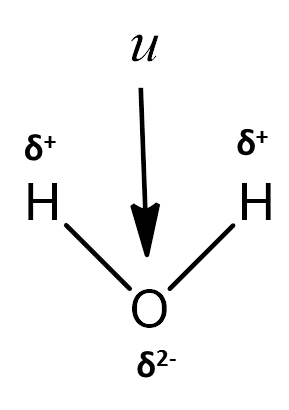
- The bond angle which is present in water is 104.5$^{o}$ .
- The individual bond moment of each hydrogen-oxygen bond is 1.5 D.
- There are two hydrogen in water molecules, the two hydrogen creates their individual dipole moments.
- We have to calculate the individual dipole moments and later we have to do the sum to get the dipole moment of the water molecule.
- The dipole moment caused by the left hydrogen in water molecule = $1.5D\times \cos ({{52.2388}^{o}})=15D\times 0.612 = 0.9187$
(Here, ${{52.2388}^{o}}=\dfrac{{{104.5}^{o}}}{2}$ )
- The dipole moment caused by the right hydrogen in water molecule = $1.5D\times \cos ({{52.2388}^{o}})=15D\times 0.612 = 0.9187$
(Here, ${{52.2388}^{o}}=\dfrac{{{104.5}^{o}}}{2}$ )
Therefore the net dipole moment of the water molecule = $0.9187 + 0.9187 = 1.837 D$.
Note: The unit to measure dipole moment of the molecules is D (Debye). The dipole moment for linear molecules like beryllium difluoride are 0. Because the dipole moment caused by individual fluorine atoms is zero.
Complete answer:
- In the question they asked how we can calculate the dipole moment of water.
- There is a formula to calculate the dipole moment and it is as follows.
\[\text{Dipole moment (}\mu \text{) = charge (Q) }\times \text{ distance of separation (r)}\]
- Now coming to the calculation of the dipole moment of the water molecule.
- We know that the electrons are localized around the oxygen atom in the water molecule.
- The localization of electrons is due to the high electronegativity of the central oxygen atom in water molecules.
- Due to the presence of lone pairs of electrons on the oxygen molecule the shape of the molecule is going to be a bent shape.
- The shape and charge separation in the water can be seen in the following picture.
- The bond angle which is present in water is 104.5$^{o}$ .
- The individual bond moment of each hydrogen-oxygen bond is 1.5 D.
- There are two hydrogen in water molecules, the two hydrogen creates their individual dipole moments.
- We have to calculate the individual dipole moments and later we have to do the sum to get the dipole moment of the water molecule.
- The dipole moment caused by the left hydrogen in water molecule = $1.5D\times \cos ({{52.2388}^{o}})=15D\times 0.612 = 0.9187$
(Here, ${{52.2388}^{o}}=\dfrac{{{104.5}^{o}}}{2}$ )
- The dipole moment caused by the right hydrogen in water molecule = $1.5D\times \cos ({{52.2388}^{o}})=15D\times 0.612 = 0.9187$
(Here, ${{52.2388}^{o}}=\dfrac{{{104.5}^{o}}}{2}$ )
Therefore the net dipole moment of the water molecule = $0.9187 + 0.9187 = 1.837 D$.
Note: The unit to measure dipole moment of the molecules is D (Debye). The dipole moment for linear molecules like beryllium difluoride are 0. Because the dipole moment caused by individual fluorine atoms is zero.
Recently Updated Pages
Write structures of the following compounds i 2 Chloro3methylpentane class 11 chemistry CBSE

What is BLO What is the full form of BLO class 8 social science CBSE
Explain the Treaty of Vienna of 1815 class 10 social science CBSE
A Paragraph on Pollution in about 100-150 Words
XIX+XXX A 49 B 51 C 55 D 44 class 5 maths CBSE
If x a + bt + ct2 where x is in meters and t is in class 11 physics CBSE
Trending doubts
One Metric ton is equal to kg A 10000 B 1000 C 100 class 11 physics CBSE
Find the value of the expression given below sin 30circ class 11 maths CBSE
Draw a diagram of nephron and explain its structur class 11 biology CBSE
10 examples of friction in our daily life
Draw a diagram of a plant cell and label at least eight class 11 biology CBSE
Proton was discovered by A Thomson B Rutherford C Chadwick class 11 chemistry CBSE