




Briefly describe the human female reproductive system with a suitable diagram.
Answer
 Verified
605.7k+ views
Hint: Human reproductive organs and its functions form a complex and well developed system. The female reproductive system consists of both internal and external sex organs which all function together to produce new offspring.
Complete answer:
At birth, the reproductive organs are immature which develops into fully functional organs capable of producing eggs and carrying a foetus at puberty. Now let us look at the key internal organs of the female reproductive system.
-Vagina – It is a fibromuscular tube like structure which leads from the outside of the body to the cervix. It plays a key role in sexual intercourse and acts as a birth canal.
-Cervix – The cervix is found just below the uterus and is 2 or 3 cm long. It allows the entry of sperms from male into the uterus for fertilization. During pregnancy, at the time of birth the baby’s head rests on the cervix facilitating childbirth.
-Uterus – It is a pear shaped organ that receives the fertilized ovum and implants it in the endometrium. It is an important organ as it supports the fetus by providing it nutrition for development as well as removes wastes. The suspensory ligaments in it stabilizes the foetus by limiting their mobility. During childbirth, the walls of the uterus start contracting which pushes the baby out.
-Fallopian tubes – These tubes extend from the ovary into the uterus. When the ovum matures, the fallopian tube receives it and fertilizes it if sperms are present. After fertilization, the cilia in the walls of the tube guides the embryo into the uterus for implantation.
-Ovaries – It is a small-paired organ that produces ovum. It produces hormones through prenatal period, puberty, menstrual cycle, pregnancy until menopause making it an endocrine gland. These hormones regulate and determine fertility.
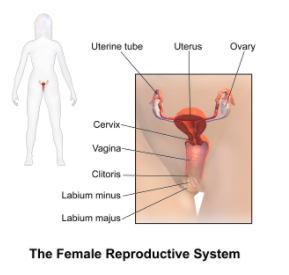
The external organs include vulva, clitoris, labia and vaginal opening. These are called the genitals.
Note: The ovum is produced every month by the ovaries after puberty. If it is fertilized, it gets implanted into the uterus. Otherwise, the uterine walls and the endometrium begins to shed to begin a new cycle. A number of hormones like estrogen, progesterone, luteinizing hormone etc., regulate the entire process until menopause. At menopause, the secretion of these hormones stops and thus ends the fertile phase.
Complete answer:
At birth, the reproductive organs are immature which develops into fully functional organs capable of producing eggs and carrying a foetus at puberty. Now let us look at the key internal organs of the female reproductive system.
-Vagina – It is a fibromuscular tube like structure which leads from the outside of the body to the cervix. It plays a key role in sexual intercourse and acts as a birth canal.
-Cervix – The cervix is found just below the uterus and is 2 or 3 cm long. It allows the entry of sperms from male into the uterus for fertilization. During pregnancy, at the time of birth the baby’s head rests on the cervix facilitating childbirth.
-Uterus – It is a pear shaped organ that receives the fertilized ovum and implants it in the endometrium. It is an important organ as it supports the fetus by providing it nutrition for development as well as removes wastes. The suspensory ligaments in it stabilizes the foetus by limiting their mobility. During childbirth, the walls of the uterus start contracting which pushes the baby out.
-Fallopian tubes – These tubes extend from the ovary into the uterus. When the ovum matures, the fallopian tube receives it and fertilizes it if sperms are present. After fertilization, the cilia in the walls of the tube guides the embryo into the uterus for implantation.
-Ovaries – It is a small-paired organ that produces ovum. It produces hormones through prenatal period, puberty, menstrual cycle, pregnancy until menopause making it an endocrine gland. These hormones regulate and determine fertility.
The external organs include vulva, clitoris, labia and vaginal opening. These are called the genitals.
Note: The ovum is produced every month by the ovaries after puberty. If it is fertilized, it gets implanted into the uterus. Otherwise, the uterine walls and the endometrium begins to shed to begin a new cycle. A number of hormones like estrogen, progesterone, luteinizing hormone etc., regulate the entire process until menopause. At menopause, the secretion of these hormones stops and thus ends the fertile phase.
Recently Updated Pages
Master Class 12 Business Studies: Engaging Questions & Answers for Success

Master Class 12 Chemistry: Engaging Questions & Answers for Success
Master Class 12 Biology: Engaging Questions & Answers for Success
Class 12 Question and Answer - Your Ultimate Solutions Guide
Master Class 11 English: Engaging Questions & Answers for Success
Master Class 11 Social Science: Engaging Questions & Answers for Success
Trending doubts
Which are the Top 10 Largest Countries of the World?
Draw a labelled sketch of the human eye class 12 physics CBSE
The end of compass needle which points towards north class 12 physics CBSE
Differentiate between homogeneous and heterogeneous class 12 chemistry CBSE
In order to find out the different types of gametes class 12 biology NEET_UG
Why is the cell called the structural and functional class 12 biology CBSE