




Both husband and wife have a normal vision though their fathers were colourblind and mothers did not have any gene for color blindness. The probability of their daughters becoming colourblind is
A) $50%$
B) $75%$
C) $0%$
D) $25%$
Answer
 Verified
561.3k+ views
Hint: Colorblindness is a situation where an affected individual cannot differentiate between different colours or cannot see any colour. Colour-blind people suffer minor difficulties but adapt with time. It is an X chromosome-linked recessive disorder. Thus, it needs a homozygous recessive pair to show its effect.
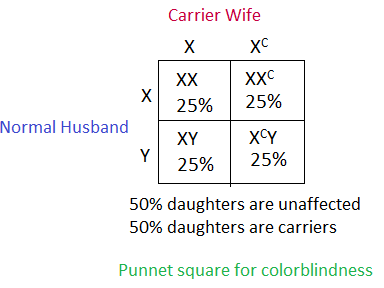
Complete answer: Colorblindness is a sex-linked disorder whose genes are located on the X-chromosome of the sex chromosome pair. A male carrying an affected X-chromosome will show color blindness as males have only one X chromosome and it shows its complete expression. On the other hand, in females, there are two copies of the X chromosome. There need to be both X chromosomes carrying the gene for color blindness to express itself. A female having a single X-chromosome for the color blindness gene will be a carrier for the disorder. In the given situation, the fathers of both husband and wife carried the affected X-chromosome. A single copy of the affected X chromosome was enough to show the disorder. The father of the husband did not contribute to the X of XY pair in him. Thus, he shows normal XY genes. But the X in wife came from her father and thus she is a carrier but not affected. Thus, her genotype will be XCX. So, the $50%$ daughters of the carrier wife and normal husband will get one copy of the XC chromosome from the mother but one copy of the normal X chromosome from the father. Thus, they will be carriers only with genotype XXC. The rest $50%$ will be neither carriers nor affected as they will receive copies of the normal X chromosome from both parents.
This can be represented through a punnett square. Hence, the probability of their daughters becoming colourblind is $0%$.
So, the correct answer is option C.
Note: The ‘Ishihara colour test’ is a specialized series of coloured spots that are used for the diagnosis of colourblind people. It specifically detects red-green colour deficiencies. It consists of a figure embedded in-between spots of a different colour. Normal colour vision can detect this figure, while colour blindness finds it difficult to detect the figure.
Complete answer: Colorblindness is a sex-linked disorder whose genes are located on the X-chromosome of the sex chromosome pair. A male carrying an affected X-chromosome will show color blindness as males have only one X chromosome and it shows its complete expression. On the other hand, in females, there are two copies of the X chromosome. There need to be both X chromosomes carrying the gene for color blindness to express itself. A female having a single X-chromosome for the color blindness gene will be a carrier for the disorder. In the given situation, the fathers of both husband and wife carried the affected X-chromosome. A single copy of the affected X chromosome was enough to show the disorder. The father of the husband did not contribute to the X of XY pair in him. Thus, he shows normal XY genes. But the X in wife came from her father and thus she is a carrier but not affected. Thus, her genotype will be XCX. So, the $50%$ daughters of the carrier wife and normal husband will get one copy of the XC chromosome from the mother but one copy of the normal X chromosome from the father. Thus, they will be carriers only with genotype XXC. The rest $50%$ will be neither carriers nor affected as they will receive copies of the normal X chromosome from both parents.
This can be represented through a punnett square. Hence, the probability of their daughters becoming colourblind is $0%$.
So, the correct answer is option C.
Note: The ‘Ishihara colour test’ is a specialized series of coloured spots that are used for the diagnosis of colourblind people. It specifically detects red-green colour deficiencies. It consists of a figure embedded in-between spots of a different colour. Normal colour vision can detect this figure, while colour blindness finds it difficult to detect the figure.
Recently Updated Pages
Master Class 12 Economics: Engaging Questions & Answers for Success

Master Class 12 Physics: Engaging Questions & Answers for Success
Master Class 12 English: Engaging Questions & Answers for Success
Master Class 12 Social Science: Engaging Questions & Answers for Success
Master Class 12 Maths: Engaging Questions & Answers for Success
Master Class 12 Business Studies: Engaging Questions & Answers for Success
Trending doubts
Which are the Top 10 Largest Countries of the World?
What are the major means of transport Explain each class 12 social science CBSE
Draw a labelled sketch of the human eye class 12 physics CBSE
What is a transformer Explain the principle construction class 12 physics CBSE
Why cannot DNA pass through cell membranes class 12 biology CBSE
Differentiate between insitu conservation and exsitu class 12 biology CBSE