




Based on the energy diagram, what type of reaction could this represent?
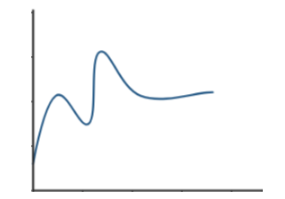
(A) The reaction is an endothermic, two-step reaction that involves the formation of an intermediate.
(B) The reaction is an exothermic, two-step reaction that involves the formation of an intermediate.
(C) The reaction is an endothermic reaction that involves an activated complex.
(D) The reaction is an exothermic reaction that involves an activated complex.
Answer
 Verified
617.1k+ views
Hint: Energy diagram can be used to represent the change in potential energies of reactants, products, or even formation of the transitional state with respect to time. If energy increases over time, then it means energy is being absorbed by the compounds.
Complete step-by-step answer
Whenever a reactant is converted into the product by either absorption or release of energy it is known as a chemical reaction. It can be of two types, Endothermic reaction or exothermic reaction.
The exothermic reaction involves the release of energy in the form of either heat, light, etc. when reactants are converted into products.
Endothermic reactions involve the formation of products from reactants by absorption of heat energy from the surrounding, making the surrounding cool. In an endothermic reaction the potential energy of reactant is lower compared to the product that is reactant absorbs energy from the surrounding to convert into the product, therefore the energy diagram indicates a rising curve.
In the above diagram,
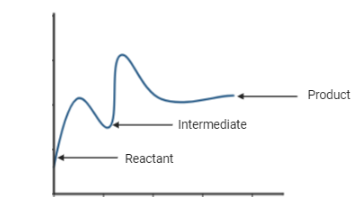
Here, as we can see, the potential energy of the reactant is lower compared to the product; this reaction is a two-step endothermic reaction with the formation of one intermediate.
Hence, the correct option will be option A - The reaction is an endothermic, two-step reaction that involves the formation of an intermediate.
Note:
In a system, whenever a chemical bond is formed in the reaction energy is required similarly breaking of bond involves the release of energy. An endothermic reaction is associated with the formation of a bond where the enthalpy of the system is positive, whereas in exothermic reaction energy is released hence, the enthalpy of the system is always negative.
Complete step-by-step answer
Whenever a reactant is converted into the product by either absorption or release of energy it is known as a chemical reaction. It can be of two types, Endothermic reaction or exothermic reaction.
The exothermic reaction involves the release of energy in the form of either heat, light, etc. when reactants are converted into products.
Endothermic reactions involve the formation of products from reactants by absorption of heat energy from the surrounding, making the surrounding cool. In an endothermic reaction the potential energy of reactant is lower compared to the product that is reactant absorbs energy from the surrounding to convert into the product, therefore the energy diagram indicates a rising curve.
In the above diagram,
Here, as we can see, the potential energy of the reactant is lower compared to the product; this reaction is a two-step endothermic reaction with the formation of one intermediate.
Hence, the correct option will be option A - The reaction is an endothermic, two-step reaction that involves the formation of an intermediate.
Note:
In a system, whenever a chemical bond is formed in the reaction energy is required similarly breaking of bond involves the release of energy. An endothermic reaction is associated with the formation of a bond where the enthalpy of the system is positive, whereas in exothermic reaction energy is released hence, the enthalpy of the system is always negative.
Recently Updated Pages
If x a + bt + ct2 where x is in meters and t is in class 11 physics CBSE

A car covers the first half distance between two places class 11 physics CBSE
The resultant of two vectors overrightarrow P and overrightarrow class 11 physics CBSE
Find the value of cos 135 class 11 maths CBSE
A mass M is held in place by an applied force F and class 11 physics CBSE
A solution of glucose in water is labelled as 10 dfracwv class 11 chemistry CBSE
Trending doubts
Find the value of the expression given below sin 30circ class 11 maths CBSE
One Metric ton is equal to kg A 10000 B 1000 C 100 class 11 physics CBSE
Draw a diagram of nephron and explain its structur class 11 biology CBSE
10 examples of friction in our daily life
Proton was discovered by A Thomson B Rutherford C Chadwick class 11 chemistry CBSE
Bond order ofO2 O2+ O2 and O22 is in order A O2 langle class 11 chemistry CBSE