




Based on the diagram, identify the structure
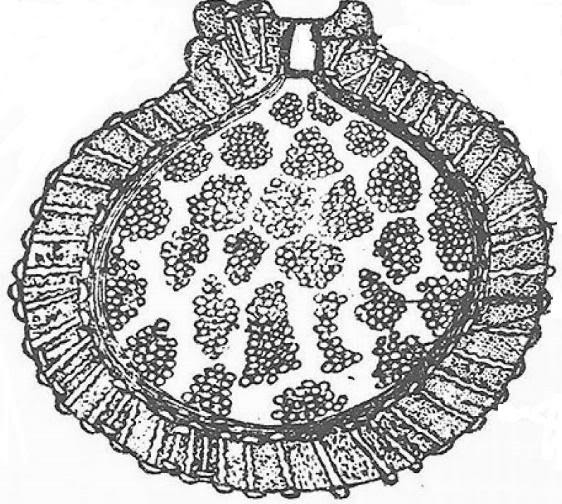
A. It is an archaeocyte
B. It is a gemmule
C. It is a amoebocyte
D. It is a spicule
Answer
 Verified
576.6k+ views
Hint: Sponges, who belong to the phylum Porifera, are a basal Metazoa clade and Diploblasts' sibling. They are multicellular species with a jelly-like sandwiched between two thin layers of cells and a body full of pores and channels that cause water to flow through them. Sponges reproduce in two ways: asexually and sexually. Most sexually reproducing poriferans are hermaphroditic, meaning they develop eggs and sperm at various times.
Complete answer:
Option A: Amoeboid cells present in sponges are called archaeocytes or amoebocytes. They are totipotent, which means they can perform a variety of roles depending on the animal. These cells have a similar structure to stem cells in that they have a high cytoplasmic content that allows them to morph according to their function.
So, option A is incorrect.
Option B: It's a gemmule, to be precise. Gemmules are a type of sponge body that is involved in asexual reproduction. It is a collection of cells capable of forming a new body, such as an adult sponge. They can live in harsh conditions due to their resistance to desiccation (drying out), freezing, and anoxia (lack of oxygen).
So, option B is correct.
Option C: A mobile cell found in the bodies of invertebrates such as echinoderms, mollusks, tunicates, sponges, and some chelicerates is known as an amebocyte or amoebocyte. Pseudopodia are the means by which they travel.
So, option C is incorrect.
Option D: Some sponges have spicules, which are structural components. They offer structural protection as well as serve as a deterrent to predators.
So, option D is incorrect.
Hence, Option B is the correct answer.
Note:
A Gemmule is an asexually formed mass of cells capable of evolving into a new organism or into an adult freshwater sponge. Sponge buds are tiny bud-like cells that sponges form to survive harsh environmental conditions. A freshwater sponge can replicate sexually as well as asexually. Budding and gemmulation are the most common forms of asexual reproduction. Gemmules are the internal buds produced by freshwater sponges. These gemmules are tough and covered in an embryonic cell cluster that is dormant. Freshwater sponges are multicellular marine sponges belonging to the Porifera Kingdom Phylum. Sponge, for example, is a member of this empire.
Complete answer:
Option A: Amoeboid cells present in sponges are called archaeocytes or amoebocytes. They are totipotent, which means they can perform a variety of roles depending on the animal. These cells have a similar structure to stem cells in that they have a high cytoplasmic content that allows them to morph according to their function.
So, option A is incorrect.
Option B: It's a gemmule, to be precise. Gemmules are a type of sponge body that is involved in asexual reproduction. It is a collection of cells capable of forming a new body, such as an adult sponge. They can live in harsh conditions due to their resistance to desiccation (drying out), freezing, and anoxia (lack of oxygen).
So, option B is correct.
Option C: A mobile cell found in the bodies of invertebrates such as echinoderms, mollusks, tunicates, sponges, and some chelicerates is known as an amebocyte or amoebocyte. Pseudopodia are the means by which they travel.
So, option C is incorrect.
Option D: Some sponges have spicules, which are structural components. They offer structural protection as well as serve as a deterrent to predators.
So, option D is incorrect.
Hence, Option B is the correct answer.
Note:
A Gemmule is an asexually formed mass of cells capable of evolving into a new organism or into an adult freshwater sponge. Sponge buds are tiny bud-like cells that sponges form to survive harsh environmental conditions. A freshwater sponge can replicate sexually as well as asexually. Budding and gemmulation are the most common forms of asexual reproduction. Gemmules are the internal buds produced by freshwater sponges. These gemmules are tough and covered in an embryonic cell cluster that is dormant. Freshwater sponges are multicellular marine sponges belonging to the Porifera Kingdom Phylum. Sponge, for example, is a member of this empire.
Recently Updated Pages
If x a + bt + ct2 where x is in meters and t is in class 11 physics CBSE

A car covers the first half distance between two places class 11 physics CBSE
The resultant of two vectors overrightarrow P and overrightarrow class 11 physics CBSE
Find the value of cos 135 class 11 maths CBSE
A mass M is held in place by an applied force F and class 11 physics CBSE
A solution of glucose in water is labelled as 10 dfracwv class 11 chemistry CBSE
Trending doubts
One Metric ton is equal to kg A 10000 B 1000 C 100 class 11 physics CBSE
Find the value of the expression given below sin 30circ class 11 maths CBSE
Draw a diagram of nephron and explain its structur class 11 biology CBSE
10 examples of friction in our daily life
Proton was discovered by A Thomson B Rutherford C Chadwick class 11 chemistry CBSE
Bond order ofO2 O2+ O2 and O22 is in order A O2 langle class 11 chemistry CBSE