




What are the three characteristics of asexual reproduction?
Answer
 Verified
594.6k+ views
Hint: Asexual reproduction is a kind of reproduction process that does not involve fusion of male and female gametes. However, such individuals can be both unicellular or multicellular.
Complete answer:
Following are the three characteristics of asexual reproduction:
1. Asexual reproduction involves single parent such that the organism divides itself as a whole or its fragment to form a new individual. Therefore, they grow at a comparatively faster rate.
2. This process of reproduction is quite faster. Usually, the zygote formed in a sexual reproduction takes a quite long gestation period to grow and develop due to which the reproduction period extends whereas the asexual reproduction is doest not require any gestation period so completes faster.
3. The offsprings produced out of asexual reproduction are genetically similar. They look identical to their parents and fellow individuals. However, this might be possible due to the fact that they are just a new version of their parent cells that broke down into two new individuals.
4. Asexual reproduction is common to be observed amongst unicellular organisms. However, it won't be any strange to observe multicellular organisms exhibiting the same procedure. In this process the parent cell undergoes mitotic division to form two daughter cells in case of single celled organisms whereas can involve formation of any bud-like structure on the parent body that eventually matures to separate from the parent body and then lead an individual life.
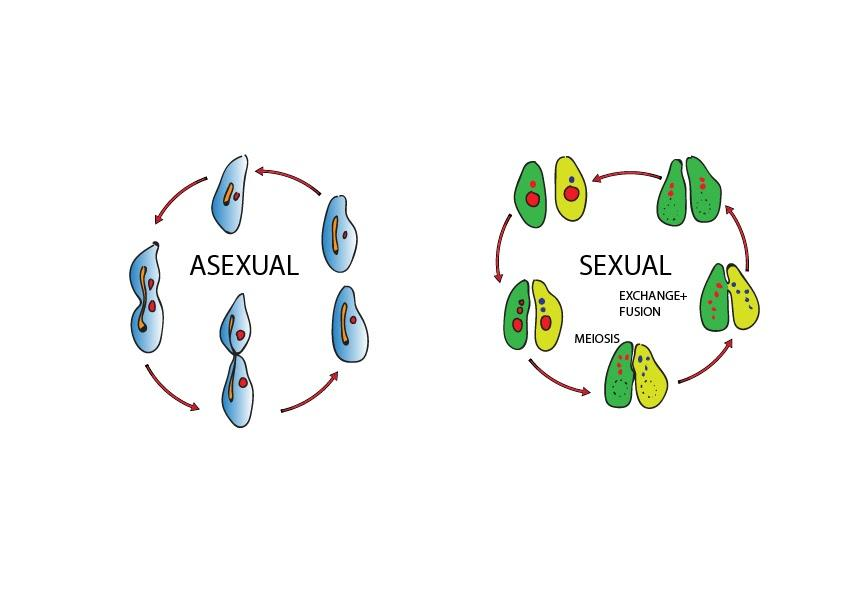
Note:
This reproduction can even involve spore formation on the parent body as in ferns or it can involve fragmentation taking place on the parent body to form new individuals as in Planaria, or undergo vegetative propagation that commonly takes place in plants such as onions.
Complete answer:
Following are the three characteristics of asexual reproduction:
1. Asexual reproduction involves single parent such that the organism divides itself as a whole or its fragment to form a new individual. Therefore, they grow at a comparatively faster rate.
2. This process of reproduction is quite faster. Usually, the zygote formed in a sexual reproduction takes a quite long gestation period to grow and develop due to which the reproduction period extends whereas the asexual reproduction is doest not require any gestation period so completes faster.
3. The offsprings produced out of asexual reproduction are genetically similar. They look identical to their parents and fellow individuals. However, this might be possible due to the fact that they are just a new version of their parent cells that broke down into two new individuals.
4. Asexual reproduction is common to be observed amongst unicellular organisms. However, it won't be any strange to observe multicellular organisms exhibiting the same procedure. In this process the parent cell undergoes mitotic division to form two daughter cells in case of single celled organisms whereas can involve formation of any bud-like structure on the parent body that eventually matures to separate from the parent body and then lead an individual life.
Note:
This reproduction can even involve spore formation on the parent body as in ferns or it can involve fragmentation taking place on the parent body to form new individuals as in Planaria, or undergo vegetative propagation that commonly takes place in plants such as onions.
Recently Updated Pages
Which of the following graphs shows the variation of class 12 physics CBSE

Draw a labelled diagram of the human male reproductive class 12 biology CBSE
Describe the experiment to compare the emf of two cells class 12 physics CBSE
What is standard hydrogen electrode
What is conventional current and electric current class 12 physics CBSE
2Bromopentane is treated with an alcoholic KOH solution class 12 chemistry CBSE
Trending doubts
Draw a labelled sketch of the human eye class 12 physics CBSE
Which are the Top 10 Largest Countries of the World?
Draw ray diagrams each showing i myopic eye and ii class 12 physics CBSE
Which is the correct genotypic ratio of mendel dihybrid class 12 biology CBSE
Which is the strongest oxidising agent out of the following class 12 chemistry CBSE
Differentiate between homogeneous and heterogeneous class 12 chemistry CBSE