




What are the components in a communication channel?
Answer
 Verified
600k+ views
Hint: Consider a telephone call, the person who speaks acts as the source of the message, his telephone transmits his voice through the telephone cables (channel) and is received by telephone of the listener who is the user of the information. Communication channel thus refers to the pathway through which information is passed on.
Complete step by step solution:
Step 1: Sketch a block diagram of a communication channel and try to explain the purpose of each block.
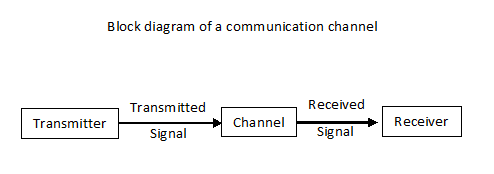
Communication refers to the act of sending and receiving information. Every communication system has 3 basic elements - transmitter, channel and receiver.
The information converted in an electrical form so that it is suitable for transmission is called a signal. Signals can be analogue or digital. Signals which are continuous variations of voltage or current are called analogue signals. Digital signals represent information as a sequence of discrete values. Source of the information produces the message signal that has to be transmitted. The transmitter processes the incoming message signal so that it is suitable for transmission through a channel. The output of the transmitter is called a transmitted signal.
Channel is a medium which accepts the transmitted signal from the transmitter as its input and produces a corrupted version of this input known as the received signal. The communication channel can be of two types – cable or broadcast. A cable (twisted-pair wire, cable and optical fibre cable) make use of physical wires to transmit and receive data. Broadcast (microwave, satellite, radio and infrared) is used when there are multiple receivers involved for eg: radio.
At the channel, the noise gets added to the original signal and this corrupted version will be sent to the receiver. The receiver filters the transmitted signal from the noise to obtain the original message signal which is then sent to the user.
Note: The arrowheads should point in the right direction in the block diagram. For a telephone call, the speaker and the listener interchange their role and therefore, the phone has a built-in transmitter and receiver. Also, the transmitted message should be an electrical signal and if it is not then, it must be converted to an electrical signal. A transducer fulfils this purpose as it converts one form of energy into another form of energy (here, electrical energy).
Complete step by step solution:
Step 1: Sketch a block diagram of a communication channel and try to explain the purpose of each block.
Communication refers to the act of sending and receiving information. Every communication system has 3 basic elements - transmitter, channel and receiver.
The information converted in an electrical form so that it is suitable for transmission is called a signal. Signals can be analogue or digital. Signals which are continuous variations of voltage or current are called analogue signals. Digital signals represent information as a sequence of discrete values. Source of the information produces the message signal that has to be transmitted. The transmitter processes the incoming message signal so that it is suitable for transmission through a channel. The output of the transmitter is called a transmitted signal.
Channel is a medium which accepts the transmitted signal from the transmitter as its input and produces a corrupted version of this input known as the received signal. The communication channel can be of two types – cable or broadcast. A cable (twisted-pair wire, cable and optical fibre cable) make use of physical wires to transmit and receive data. Broadcast (microwave, satellite, radio and infrared) is used when there are multiple receivers involved for eg: radio.
At the channel, the noise gets added to the original signal and this corrupted version will be sent to the receiver. The receiver filters the transmitted signal from the noise to obtain the original message signal which is then sent to the user.
Note: The arrowheads should point in the right direction in the block diagram. For a telephone call, the speaker and the listener interchange their role and therefore, the phone has a built-in transmitter and receiver. Also, the transmitted message should be an electrical signal and if it is not then, it must be converted to an electrical signal. A transducer fulfils this purpose as it converts one form of energy into another form of energy (here, electrical energy).
Recently Updated Pages
Master Class 12 Business Studies: Engaging Questions & Answers for Success

Master Class 12 Biology: Engaging Questions & Answers for Success
Master Class 12 Chemistry: Engaging Questions & Answers for Success
Class 12 Question and Answer - Your Ultimate Solutions Guide
Master Class 11 Social Science: Engaging Questions & Answers for Success
Master Class 11 English: Engaging Questions & Answers for Success
Trending doubts
Which are the Top 10 Largest Countries of the World?
Draw a labelled sketch of the human eye class 12 physics CBSE
Differentiate between homogeneous and heterogeneous class 12 chemistry CBSE
Sulphuric acid is known as the king of acids State class 12 chemistry CBSE
Why is the cell called the structural and functional class 12 biology CBSE
Which is the correct genotypic ratio of mendel dihybrid class 12 biology CBSE