




What are progressive waves? Find the equation of progressive wave travelling in +x direction.
Answer
 Verified
622.5k+ views
Hint: A wave is simply a disturbance propagating through space. It is also interpreted as energy or disturbance propagating energy through a medium. Thus, a wave is a disturbance propagating through space which usually transfers energy. There are two types of waves, stationary and progressive. We shall analyze the progressive wave now.
Complete answer:
In a progressive wave, the particles of the wave undergo a vibratory motion in an elastic medium to pass the disturbance induced from one particle to the successive particle throughout the medium.
The equation of a progressive wave is a cosine function of the position and time of the wave which is expressed as:
$y\left( x,t \right)=A\cos \left( \dfrac{2\pi }{\lambda }x-\dfrac{2\pi }{T}t \right)$
Where,
$y=$ the vertical height of the wave
$x=$ horizontal position of wave at any instant of time
$t=$ any instant of time during wave motion
$A=$ amplitude of wave
$\lambda =$ wavelength of wave
$T=$ time period of wave
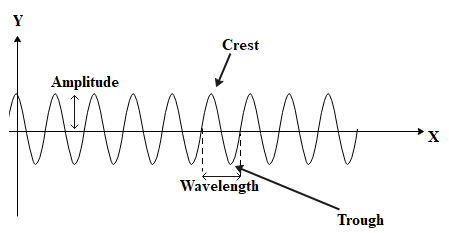
The amplitude of the wave is the maximum vertical displacement of the wave from its equilibrium position.The wavelength of wave is the distance between two successive crests or two successive troughs of wave. As the name suggests, the time period of a wave is the time required for a wave to travel one wavelength. The negative sign denotes that the wave is travelling in positive x-direction.
Note:
Our equation of a wave should be an equation for the vertical height of the wave at any horizontal position of the wave with respect to time. Thus, Y should equal as a function of x, it should not be greater than the amplitude of the wave. The path of a wave can be a sine or cosine graph.
Complete answer:
In a progressive wave, the particles of the wave undergo a vibratory motion in an elastic medium to pass the disturbance induced from one particle to the successive particle throughout the medium.
The equation of a progressive wave is a cosine function of the position and time of the wave which is expressed as:
$y\left( x,t \right)=A\cos \left( \dfrac{2\pi }{\lambda }x-\dfrac{2\pi }{T}t \right)$
Where,
$y=$ the vertical height of the wave
$x=$ horizontal position of wave at any instant of time
$t=$ any instant of time during wave motion
$A=$ amplitude of wave
$\lambda =$ wavelength of wave
$T=$ time period of wave
The amplitude of the wave is the maximum vertical displacement of the wave from its equilibrium position.The wavelength of wave is the distance between two successive crests or two successive troughs of wave. As the name suggests, the time period of a wave is the time required for a wave to travel one wavelength. The negative sign denotes that the wave is travelling in positive x-direction.
Note:
Our equation of a wave should be an equation for the vertical height of the wave at any horizontal position of the wave with respect to time. Thus, Y should equal as a function of x, it should not be greater than the amplitude of the wave. The path of a wave can be a sine or cosine graph.
Recently Updated Pages
If x a + bt + ct2 where x is in meters and t is in class 11 physics CBSE

A car covers the first half distance between two places class 11 physics CBSE
The resultant of two vectors overrightarrow P and overrightarrow class 11 physics CBSE
Find the value of cos 135 class 11 maths CBSE
A mass M is held in place by an applied force F and class 11 physics CBSE
A solution of glucose in water is labelled as 10 dfracwv class 11 chemistry CBSE
Trending doubts
Find the value of the expression given below sin 30circ class 11 maths CBSE
One Metric ton is equal to kg A 10000 B 1000 C 100 class 11 physics CBSE
Draw a diagram of nephron and explain its structur class 11 biology CBSE
10 examples of friction in our daily life
Proton was discovered by A Thomson B Rutherford C Chadwick class 11 chemistry CBSE
Bond order ofO2 O2+ O2 and O22 is in order A O2 langle class 11 chemistry CBSE