




What is the angle of incidence when a ray of light is incident on a concave mirror from its centre of curvature?
A) $90^\circ $
B) $60^\circ $
C) $45^\circ $
D) $0^\circ $
Answer
 Verified
611.4k+ views
Hint:Angle of incidence is the angle made by an incident ray with the normal to the point of incidence. The laws of reflection suggest that a ray of light that is incident perpendicular on the surface of a plane mirror will retrace its path upon reflection. The same result is observed when a ray of light passes through the centre of curvature of a concave mirror.
Complete step by step answer.
Step 1: Sketch a concave mirror with the light ray incident on it from its centre of curvature.
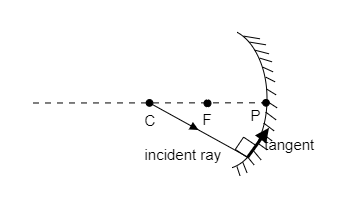
As shown in the above figure, the light ray makes an angle $90^\circ $ with the tangent at the point of incidence on the concave mirror. This suggests that the ray of light actually coincides with the normal to that point.
The angle of incidence is the angle formed by an incident ray with the normal to the surface and here as the incident ray and the normal coincide, the angle of incidence will be $i = 0^\circ $ .
Also by the laws of reflection, the reflected ray will retrace the path of the incident ray and so the angle of reflection will also be $r = i = 0^\circ $ .
So the correct option is D.
Note:The normal to a surface makes an angle of $90^\circ $ with the surface. A concave mirror is considered to be a part of a spherical mirror. A line from the centre of the spherical mirror will be perpendicular to the tangent at that point. The tangent will then act as a plane mirror. This is shown in the figure below.
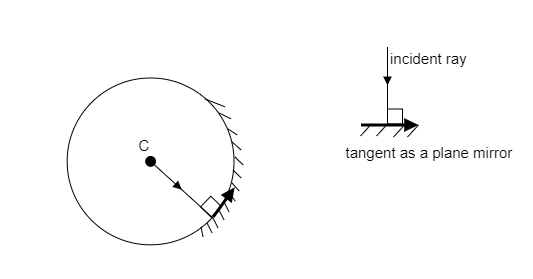
So a light ray passing through the centre of curvature of the concave mirror will also be perpendicular to the tangent at the point of incidence.
Complete step by step answer.
Step 1: Sketch a concave mirror with the light ray incident on it from its centre of curvature.
As shown in the above figure, the light ray makes an angle $90^\circ $ with the tangent at the point of incidence on the concave mirror. This suggests that the ray of light actually coincides with the normal to that point.
The angle of incidence is the angle formed by an incident ray with the normal to the surface and here as the incident ray and the normal coincide, the angle of incidence will be $i = 0^\circ $ .
Also by the laws of reflection, the reflected ray will retrace the path of the incident ray and so the angle of reflection will also be $r = i = 0^\circ $ .
So the correct option is D.
Note:The normal to a surface makes an angle of $90^\circ $ with the surface. A concave mirror is considered to be a part of a spherical mirror. A line from the centre of the spherical mirror will be perpendicular to the tangent at that point. The tangent will then act as a plane mirror. This is shown in the figure below.
So a light ray passing through the centre of curvature of the concave mirror will also be perpendicular to the tangent at the point of incidence.
Recently Updated Pages
Master Class 12 Economics: Engaging Questions & Answers for Success

Master Class 12 English: Engaging Questions & Answers for Success
Master Class 12 Social Science: Engaging Questions & Answers for Success
Master Class 12 Maths: Engaging Questions & Answers for Success
Master Class 12 Physics: Engaging Questions & Answers for Success
Master Class 9 General Knowledge: Engaging Questions & Answers for Success
Trending doubts
Which are the Top 10 Largest Countries of the World?
Draw a labelled sketch of the human eye class 12 physics CBSE
Differentiate between homogeneous and heterogeneous class 12 chemistry CBSE
Why is the cell called the structural and functional class 12 biology CBSE
Draw ray diagrams each showing i myopic eye and ii class 12 physics CBSE
Which is the correct genotypic ratio of mendel dihybrid class 12 biology CBSE