




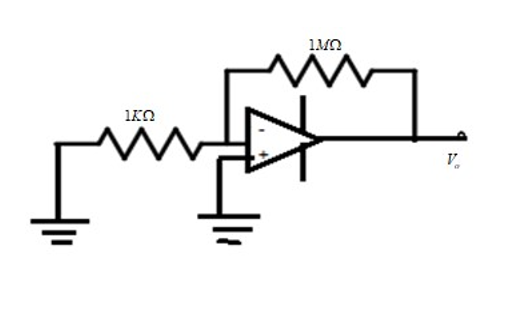
An op-amp has an offset voltage of $1mV$and is ideal in all other aspects. If this op-amp is used in the circuit shown in the figure, the output voltage will be
A) $1mV$
B) $1V$
C) $0.1V$
D) $0V$
Answer
 Verified
634.8k+ views
Hint: The inverting amplifier is then one which gives the inverted form of its input that depends on the resistance at the feedback and the input resistance.
Formula used:
\[{V_o} = - \left( {\dfrac{{{R_f}}}{{{R_i}}}} \right){V_i}\]
Where,
\[{V_o}\]=output voltage,
\[{R_f}\]=feedback resistance
\[{R_i}\]=input resistance
\[{V_i}\]=input voltage
The negative sign represents the inverted output of the op-amp.
Complete step by step answer:
We want to find the output voltage of the given inverting op-amp. We find it is the inverting op-amp as it gives its input to pin 2.From the figure, we have
\[{R_f} = 1M\Omega \]
\[ \Rightarrow {R_f} = 1 \times {10^6}\Omega \]
${R_i} = 1K\Omega $
$ \Rightarrow {R_i} = 1 \times {10^3}\Omega $
${V_i} = 1mV$
$ \Rightarrow {V_i} = 1 \times {10^{ - 3}}V$
We can apply all the given values in the formula.
\[ \Rightarrow {V_o} = - \left( {\dfrac{{{R_f}}}{{{R_i}}}} \right){V_i}\]
Substituting the values, we get,
$ \Rightarrow {V_o} = - \left( {\dfrac{{1 \times {{10}^6}}}{{1 \times {{10}^3}}}} \right) \times 1 \times {10^{ - 3}}$
We can subtract the power because the base number is same. We get,
$ \Rightarrow {V_o} = - \left( {1 \times {{10}^3}} \right) \times 1 \times {10^{ - 3}}$
$\therefore {V_o} = - 1V$
As we don’t care about the sign, because in the question they don’t mention it is an inverting op-amp and there is no option having negative sign too. So by ignoring the sign, we have${V_o} = - 1V$.
Hence the correct option is option B.
Additional information:
(i) Op-amps are the amplifiers that perform specific operations regarding its construction. Hence these amplifiers are called operation amplifiers we simply calling it op-amp.
(ii) There are basically two types of op-amps which are inverting and non-inverting amplifiers. The inverting op-amp alters the sign of the input.
(iii) Some of the other op-amps are adders, subtractors, differentiators, integrators, etc. These are all performing the operations regarding its names by just constructing the op-amps using the two basic op-amps.
(iv) The only difference between the inverting and non-inverting amplifiers is the pin no. through which we give the inputs. For the inverting amplifier, we give input to the inverting input pin of the IC (integrated chip). For the non-inverting amplifier, we give the input to the non-inverting pin of the IC.
Note:
If we give input to one of the two pins either inverting or non-inverting, another one needs to be grounded. We don’t worry about the polarity of the output voltage when the input voltage polarity is not given. Op-amps are also used as a comparator in the circuit.
Formula used:
\[{V_o} = - \left( {\dfrac{{{R_f}}}{{{R_i}}}} \right){V_i}\]
Where,
\[{V_o}\]=output voltage,
\[{R_f}\]=feedback resistance
\[{R_i}\]=input resistance
\[{V_i}\]=input voltage
The negative sign represents the inverted output of the op-amp.
Complete step by step answer:
We want to find the output voltage of the given inverting op-amp. We find it is the inverting op-amp as it gives its input to pin 2.From the figure, we have
\[{R_f} = 1M\Omega \]
\[ \Rightarrow {R_f} = 1 \times {10^6}\Omega \]
${R_i} = 1K\Omega $
$ \Rightarrow {R_i} = 1 \times {10^3}\Omega $
${V_i} = 1mV$
$ \Rightarrow {V_i} = 1 \times {10^{ - 3}}V$
We can apply all the given values in the formula.
\[ \Rightarrow {V_o} = - \left( {\dfrac{{{R_f}}}{{{R_i}}}} \right){V_i}\]
Substituting the values, we get,
$ \Rightarrow {V_o} = - \left( {\dfrac{{1 \times {{10}^6}}}{{1 \times {{10}^3}}}} \right) \times 1 \times {10^{ - 3}}$
We can subtract the power because the base number is same. We get,
$ \Rightarrow {V_o} = - \left( {1 \times {{10}^3}} \right) \times 1 \times {10^{ - 3}}$
$\therefore {V_o} = - 1V$
As we don’t care about the sign, because in the question they don’t mention it is an inverting op-amp and there is no option having negative sign too. So by ignoring the sign, we have${V_o} = - 1V$.
Hence the correct option is option B.
Additional information:
(i) Op-amps are the amplifiers that perform specific operations regarding its construction. Hence these amplifiers are called operation amplifiers we simply calling it op-amp.
(ii) There are basically two types of op-amps which are inverting and non-inverting amplifiers. The inverting op-amp alters the sign of the input.
(iii) Some of the other op-amps are adders, subtractors, differentiators, integrators, etc. These are all performing the operations regarding its names by just constructing the op-amps using the two basic op-amps.
(iv) The only difference between the inverting and non-inverting amplifiers is the pin no. through which we give the inputs. For the inverting amplifier, we give input to the inverting input pin of the IC (integrated chip). For the non-inverting amplifier, we give the input to the non-inverting pin of the IC.
Note:
If we give input to one of the two pins either inverting or non-inverting, another one needs to be grounded. We don’t worry about the polarity of the output voltage when the input voltage polarity is not given. Op-amps are also used as a comparator in the circuit.
Recently Updated Pages
Basicity of sulphurous acid and sulphuric acid are

Master Class 12 Economics: Engaging Questions & Answers for Success
Master Class 12 Biology: Engaging Questions & Answers for Success
Master Class 11 English: Engaging Questions & Answers for Success
Master Class 11 Physics: Engaging Questions & Answers for Success
Master Class 11 Computer Science: Engaging Questions & Answers for Success
Trending doubts
Draw a labelled sketch of the human eye class 12 physics CBSE
The chemical formula of tear gas is A CO Cl 2 B C 10 class 12 chemistry CBSE
Draw ray diagrams each showing i myopic eye and ii class 12 physics CBSE
Which are the Top 10 Largest Countries of the World?
Differentiate between homogeneous and heterogeneous class 12 chemistry CBSE
Which is the correct genotypic ratio of mendel dihybrid class 12 biology CBSE