




An isosceles triangle has perimeter 30 cm and each of the equal sides is 12 cm. Find the area of the triangle.
Answer
 Verified
591.3k+ views
Hint: Here, we will find the area of an isosceles triangle. We will use the perimeter formula to find the sides of the triangle from the given. We will use Heron's formula to find the area of an isosceles triangle with the sides and the perimeter of the triangle. Thus, we will find the area of an isosceles triangle.
Formula Used:
We will use the following formula:
If \[a,b,c\] are the sides of a triangle, then the perimeter of the triangle is given by \[ = a + b + cunits\]
Heron’s formula: If \[a,b,c\] are the sides of a triangle, then the area of the triangle \[ = \sqrt {s\left( {s - a} \right)\left( {s - b} \right)\left( {s - c} \right)} sq.units\] where \[s = \dfrac{{a + b + c}}{2}\] , \[s\] is the semi perimeter of the triangle that is half the perimeter of the triangle.
Complete step-by-step answer:
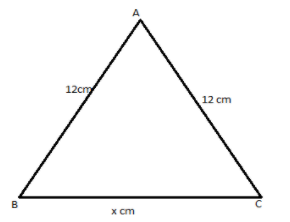
We are given that an isosceles triangle has perimeter of 30 cm. We are given that the equal sides of an isosceles triangle is of 12 cm each. We know that an isosceles triangle is a triangle where two sides of a triangle equal.
We know that the perimeter of a triangle is the sum of all sides of the triangle.
Let \[x\] cm be the unknown side of an isosceles triangle.
If \[a,b,c\] are the sides of a triangle, then the perimeter of the triangle is given by \[ = a + b + cunits\]
So, we get
\[ \Rightarrow \] Perimeter of an isosceles triangle \[ = 30cm\]
\[ \Rightarrow a + b + c = 30\]
\[ \Rightarrow 12 + x + 12 = 30\]
By adding the numbers, we get
\[ \Rightarrow 24 + x = 30\]
By rewriting the equation, we get
\[ \Rightarrow x = 30 - 24\]
\[ \Rightarrow x = 6cm\]
Thus the sides of an isosceles triangle are \[12cm,12cm,6cm\] respectively.
Now, we will find the area of the triangle using Heron’s formula.
Heron’s formula: If \[a,b,c\] are the sides of a triangle, then the area of the triangle \[ = \sqrt {s\left( {s - a} \right)\left( {s - b} \right)\left( {s - c} \right)} sq.units\] where \[s = \dfrac{{a + b + c}}{2}\] , \[s\] is the semi perimeter of the triangle that is half the perimeter of the triangle.
\[ \Rightarrow \] Semi perimeter of the triangle \[ = \dfrac{{a + b + c}}{2}\]
\[ \Rightarrow \] Semi perimeter of the triangle \[ = \dfrac{{30}}{2}\]
\[ \Rightarrow \] Semi perimeter of the triangle \[ = 15cm\]
\[ \Rightarrow \] Area of the triangle \[ = \sqrt {s\left( {s - a} \right)\left( {s - b} \right)\left( {s - c} \right)} sq.units\]
Now, substituting the semi perimeter of a triangle and the sides of all an isosceles triangle, we get
\[ \Rightarrow \] Area of the triangle \[ = \sqrt {15\left( {15 - 12} \right)\left( {15 - 6} \right)\left( {15 - 12} \right)} sq.cm\]
By simplifying the equation, we get
\[ \Rightarrow \] Area of the triangle \[ = \sqrt {15\left( 3 \right)\left( 9 \right)\left( 3 \right)} sq.cm\]
By taking the square root, we get
\[ \Rightarrow \] Area of the triangle \[ = 3 \times 3\sqrt {15} sq.cm\]
\[ \Rightarrow \] Area of the triangle \[ = 9\sqrt {15} sq.cm\]
Therefore, the area of an isosceles triangle is \[9\sqrt {15} sq.cm\].
Note: We know that the area of the triangle is half the product of base and height i.e., Area of the triangle \[ = \dfrac{1}{2} \times b \times h\]. But this formula for the area of the triangle only in the case of a right angle triangle or if the height of the triangle is known. Heron’s formula is used in finding the area of the triangle only when all the sides of a triangle are known, whatever be the type of the triangle.
Formula Used:
We will use the following formula:
If \[a,b,c\] are the sides of a triangle, then the perimeter of the triangle is given by \[ = a + b + cunits\]
Heron’s formula: If \[a,b,c\] are the sides of a triangle, then the area of the triangle \[ = \sqrt {s\left( {s - a} \right)\left( {s - b} \right)\left( {s - c} \right)} sq.units\] where \[s = \dfrac{{a + b + c}}{2}\] , \[s\] is the semi perimeter of the triangle that is half the perimeter of the triangle.
Complete step-by-step answer:
We are given that an isosceles triangle has perimeter of 30 cm. We are given that the equal sides of an isosceles triangle is of 12 cm each. We know that an isosceles triangle is a triangle where two sides of a triangle equal.
We know that the perimeter of a triangle is the sum of all sides of the triangle.
Let \[x\] cm be the unknown side of an isosceles triangle.
If \[a,b,c\] are the sides of a triangle, then the perimeter of the triangle is given by \[ = a + b + cunits\]
So, we get
\[ \Rightarrow \] Perimeter of an isosceles triangle \[ = 30cm\]
\[ \Rightarrow a + b + c = 30\]
\[ \Rightarrow 12 + x + 12 = 30\]
By adding the numbers, we get
\[ \Rightarrow 24 + x = 30\]
By rewriting the equation, we get
\[ \Rightarrow x = 30 - 24\]
\[ \Rightarrow x = 6cm\]
Thus the sides of an isosceles triangle are \[12cm,12cm,6cm\] respectively.
Now, we will find the area of the triangle using Heron’s formula.
Heron’s formula: If \[a,b,c\] are the sides of a triangle, then the area of the triangle \[ = \sqrt {s\left( {s - a} \right)\left( {s - b} \right)\left( {s - c} \right)} sq.units\] where \[s = \dfrac{{a + b + c}}{2}\] , \[s\] is the semi perimeter of the triangle that is half the perimeter of the triangle.
\[ \Rightarrow \] Semi perimeter of the triangle \[ = \dfrac{{a + b + c}}{2}\]
\[ \Rightarrow \] Semi perimeter of the triangle \[ = \dfrac{{30}}{2}\]
\[ \Rightarrow \] Semi perimeter of the triangle \[ = 15cm\]
\[ \Rightarrow \] Area of the triangle \[ = \sqrt {s\left( {s - a} \right)\left( {s - b} \right)\left( {s - c} \right)} sq.units\]
Now, substituting the semi perimeter of a triangle and the sides of all an isosceles triangle, we get
\[ \Rightarrow \] Area of the triangle \[ = \sqrt {15\left( {15 - 12} \right)\left( {15 - 6} \right)\left( {15 - 12} \right)} sq.cm\]
By simplifying the equation, we get
\[ \Rightarrow \] Area of the triangle \[ = \sqrt {15\left( 3 \right)\left( 9 \right)\left( 3 \right)} sq.cm\]
By taking the square root, we get
\[ \Rightarrow \] Area of the triangle \[ = 3 \times 3\sqrt {15} sq.cm\]
\[ \Rightarrow \] Area of the triangle \[ = 9\sqrt {15} sq.cm\]
Therefore, the area of an isosceles triangle is \[9\sqrt {15} sq.cm\].
Note: We know that the area of the triangle is half the product of base and height i.e., Area of the triangle \[ = \dfrac{1}{2} \times b \times h\]. But this formula for the area of the triangle only in the case of a right angle triangle or if the height of the triangle is known. Heron’s formula is used in finding the area of the triangle only when all the sides of a triangle are known, whatever be the type of the triangle.
Recently Updated Pages
Master Class 9 General Knowledge: Engaging Questions & Answers for Success

Master Class 9 Maths: Engaging Questions & Answers for Success
Master Class 9 Science: Engaging Questions & Answers for Success
Master Class 9 English: Engaging Questions & Answers for Success
Master Class 9 Social Science: Engaging Questions & Answers for Success
Class 9 Question and Answer - Your Ultimate Solutions Guide
Trending doubts
Find the sum of series 1 + 2 + 3 + 4 + 5 + + 100 class 9 maths CBSE
What is the Full Form of ICSE / ISC ?
What is the Full Form of ICSE, CBSE and SSC
Given that HCF 306 657 9 find the LCM 306 657 class 9 maths CBSE
On an outline map of India show its neighbouring c class 9 social science CBSE
What comes after 10 crore in Indian system class 9 maths CBSE