




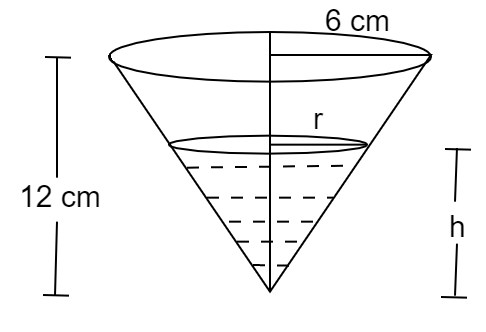
An inverted cone of height \[12{\text{ }}cm\] and base radius \[{\text{6 }}cm\] contains \[{\text{20 }}c{m^3}\] of water. Calculate the depth of water in the cone, measured from the vertex.
Answer
 Verified
561.3k+ views
Hint: We will find the volume of the cone with height of \[12{\text{ }}cm\] and base radius \[{\text{6 }}cm\]using the formula i.e., \[{\text{Volume of a cone}} = \dfrac{1}{3} \times \pi \times {\left( {radius} \right)^2} \times \left( {height} \right)\]. Similarly, we will consider another cone which is formed due to water. We will calculate its volume by assuming its radius as \[r\] and height as \[h\]. As the volume of similar figures is in the same ratio as the ratio of the cube of their heights. So, using this and putting the given volume of cone formed by water i.e., \[{\text{20 }}c{m^3}\] we will find \[h\].
Complete step by step answer:
As we know, \[{\text{Volume of a cone}} = \dfrac{1}{3} \times \pi \times {\left( {radius} \right)^2} \times \left( {height} \right)\]
Consider the larger cone with height \[12{\text{ }}cm\] and base radius \[{\text{6 }}cm\].
\[ \Rightarrow {\text{Volume of the larger cone}} = \dfrac{1}{3} \times \pi \times {\left( 6 \right)^2} \times \left( {12} \right)\]
\[ = 144\pi \]
Consider the smaller cone, let its radius be \[r\] and height as \[h\].
Given, the cone contains \[{\text{20 }}c{m^3}\] of water. Therefore,
\[ \Rightarrow {\text{Volume of the smaller cone}} = 20{\text{ }}c{m^3}\]
As we know, the volume of similar figures is in the same ratio as the ratio of the cube of their heights. So, we can write
\[ \Rightarrow \dfrac{{{\text{Volume of the larger cone}}}}{{{\text{Volume of the smaller cone }}}} = \dfrac{{{{\left( {{\text{Height of the larger cone}}} \right)}^3}}}{{{{\left( {{\text{Height of the smaller cone}}} \right)}^3}}}\]
On putting the values, we get
\[ \Rightarrow \dfrac{{{\text{144}}\pi }}{{20{\text{ }}}} = \dfrac{{{{\left( {{\text{12}}} \right)}^3}}}{{{{\left( h \right)}^3}}}\]
On cross multiplication, we get
\[ \Rightarrow {\left( h \right)^3} = \dfrac{{20 \times {{\left( {{\text{12}}} \right)}^3}}}{{{\text{144}}\pi }}\]
On simplification we get
\[ \Rightarrow {\left( h \right)^3} = \dfrac{{20 \times {{\left( {{\text{12}}} \right)}}}}{{{\text{}}\pi }}\]
\[ \Rightarrow {h^3} = \dfrac{240}{\pi}\]
\[ \Rightarrow {h^3} = 76.39437\]
\[\therefore h = 4.243{\text{ }}cm\]
Therefore, the depth of water in the cone, measured from the vertex is \[4.243{\text{ }}cm\].
Note:
We have used the concept of similar figures, but one should keep in mind that two solids are similar if and only if they are the same type of solids and their corresponding linear measures such as radii, height, base, length, etc. are proportional. Students may get confused with the height of the cone and height of the empty part of the cone.
Complete step by step answer:
As we know, \[{\text{Volume of a cone}} = \dfrac{1}{3} \times \pi \times {\left( {radius} \right)^2} \times \left( {height} \right)\]
Consider the larger cone with height \[12{\text{ }}cm\] and base radius \[{\text{6 }}cm\].
\[ \Rightarrow {\text{Volume of the larger cone}} = \dfrac{1}{3} \times \pi \times {\left( 6 \right)^2} \times \left( {12} \right)\]
\[ = 144\pi \]
Consider the smaller cone, let its radius be \[r\] and height as \[h\].
Given, the cone contains \[{\text{20 }}c{m^3}\] of water. Therefore,
\[ \Rightarrow {\text{Volume of the smaller cone}} = 20{\text{ }}c{m^3}\]
As we know, the volume of similar figures is in the same ratio as the ratio of the cube of their heights. So, we can write
\[ \Rightarrow \dfrac{{{\text{Volume of the larger cone}}}}{{{\text{Volume of the smaller cone }}}} = \dfrac{{{{\left( {{\text{Height of the larger cone}}} \right)}^3}}}{{{{\left( {{\text{Height of the smaller cone}}} \right)}^3}}}\]
On putting the values, we get
\[ \Rightarrow \dfrac{{{\text{144}}\pi }}{{20{\text{ }}}} = \dfrac{{{{\left( {{\text{12}}} \right)}^3}}}{{{{\left( h \right)}^3}}}\]
On cross multiplication, we get
\[ \Rightarrow {\left( h \right)^3} = \dfrac{{20 \times {{\left( {{\text{12}}} \right)}^3}}}{{{\text{144}}\pi }}\]
On simplification we get
\[ \Rightarrow {\left( h \right)^3} = \dfrac{{20 \times {{\left( {{\text{12}}} \right)}}}}{{{\text{}}\pi }}\]
\[ \Rightarrow {h^3} = \dfrac{240}{\pi}\]
\[ \Rightarrow {h^3} = 76.39437\]
\[\therefore h = 4.243{\text{ }}cm\]
Therefore, the depth of water in the cone, measured from the vertex is \[4.243{\text{ }}cm\].
Note:
We have used the concept of similar figures, but one should keep in mind that two solids are similar if and only if they are the same type of solids and their corresponding linear measures such as radii, height, base, length, etc. are proportional. Students may get confused with the height of the cone and height of the empty part of the cone.
Recently Updated Pages
Write any three differences between metals and nonmetals class 10 social science CBSE

Amit standing on a horizontal plane finds a bird flying class 10 maths CBSE
Two circles of radii 5 cm and 3 cm intersect at two class 10 maths CBSE
Solve the following i John and Jivanti together have class 10 maths CBSE
What is the relation between orthocenter circumcentre class 10 maths CBSE
Two plane mirrors are inclined at 70circ A ray incident class 10 physics CBSE
Trending doubts
Explain the Treaty of Vienna of 1815 class 10 social science CBSE
Which country is known as "The land of Fire and Ice"?
1 GB equals how many MB?
10 examples of evaporation in daily life with explanations
What is the full form of POSCO class 10 social science CBSE
Which is the hottest planet in the Solar system A Earth class 10 social science CBSE