




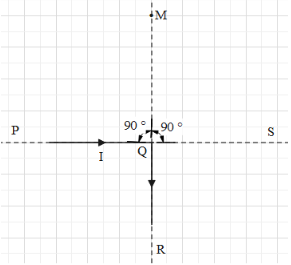
An infinitely long conductor PQR is bent to form a right angle as shown in figure. A current I flows through PQR. The magnetic field due to this current carrying conductor at the point M is ${{B}_{1}}$. Now, another infinitely long straight conductor QS, is connected at Q so that the current is $\dfrac{I}{2}$ in QR as well as in QS, the current in PQ remaining unchanged. The magnetic field at M is now ${{B}_{2}}$. The ratio $\dfrac{{{B}_{1}}}{{{B}_{2}}}$ is given by
A. $\dfrac{1}{2}$
B. $1$
C. $\dfrac{2}{3}$
D. $2$
Answer
 Verified
616.8k+ views
Hint:Use the formula for the magnitude of the magnetic field at a point P due to a straight current carrying conductor and the right hand thumb rule to find the direction of the magnetic field. With these find the magnetic field in both the case and then calculate the ratio of both.
Formula used:
$B=\dfrac{{{\mu }_{0}}I}{4\pi d}\left( sin{{\theta }_{1}}+sin{{\theta }_{2}} \right)$
where ${{\mu }_{0}}$ is the permeability of free space, I is the current in the conductor and ${{\theta }_{1}}$, ${{\theta }_{2}}$ are the angles .
Complete step by step answer:
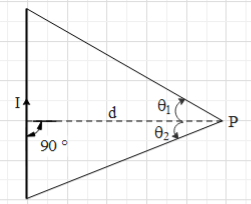
Consider a straight current carrying conduction of length l. The magnitude of the magnetic field at a point P, which is at a perpendicular d from the conductor as shown in the figure is given as $B=\dfrac{{{\mu }_{0}}I}{4\pi d}\left( sin{{\theta }_{1}}+sin{{\theta }_{2}} \right)$,
where ${{\mu }_{0}}$ is the permeability of free space, I is the current in the conductor and ${{\theta }_{1}}$, ${{\theta }_{2}}$ are the angles as shown in the figure.
The direction of the magnetic field is given by the right hand thumb rule.In the first case, the magnetic field at point M due the current in QR is zero since it passes through the axis of QR. The magnetic field at the same point due to current in PQ is ${{B}_{1}}=\dfrac{{{\mu }_{0}}I}{4\pi d}\left( sin(0)+sin{{90}^{\circ }} \right)$.
(since the conductor is infinitely long, ${{\theta }_{2}}\approx {{90}^{\circ }}$).
And $\sin {{90}^{\circ }}=1$, $\sin {{0}^{\circ }}=0$.
${{B}_{1}}=\dfrac{{{\mu }_{0}}I}{4\pi d}$ …. (i).
From the right hand thumb rule, the direction of ${{B}_{1}}$ is outwards the plane.
In the second case too, the magnetic field at point M due to QR is zero. The magnetic field at the same point due to the current in PQ is ${{B}_{PQ}}=\dfrac{{{\mu }_{0}}I}{4\pi d}$.The magnetic field due to the current in QS is,
${{B}_{QS}}=\dfrac{{{\mu }_{0}}\left( \dfrac{I}{2} \right)}{4\pi d}\left( sin{{90}^{\circ }}+sin(0) \right)\\
\Rightarrow{{B}_{QS}} =\dfrac{{{\mu }_{0}}\left( \dfrac{I}{2} \right)}{4\pi d}\\
\Rightarrow{{B}_{QS}} =\dfrac{{{\mu }_{0}}I}{8\pi d}$.
From the right hand thumb rule, the direction of both ${{B}_{PQ}}$ and ${{B}_{QS}}$ are parallel and outwards the plane.This means that the net magnetic field due to the set up is ${{B}_{2}}={{B}_{PQ}}+{{B}_{QS}}$.
$\Rightarrow {{B}_{2}}=\dfrac{{{\mu }_{0}}I}{4\pi d}+\dfrac{{{\mu }_{0}}I}{8\pi d}$.
$\Rightarrow {{B}_{2}}=\dfrac{3{{\mu }_{0}}I}{8\pi d}$ …. (ii).
Now divide (i) by (ii).
$\Rightarrow \dfrac{{{B}_{1}}}{{{B}_{2}}}=\dfrac{\dfrac{{{\mu }_{0}}I}{4\pi d}}{\dfrac{3{{\mu }_{0}}I}{8\pi d}}\\
\therefore \dfrac{{{B}_{1}}}{{{B}_{2}}} =\dfrac{2}{3}$.
With this we found the value of the ratio.
Hence, the correct option is C.
Note: In the formula for the magnitude of magnetic field that we discussed above, we see that the magnetic field due to PQ and QS is directly proportional to current because all the other factors are the same for both. Therefore, this means that in the second case ${{B}_{QS}}=\dfrac{{{B}_{PQ}}}{2}$, since the current in QS is half of the current in PQ.
$\Rightarrow {{B}_{2}}={{B}_{PQ}}+\dfrac{{{B}_{PQ}}}{2}\\
\Rightarrow {{B}_{2}} =\dfrac{3{{B}_{PQ}}}{2}$.
And in the first case ${{B}_{1}}={{B}_{PQ}}$.
When we divide both, we get that $\dfrac{{{B}_{1}}}{{{B}_{2}}}=\dfrac{{{B}_{PQ}}}{\dfrac{3{{B}_{PQ}}}{2}}$
$\Rightarrow \dfrac{{{B}_{1}}}{{{B}_{2}}}=\dfrac{2}{3}$.
Formula used:
$B=\dfrac{{{\mu }_{0}}I}{4\pi d}\left( sin{{\theta }_{1}}+sin{{\theta }_{2}} \right)$
where ${{\mu }_{0}}$ is the permeability of free space, I is the current in the conductor and ${{\theta }_{1}}$, ${{\theta }_{2}}$ are the angles .
Complete step by step answer:
Consider a straight current carrying conduction of length l. The magnitude of the magnetic field at a point P, which is at a perpendicular d from the conductor as shown in the figure is given as $B=\dfrac{{{\mu }_{0}}I}{4\pi d}\left( sin{{\theta }_{1}}+sin{{\theta }_{2}} \right)$,
where ${{\mu }_{0}}$ is the permeability of free space, I is the current in the conductor and ${{\theta }_{1}}$, ${{\theta }_{2}}$ are the angles as shown in the figure.
The direction of the magnetic field is given by the right hand thumb rule.In the first case, the magnetic field at point M due the current in QR is zero since it passes through the axis of QR. The magnetic field at the same point due to current in PQ is ${{B}_{1}}=\dfrac{{{\mu }_{0}}I}{4\pi d}\left( sin(0)+sin{{90}^{\circ }} \right)$.
(since the conductor is infinitely long, ${{\theta }_{2}}\approx {{90}^{\circ }}$).
And $\sin {{90}^{\circ }}=1$, $\sin {{0}^{\circ }}=0$.
${{B}_{1}}=\dfrac{{{\mu }_{0}}I}{4\pi d}$ …. (i).
From the right hand thumb rule, the direction of ${{B}_{1}}$ is outwards the plane.
In the second case too, the magnetic field at point M due to QR is zero. The magnetic field at the same point due to the current in PQ is ${{B}_{PQ}}=\dfrac{{{\mu }_{0}}I}{4\pi d}$.The magnetic field due to the current in QS is,
${{B}_{QS}}=\dfrac{{{\mu }_{0}}\left( \dfrac{I}{2} \right)}{4\pi d}\left( sin{{90}^{\circ }}+sin(0) \right)\\
\Rightarrow{{B}_{QS}} =\dfrac{{{\mu }_{0}}\left( \dfrac{I}{2} \right)}{4\pi d}\\
\Rightarrow{{B}_{QS}} =\dfrac{{{\mu }_{0}}I}{8\pi d}$.
From the right hand thumb rule, the direction of both ${{B}_{PQ}}$ and ${{B}_{QS}}$ are parallel and outwards the plane.This means that the net magnetic field due to the set up is ${{B}_{2}}={{B}_{PQ}}+{{B}_{QS}}$.
$\Rightarrow {{B}_{2}}=\dfrac{{{\mu }_{0}}I}{4\pi d}+\dfrac{{{\mu }_{0}}I}{8\pi d}$.
$\Rightarrow {{B}_{2}}=\dfrac{3{{\mu }_{0}}I}{8\pi d}$ …. (ii).
Now divide (i) by (ii).
$\Rightarrow \dfrac{{{B}_{1}}}{{{B}_{2}}}=\dfrac{\dfrac{{{\mu }_{0}}I}{4\pi d}}{\dfrac{3{{\mu }_{0}}I}{8\pi d}}\\
\therefore \dfrac{{{B}_{1}}}{{{B}_{2}}} =\dfrac{2}{3}$.
With this we found the value of the ratio.
Hence, the correct option is C.
Note: In the formula for the magnitude of magnetic field that we discussed above, we see that the magnetic field due to PQ and QS is directly proportional to current because all the other factors are the same for both. Therefore, this means that in the second case ${{B}_{QS}}=\dfrac{{{B}_{PQ}}}{2}$, since the current in QS is half of the current in PQ.
$\Rightarrow {{B}_{2}}={{B}_{PQ}}+\dfrac{{{B}_{PQ}}}{2}\\
\Rightarrow {{B}_{2}} =\dfrac{3{{B}_{PQ}}}{2}$.
And in the first case ${{B}_{1}}={{B}_{PQ}}$.
When we divide both, we get that $\dfrac{{{B}_{1}}}{{{B}_{2}}}=\dfrac{{{B}_{PQ}}}{\dfrac{3{{B}_{PQ}}}{2}}$
$\Rightarrow \dfrac{{{B}_{1}}}{{{B}_{2}}}=\dfrac{2}{3}$.
Recently Updated Pages
Basicity of sulphurous acid and sulphuric acid are

Master Class 12 Economics: Engaging Questions & Answers for Success
Master Class 12 Biology: Engaging Questions & Answers for Success
Master Class 11 English: Engaging Questions & Answers for Success
Master Class 11 Physics: Engaging Questions & Answers for Success
Master Class 11 Computer Science: Engaging Questions & Answers for Success
Trending doubts
Draw a labelled sketch of the human eye class 12 physics CBSE
The chemical formula of tear gas is A CO Cl 2 B C 10 class 12 chemistry CBSE
Draw ray diagrams each showing i myopic eye and ii class 12 physics CBSE
Which are the Top 10 Largest Countries of the World?
Differentiate between homogeneous and heterogeneous class 12 chemistry CBSE
Which is the correct genotypic ratio of mendel dihybrid class 12 biology CBSE