




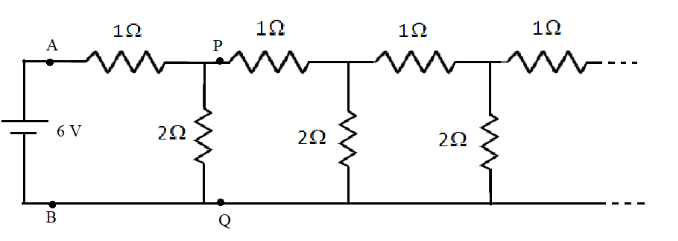
An infinite ladder network of resistances is constructed with \[1\,\Omega \] and \[2\,\Omega \] resistances as shown in the figure. The 6 V battery between A and B has negligible internal resistance. The equivalent resistance between A and B is?
Answer
 Verified
640.8k+ views
Hint:: Assume the equivalent resistance of the circuit beyond the first loop of the circuit as R, then find the equivalent resistance of the whole network.
Formula used:
The equivalent resistance of the parallel combination of resistors \[{R_1}\] and \[{R_2}\]:
\[{R_{12}} = \dfrac{{{R_1}{R_2}}}{{{R_1} + {R_2}}}\]
The equivalent resistance of the series combination of resistors \[{R_1}\] and \[{R_2}\]:
\[{R_{12}} = {R_1} + {R_2}\]
Complete step by step answer:
The above circuit diagram of infinite ladder network is,
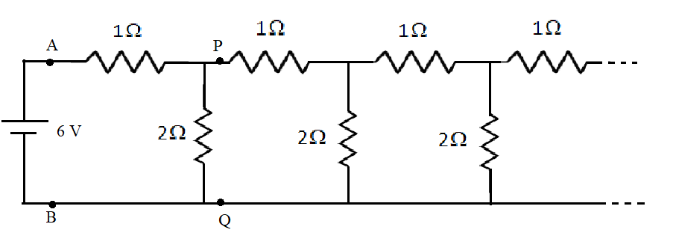
Let the equivalent resistance of the above circuit is R. Since the circuit is infinitely long, removing the loop ABDC from the circuit will not affect the equivalent resistance of the circuit. Therefore, the equivalent resistance of the circuit beyond PQ is also R.
Now, the revised circuit diagram for this case will become,
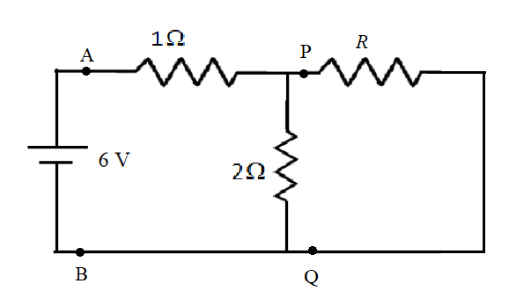
In the above circuit diagram, the resistors R and \[2\,\Omega \] are in parallel combination to each other. The equivalent resistance of these two is,
\[{R_1} = \dfrac{{\left( R \right)\left( {2\,} \right)}}{{R + 2\,}}\]
\[ \Rightarrow {R_1} = \dfrac{{2R}}{{R + 2}}\]
Now, \[{R_1}\] is in series with \[1\,\Omega \] resistance of the first loop and we know that the equivalent resistance of these two resistors is R. therefore,
\[R = \dfrac{{2R}}{{R + 2}} + 1\]
\[ \Rightarrow R\left( {R + 2} \right) = 2R + \left( {R + 2} \right)\]
\[ \Rightarrow {R^2} - R + 2 = 0\]
Solve this second order equation to get the value of equivalent resistance as follows,
\[R = \dfrac{{1 \pm \sqrt {{1^2} + 4\left( 2 \right)} }}{2}\]
\[\therefore R = + 2\,\,{\text{or}}\, - 2\]
But resistance can never be negative. Therefore, the equivalent resistance of the circuit is \[2\,\Omega \].
Note: We cannot find the equivalent resistance of the infinite ladder network by determining the equivalent resistance of each loop in the circuit. Always assume the equivalent resistance of the network excluding the first loop as R.
Formula used:
The equivalent resistance of the parallel combination of resistors \[{R_1}\] and \[{R_2}\]:
\[{R_{12}} = \dfrac{{{R_1}{R_2}}}{{{R_1} + {R_2}}}\]
The equivalent resistance of the series combination of resistors \[{R_1}\] and \[{R_2}\]:
\[{R_{12}} = {R_1} + {R_2}\]
Complete step by step answer:
The above circuit diagram of infinite ladder network is,
Let the equivalent resistance of the above circuit is R. Since the circuit is infinitely long, removing the loop ABDC from the circuit will not affect the equivalent resistance of the circuit. Therefore, the equivalent resistance of the circuit beyond PQ is also R.
Now, the revised circuit diagram for this case will become,
In the above circuit diagram, the resistors R and \[2\,\Omega \] are in parallel combination to each other. The equivalent resistance of these two is,
\[{R_1} = \dfrac{{\left( R \right)\left( {2\,} \right)}}{{R + 2\,}}\]
\[ \Rightarrow {R_1} = \dfrac{{2R}}{{R + 2}}\]
Now, \[{R_1}\] is in series with \[1\,\Omega \] resistance of the first loop and we know that the equivalent resistance of these two resistors is R. therefore,
\[R = \dfrac{{2R}}{{R + 2}} + 1\]
\[ \Rightarrow R\left( {R + 2} \right) = 2R + \left( {R + 2} \right)\]
\[ \Rightarrow {R^2} - R + 2 = 0\]
Solve this second order equation to get the value of equivalent resistance as follows,
\[R = \dfrac{{1 \pm \sqrt {{1^2} + 4\left( 2 \right)} }}{2}\]
\[\therefore R = + 2\,\,{\text{or}}\, - 2\]
But resistance can never be negative. Therefore, the equivalent resistance of the circuit is \[2\,\Omega \].
Note: We cannot find the equivalent resistance of the infinite ladder network by determining the equivalent resistance of each loop in the circuit. Always assume the equivalent resistance of the network excluding the first loop as R.
Recently Updated Pages
Onehalf of a convex lens is covered with a black paper class 12 physics CBSE

Differentiate between lanthanoids and actinoids class 12 chemistry CBSE
An object 5 cm in length is held 25 cm away from a class 12 physics CBSE
Name the following halides according to the IUPAC system class 12 chemistry CBSE
An infinite ladder network of resistances is constructed class 12 physics CBSE
How will you bring about the following conversions class 12 chemistry CBSE
Trending doubts
Draw a labelled sketch of the human eye class 12 physics CBSE
Which are the Top 10 Largest Countries of the World?
Draw ray diagrams each showing i myopic eye and ii class 12 physics CBSE
Which is the correct genotypic ratio of mendel dihybrid class 12 biology CBSE
Differentiate between homogeneous and heterogeneous class 12 chemistry CBSE
What is the Full Form of PVC, PET, HDPE, LDPE, PP and PS ?