




An inductor $L$ is allowed to discharge through a capacitor $C$ . Find the emf induced across the inductor when the capacitor is fully charged.
A. Maximum
B. Minimum
C. Zero
D. Infinite
Answer
 Verified
611.1k+ views
Hint:As the inductor discharges, the electrical energy stored in the capacitor increases and once it is fully charged the capacitor will have the maximum electrical energy. Also as the capacitor charges, the current in the circuit will decrease.
Formula used:
->The emf induced across the inductor is given by, $\varepsilon = - L\dfrac{{di}}{{dt}}$ where $L$ is the inductance and $i$ is the current through the circuit.
Complete step-by-step solution:
->Step 1: Describe the process of discharging an inductor to determine the emf induced in it when the capacitor is charged fully.
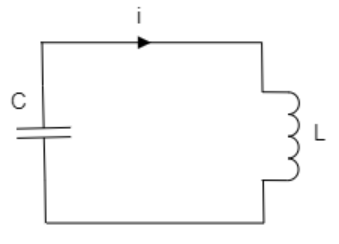
In the above figure, an inductor is connected to a capacitor and the circuit gives rise to LC oscillations.
When we say the inductor discharges we essentially mean that the inductor gets demagnetised. The current in the circuit will decrease and the magnetic energy stored in the inductor slowly gets converted to electrical energy. This means that the capacitor begins to charge. Once the capacitor becomes fully charged, the current in the circuit will be zero and thus the rate of change of current will also be zero. Then the induced emf will be $\varepsilon = - L \times 0 = 0$ .
So when the capacitor is fully charged the induced emf will be zero.
Hence the correct option is C.
Note:- It is the decrease in current which allows the capacitor to get charged. An inductor opposes the change in the current of the circuit while a capacitor opposes the change in voltage across the plates. Once the capacitor is fully charged the potential difference across the capacitor will be maximum. The magnetizing and demagnetizing of the inductor will occur consecutively. In an ideal case, the exchange of energy between the inductor and the capacitor will go on indefinitely.
Formula used:
->The emf induced across the inductor is given by, $\varepsilon = - L\dfrac{{di}}{{dt}}$ where $L$ is the inductance and $i$ is the current through the circuit.
Complete step-by-step solution:
->Step 1: Describe the process of discharging an inductor to determine the emf induced in it when the capacitor is charged fully.
In the above figure, an inductor is connected to a capacitor and the circuit gives rise to LC oscillations.
When we say the inductor discharges we essentially mean that the inductor gets demagnetised. The current in the circuit will decrease and the magnetic energy stored in the inductor slowly gets converted to electrical energy. This means that the capacitor begins to charge. Once the capacitor becomes fully charged, the current in the circuit will be zero and thus the rate of change of current will also be zero. Then the induced emf will be $\varepsilon = - L \times 0 = 0$ .
So when the capacitor is fully charged the induced emf will be zero.
Hence the correct option is C.
Note:- It is the decrease in current which allows the capacitor to get charged. An inductor opposes the change in the current of the circuit while a capacitor opposes the change in voltage across the plates. Once the capacitor is fully charged the potential difference across the capacitor will be maximum. The magnetizing and demagnetizing of the inductor will occur consecutively. In an ideal case, the exchange of energy between the inductor and the capacitor will go on indefinitely.
Recently Updated Pages
Master Class 12 Business Studies: Engaging Questions & Answers for Success

Master Class 12 Biology: Engaging Questions & Answers for Success
Master Class 12 Chemistry: Engaging Questions & Answers for Success
Class 12 Question and Answer - Your Ultimate Solutions Guide
Master Class 11 Social Science: Engaging Questions & Answers for Success
Master Class 11 English: Engaging Questions & Answers for Success
Trending doubts
Which are the Top 10 Largest Countries of the World?
Draw a labelled sketch of the human eye class 12 physics CBSE
Differentiate between homogeneous and heterogeneous class 12 chemistry CBSE
Sulphuric acid is known as the king of acids State class 12 chemistry CBSE
Why is the cell called the structural and functional class 12 biology CBSE
Which is the correct genotypic ratio of mendel dihybrid class 12 biology CBSE