



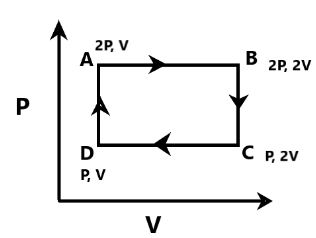
An ideal monatomic gas is taken around the cycle $ABCDA$ as shown in $P - V$ diagram. The Work done during the cycle is
A. $PV$
B. $0.5PV$
C. $2PV$
D. $3PV$
Answer
 Verified
559.2k+ views
Hint:The work done by an ideal gas can be calculated using the $P - V$ diagram or the curve from the specific graph. Based on the plot the work done can be calculated as the pressure and volume at different time points for the given ideal gas can be calculated from the given graph itself.
Complete step-by-step answer: The given $P - V$ diagram or plot has the cyclic process given with the $ABCDA$ plot. The work done needs to be calculated using the area of the cyclic process that is given in the plot as $ABCDA$. The whole cyclic process can be presented as a rectangular structure which is why the area of the rectangular structure $ABCDA$ can be considered as the work done by the monatomic gas in the specific time point. From the given rectangular cyclic structure, the area can be calculated as $BA \times DA$. The $BA$ can be calculated as the difference of the pressure and volume from the point $B$ to point $A$. There is a volume change observed, which is why the value of $BA$ in the given cyclic process is $V$. The $DA$ can be calculated based on the differences between pressure and volume. There is a change observed only in the pressure between the time points $D$ to $A$. This is why the value of $DA$ in the cyclic process can be defined as $P$. Therefore, the work done in the cyclic process $ABCDA$ can be calculated using the formula $BA \times DA$. This is why from the values the work is done will be: $W = P \times V$. Therefore, the work done in the given process for this cyclic process will be $PV$.
Hence the correct option is (A).
Note:The $P - V$ diagram is the graphical representation of the changes in the physical property of the gases which shows the changes in the pressure and volume with respect to time. The changes in the physical properties can define the condition in which the monatomic gas is present.
Complete step-by-step answer: The given $P - V$ diagram or plot has the cyclic process given with the $ABCDA$ plot. The work done needs to be calculated using the area of the cyclic process that is given in the plot as $ABCDA$. The whole cyclic process can be presented as a rectangular structure which is why the area of the rectangular structure $ABCDA$ can be considered as the work done by the monatomic gas in the specific time point. From the given rectangular cyclic structure, the area can be calculated as $BA \times DA$. The $BA$ can be calculated as the difference of the pressure and volume from the point $B$ to point $A$. There is a volume change observed, which is why the value of $BA$ in the given cyclic process is $V$. The $DA$ can be calculated based on the differences between pressure and volume. There is a change observed only in the pressure between the time points $D$ to $A$. This is why the value of $DA$ in the cyclic process can be defined as $P$. Therefore, the work done in the cyclic process $ABCDA$ can be calculated using the formula $BA \times DA$. This is why from the values the work is done will be: $W = P \times V$. Therefore, the work done in the given process for this cyclic process will be $PV$.
Hence the correct option is (A).
Note:The $P - V$ diagram is the graphical representation of the changes in the physical property of the gases which shows the changes in the pressure and volume with respect to time. The changes in the physical properties can define the condition in which the monatomic gas is present.
Recently Updated Pages
Master Class 12 Economics: Engaging Questions & Answers for Success

Master Class 12 Physics: Engaging Questions & Answers for Success
Master Class 12 English: Engaging Questions & Answers for Success
Master Class 12 Social Science: Engaging Questions & Answers for Success
Master Class 12 Maths: Engaging Questions & Answers for Success
Master Class 12 Business Studies: Engaging Questions & Answers for Success
Trending doubts
Which are the Top 10 Largest Countries of the World?
What are the major means of transport Explain each class 12 social science CBSE
Draw a labelled sketch of the human eye class 12 physics CBSE
What is a transformer Explain the principle construction class 12 physics CBSE
Why cannot DNA pass through cell membranes class 12 biology CBSE
Differentiate between insitu conservation and exsitu class 12 biology CBSE