




An exterior angle of a triangle is 100 and its interior opposite angles are equal to each other. Find the measure of each angle of the triangle.
Answer
 Verified
673.8k+ views
Hint: The Angle Sum Theorem tells us that the sum of the measures of the interior angles of a triangle is 180 degrees. We can prove this by using properties of parallel lines cut by transversals. This creates alternate interior angles that are congruent.
An exterior angle of a triangle is equal to the sum of the opposite interior angles. For more on this see Triangle external angle theorem.
Using the theorem that if the side of a triangle is produced then the interior angle is equal to the sum of two interior opposite angles of the triangle.
Complete Step-by-step Solution
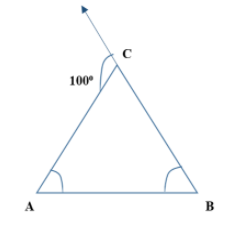
Let be a triangle where the side BC is produced.
By using angle sum theorem, we have
$\angle A + \angle B = {100^ \circ }$…………………………………………………………… (1)
It is given that the interior opposite angles are equal i.e., \[\angle A = \angle B.\]
\[\therefore \]Equation (1) becomes
\[2\angle A = {100^ \circ }\]
\[\angle A = {50^ \circ }\]
\[ \Rightarrow \angle B = {50^ \circ }\]
Using angle sum property of a triangle,
Sum of all angles of a triangle =180o
\[ \Rightarrow \angle A + \angle B + \angle C = {180^ \circ }\]
\[ \Rightarrow 100 + \angle C = {180^ \circ }\] ………………………………………………… [from (1)]
\[ \Rightarrow \angle C = {180^ \circ } - {110^ \circ }\]
\[ \Rightarrow \angle C = {80^ \circ }\]
Hence \[\angle A = {50^ \circ }\]
\[\angle B = {50^ \circ }\]
\[\angle C = {80^ \circ }\]
Note: Student should keep in mind that Angle sum property is very important, it describes to you that the sum of angles of a triangle is always equal to ${180^ \circ }$.
The measure of an exterior angle of a triangle is equal to the sum of the measures of the two non-adjacent interior angles. (Non-adjacent interior angles may also be referred to as remote interior angles.)
An exterior angle of a triangle is equal to the sum of the opposite interior angles. For more on this see Triangle external angle theorem.
Using the theorem that if the side of a triangle is produced then the interior angle is equal to the sum of two interior opposite angles of the triangle.
Complete Step-by-step Solution
Let be a triangle where the side BC is produced.
By using angle sum theorem, we have
$\angle A + \angle B = {100^ \circ }$…………………………………………………………… (1)
It is given that the interior opposite angles are equal i.e., \[\angle A = \angle B.\]
\[\therefore \]Equation (1) becomes
\[2\angle A = {100^ \circ }\]
\[\angle A = {50^ \circ }\]
\[ \Rightarrow \angle B = {50^ \circ }\]
Using angle sum property of a triangle,
Sum of all angles of a triangle =180o
\[ \Rightarrow \angle A + \angle B + \angle C = {180^ \circ }\]
\[ \Rightarrow 100 + \angle C = {180^ \circ }\] ………………………………………………… [from (1)]
\[ \Rightarrow \angle C = {180^ \circ } - {110^ \circ }\]
\[ \Rightarrow \angle C = {80^ \circ }\]
Hence \[\angle A = {50^ \circ }\]
\[\angle B = {50^ \circ }\]
\[\angle C = {80^ \circ }\]
Note: Student should keep in mind that Angle sum property is very important, it describes to you that the sum of angles of a triangle is always equal to ${180^ \circ }$.
The measure of an exterior angle of a triangle is equal to the sum of the measures of the two non-adjacent interior angles. (Non-adjacent interior angles may also be referred to as remote interior angles.)
Recently Updated Pages
Master Class 9 Science: Engaging Questions & Answers for Success

Master Class 9 Social Science: Engaging Questions & Answers for Success
Master Class 9 English: Engaging Questions & Answers for Success
Master Class 9 Maths: Engaging Questions & Answers for Success
Class 9 Question and Answer - Your Ultimate Solutions Guide
Master Class 12 English: Engaging Questions & Answers for Success
Trending doubts
Fill the blanks with the suitable prepositions 1 The class 9 english CBSE
What is the full form of pH?
Difference Between Plant Cell and Animal Cell
What is pollution? How many types of pollution? Define it
What is the Full Form of ICSE / ISC ?
On an outline map of India show its neighbouring c class 9 social science CBSE