




An express train is running between two stations with a uniform speed. If the diameter of each wheel of the train is 42 cm and each wheel makes 1200 revolutions per minute, find the speed of the train.
(A) 18 km/hr
(B) 45 km/hr
(C) 72.97 km/hr
(D) 95.04 km/hr
Answer
 Verified
653.4k+ views
Hint: The diameter of the wheel is 42 cm. Now, get the value of the radius using the fact that the radius is always half of the diameter. Then, use the formula, \[Circumference=2\pi \left( radius \right)\], and calculate the circumference of the wheel. The distance covered by the wheel in one revolution is equal to the circumference of the wheel. Now, get the distance covered by the wheel in 1200 revolutions. Now, we have got the distance covered by the wheel in a minute. We know that
\[\text{1hr=60minutes}\] . Then, calculate the distance covered by the wheel in an hour. Calculate the speed using the formula, \[\text{Speed=}\dfrac{\text{Distance}}{\text{Time}}\] . Now, convert the speed into km/hr using the relation \[1km=100000cm\] .
Complete step by step answer:
According to the question, it is given that,
The diameter of the wheel = 42 cm …………………………………..(1)
The number of revolutions per minute = 1200 ………………………………………(2)
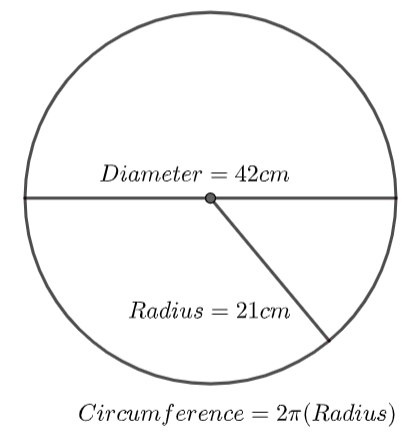
We know that the radius is half of the diameter.
From equation (1), we have the value of the diameter of the wheel.
The radius of the wheel = \[\dfrac{42}{2}\] cm = 21 cm ……………………………………(3)
We know the formula, \[Circumference=2\pi \left( radius \right)\] ………………………………(4)
Now, from equation (3) and equation (4), we get
The circumference of the wheel = \[2\times \dfrac{22}{7}\times 21cm=44\times 3cm\] ……………………………….(5)
In one revolution, the wheel covers a distance equal to its circumference.
From equation (5), we have the circumference of the wheel.
The distance covered by the wheel in one revolution = \[44\times 3\] cm ………………………………….(6)
It is given that the wheel makes 1200 revolutions per minute.
From equation (6), we have the distance covered by the wheel in one revolution.
The distance covered by the wheel in a minute = \[44\times 3\times 1200\] cm …………………………..(7)
We know that \[\text{1hr=60minutes}\] .
Using the unitary method,
The distance covered by the wheel in an hour = \[44\times 3\times 1200\times 60\] cm ……………………………. (8)
We know the formula, \[\text{Speed=}\dfrac{\text{Distance}}{\text{Time}}\] ………………………………(9)
Now, from equation (8) and equation (9), we get
The speed of the train = \[\dfrac{44\times 3\times 1200\times 60cm}{1hr}\] = 9504000 cm/hr ………………………….(10)
We know that, \[1km=100000cm\] ………………………………..(11)
From equation (10) and equation (11), we get
The speed of the train = 9504000 cm/hr = \[95.04\times 100000\] cm/hr = 95.04 km/hr.
Therefore, the speed of the train is 95.04 km/hr.
Hence, the correct option is (D)
Note:
In this question, one might think that the value area of the wheel is equal to the distance covered by the wheel in one revolution. This is wrong. Since the wheel is moving along the circumference so, the distance covered by the wheel in one revolution is equal to the circumference of the wheel.
\[\text{1hr=60minutes}\] . Then, calculate the distance covered by the wheel in an hour. Calculate the speed using the formula, \[\text{Speed=}\dfrac{\text{Distance}}{\text{Time}}\] . Now, convert the speed into km/hr using the relation \[1km=100000cm\] .
Complete step by step answer:
According to the question, it is given that,
The diameter of the wheel = 42 cm …………………………………..(1)
The number of revolutions per minute = 1200 ………………………………………(2)
We know that the radius is half of the diameter.
From equation (1), we have the value of the diameter of the wheel.
The radius of the wheel = \[\dfrac{42}{2}\] cm = 21 cm ……………………………………(3)
We know the formula, \[Circumference=2\pi \left( radius \right)\] ………………………………(4)
Now, from equation (3) and equation (4), we get
The circumference of the wheel = \[2\times \dfrac{22}{7}\times 21cm=44\times 3cm\] ……………………………….(5)
In one revolution, the wheel covers a distance equal to its circumference.
From equation (5), we have the circumference of the wheel.
The distance covered by the wheel in one revolution = \[44\times 3\] cm ………………………………….(6)
It is given that the wheel makes 1200 revolutions per minute.
From equation (6), we have the distance covered by the wheel in one revolution.
The distance covered by the wheel in a minute = \[44\times 3\times 1200\] cm …………………………..(7)
We know that \[\text{1hr=60minutes}\] .
Using the unitary method,
The distance covered by the wheel in an hour = \[44\times 3\times 1200\times 60\] cm ……………………………. (8)
We know the formula, \[\text{Speed=}\dfrac{\text{Distance}}{\text{Time}}\] ………………………………(9)
Now, from equation (8) and equation (9), we get
The speed of the train = \[\dfrac{44\times 3\times 1200\times 60cm}{1hr}\] = 9504000 cm/hr ………………………….(10)
We know that, \[1km=100000cm\] ………………………………..(11)
From equation (10) and equation (11), we get
The speed of the train = 9504000 cm/hr = \[95.04\times 100000\] cm/hr = 95.04 km/hr.
Therefore, the speed of the train is 95.04 km/hr.
Hence, the correct option is (D)
Note:
In this question, one might think that the value area of the wheel is equal to the distance covered by the wheel in one revolution. This is wrong. Since the wheel is moving along the circumference so, the distance covered by the wheel in one revolution is equal to the circumference of the wheel.
Recently Updated Pages
Write any three differences between metals and nonmetals class 10 social science CBSE

Amit standing on a horizontal plane finds a bird flying class 10 maths CBSE
Two circles of radii 5 cm and 3 cm intersect at two class 10 maths CBSE
Solve the following i John and Jivanti together have class 10 maths CBSE
What is the relation between orthocenter circumcentre class 10 maths CBSE
Two plane mirrors are inclined at 70circ A ray incident class 10 physics CBSE
Trending doubts
Explain the Treaty of Vienna of 1815 class 10 social science CBSE
Which country is known as "The land of Fire and Ice"?
1 GB equals how many MB?
10 examples of evaporation in daily life with explanations
What is the full form of POSCO class 10 social science CBSE
Make a sketch of the human nerve cell What function class 10 biology CBSE