




An equilateral triangle is inscribed in a circle of radius 6cm. Find its side.
Answer
 Verified
655.8k+ views
Hint: Draw the figure. The line connecting the centre of the circle to the vertex of the triangle is taken as radius. Draw perpendicular to the base of the triangle. Solve the triangle using Pythagoras theorem and find the length of the side.
Complete step-by-step answer:
Let ABC be an equilateral triangle inscribed in a circle of radius of 6cm.
Let us consider O as the centre of the circle.
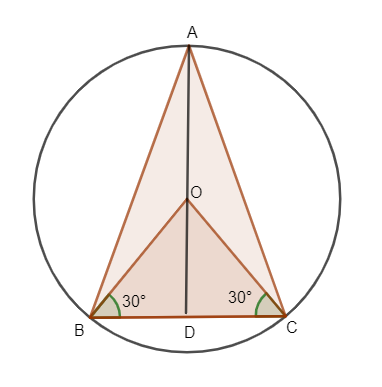
OA, OB and OC correspond to the radius of the circle.
OA=OB=OC=r
OA=OB=OC=6cm.
Let OD be a perpendicular from 0 to side BC.
So D becomes the mid-point of BC. So, OB and OC are bisectors of $\angle B$ and $\angle C$ respectively.
For an Equilateral triangle all angles as $60{}^\circ $,
$\therefore $For $\Delta ABC$,
$\angle A=\angle B=\angle C=60{}^\circ $
As OB and OC bisects angle$\angle B$ and $\angle C$, their angle becomes half of $\angle B$ and $\angle C$.
$\therefore \angle OBD=\angle OCD=\dfrac{60{}^\circ }{2}=30{}^\circ $
Now let us consider $\Delta OBD$, from the figure.
We know the angle=$30{}^\circ $and length of OB=6cm.
By using basic trigonometry we know that,
$\cos 30=\dfrac{BD}{6}$
$\Rightarrow $Length of BD = $6\times \cos 30.$
We know, $\cos 30=\dfrac{\sqrt{3}}{2}$
$\therefore $BD= $\dfrac{6\times \sqrt{3}}{2}=3\sqrt{3}$
BC=2BD
Because $\Delta OBD$ is equal to $\Delta ODC.$
Length BD=length DC.
Total length BC= BD+DC.
BC=BD+BC
BC=2BD
BC=$2\times 3\sqrt{3}=6\sqrt{3}$cm.
As it is an equilateral triangle,
AB=BC=AC=$6\sqrt{3}$cm
Note: If the question was given for isosceles triangle instead of equilateral triangle, the OA$\ne $OB$\ne $OC $\ne $radius. The angle will vary in case of isosceles triangle.
Complete step-by-step answer:
Let ABC be an equilateral triangle inscribed in a circle of radius of 6cm.
Let us consider O as the centre of the circle.
OA, OB and OC correspond to the radius of the circle.
OA=OB=OC=r
OA=OB=OC=6cm.
Let OD be a perpendicular from 0 to side BC.
So D becomes the mid-point of BC. So, OB and OC are bisectors of $\angle B$ and $\angle C$ respectively.
For an Equilateral triangle all angles as $60{}^\circ $,
$\therefore $For $\Delta ABC$,
$\angle A=\angle B=\angle C=60{}^\circ $
As OB and OC bisects angle$\angle B$ and $\angle C$, their angle becomes half of $\angle B$ and $\angle C$.
$\therefore \angle OBD=\angle OCD=\dfrac{60{}^\circ }{2}=30{}^\circ $
Now let us consider $\Delta OBD$, from the figure.
We know the angle=$30{}^\circ $and length of OB=6cm.
By using basic trigonometry we know that,
$\cos 30=\dfrac{BD}{6}$
$\Rightarrow $Length of BD = $6\times \cos 30.$
We know, $\cos 30=\dfrac{\sqrt{3}}{2}$
$\therefore $BD= $\dfrac{6\times \sqrt{3}}{2}=3\sqrt{3}$
BC=2BD
Because $\Delta OBD$ is equal to $\Delta ODC.$
Length BD=length DC.
Total length BC= BD+DC.
BC=BD+BC
BC=2BD
BC=$2\times 3\sqrt{3}=6\sqrt{3}$cm.
As it is an equilateral triangle,
AB=BC=AC=$6\sqrt{3}$cm
Note: If the question was given for isosceles triangle instead of equilateral triangle, the OA$\ne $OB$\ne $OC $\ne $radius. The angle will vary in case of isosceles triangle.
Recently Updated Pages
Master Class 11 English: Engaging Questions & Answers for Success

Master Class 11 Social Science: Engaging Questions & Answers for Success
Master Class 11 Maths: Engaging Questions & Answers for Success
Master Class 11 Chemistry: Engaging Questions & Answers for Success
Master Class 11 Biology: Engaging Questions & Answers for Success
Master Class 11 Physics: Engaging Questions & Answers for Success
Trending doubts
One Metric ton is equal to kg A 10000 B 1000 C 100 class 11 physics CBSE
Difference Between Prokaryotic Cells and Eukaryotic Cells
Find the value of the expression given below sin 30circ class 11 maths CBSE
1 ton equals to A 100 kg B 1000 kg C 10 kg D 10000 class 11 physics CBSE
Two of the body parts which do not appear in MRI are class 11 biology CBSE
Draw a diagram of nephron and explain its structur class 11 biology CBSE