




An electric charge \[{{10}^{-3}}\mu C\] is placed at the origin (0,0) of (x,y) coordinate system. Two points A and B are situated at \[\left( \sqrt{2},\sqrt{2} \right)\] and \[\left( 2,0 \right)\] respectively. The potential difference between the points A and B will be:
A. 4.5V
B. 9V
C. 0V
D. 2V
Answer
 Verified
616.5k+ views
Hint: The potential difference between two points is the difference between their individual potentials. The formula for calculating potential due to a point charge is given below. The difference between the potentials at point A and B due to the point charge would be our answer.
Formula Used:
\[V=\dfrac{1}{4\pi {{\in }_{0}}}\cdot \dfrac{Q}{()}\]
\[{{V}_{A-B}}={{V}_{A}}-{{V}_{B}}\]
Complete answer:
The potential at any point in space due to a point charge is given by
\[V=\dfrac{1}{4\pi {{\in }_{0}}}\cdot \dfrac{Q}{()}\]
Where Q is the charge on the point charge and is the magnitude of the vector joining the charge and the point at which potential is to be found.
In the question, the magnitude and coordinates of the point charge are given. And the coordinates of points between whose potential difference is to be found is also given.
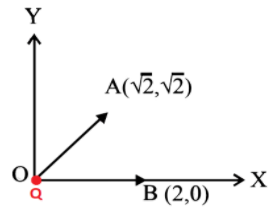
First, we need to find the distance between the charge and the points A and B respectively.
\[OA=\left| \overrightarrow{OA} \right|=\sqrt{{{\left( \sqrt{2} \right)}^{2}}+{{\left( \sqrt{2} \right)}^{2}}}=\sqrt{4}=2units\]
Similarly, for B
\[OB=\mid \overrightarrow{OB}\mid =\sqrt{{{(2)}^{2}}+{{(0)}^{2}}}=2units\]
Now potential at A will be
\[\begin{align}
& {{V}_{A}}=\dfrac{1}{4\pi {{\in }_{0}}}\cdot \dfrac{Q}{(OA)} \\
& \Rightarrow {{V}_{A}}=\dfrac{1}{4\pi {{\in }_{0}}}\cdot \dfrac{{{10}^{-3}}}{2} \\
\end{align}\]
And potential at B due to the point charge will be
\[\begin{align}
& {{V}_{B}}=\dfrac{1}{4\pi {{\in }_{0}}}\cdot \dfrac{Q}{(OB)} \\
& \Rightarrow {{V}_{B}}=\dfrac{1}{4\pi {{\in }_{0}}}\cdot \dfrac{{{10}^{-3}}}{2} \\
\end{align}\]
Now we need to find the potential difference between A and B. We know that the potential difference, \[{{V}_{A-B}}\], between points is given by
\[{{V}_{A-B}}={{V}_{A}}-{{V}_{B}}\]
Plugging in the calculated values
\[\begin{align}
& {{V}_{A-B}}={{V}_{A}}-{{V}_{B}} \\
& \Rightarrow {{V}_{A-B}}=\left( \dfrac{1}{4\pi {{\in }_{0}}}\cdot \dfrac{{{10}^{-3}}}{2} \right)-\left( \dfrac{1}{4\pi {{\in }_{0}}}\cdot \dfrac{{{10}^{-3}}}{2} \right) \\
& \Rightarrow {{V}_{A-B}}=0V \\
\end{align}\]
So, the potential difference between the points A and B will be 0Volts.
So, Option C is correct.
Note:
For point charges, every point that is at an equal distance from the charge has equal potential. In other words, Point charges have spherical equipotential surfaces. The potential difference between any two points on the equipotential surface is zero. As in the given question the points are equidistant from the charge they fall on the same equipotential surface and hence the potential difference between them would be zero.
Formula Used:
\[V=\dfrac{1}{4\pi {{\in }_{0}}}\cdot \dfrac{Q}{()}\]
\[{{V}_{A-B}}={{V}_{A}}-{{V}_{B}}\]
Complete answer:
The potential at any point in space due to a point charge is given by
\[V=\dfrac{1}{4\pi {{\in }_{0}}}\cdot \dfrac{Q}{()}\]
Where Q is the charge on the point charge and is the magnitude of the vector joining the charge and the point at which potential is to be found.
In the question, the magnitude and coordinates of the point charge are given. And the coordinates of points between whose potential difference is to be found is also given.
First, we need to find the distance between the charge and the points A and B respectively.
\[OA=\left| \overrightarrow{OA} \right|=\sqrt{{{\left( \sqrt{2} \right)}^{2}}+{{\left( \sqrt{2} \right)}^{2}}}=\sqrt{4}=2units\]
Similarly, for B
\[OB=\mid \overrightarrow{OB}\mid =\sqrt{{{(2)}^{2}}+{{(0)}^{2}}}=2units\]
Now potential at A will be
\[\begin{align}
& {{V}_{A}}=\dfrac{1}{4\pi {{\in }_{0}}}\cdot \dfrac{Q}{(OA)} \\
& \Rightarrow {{V}_{A}}=\dfrac{1}{4\pi {{\in }_{0}}}\cdot \dfrac{{{10}^{-3}}}{2} \\
\end{align}\]
And potential at B due to the point charge will be
\[\begin{align}
& {{V}_{B}}=\dfrac{1}{4\pi {{\in }_{0}}}\cdot \dfrac{Q}{(OB)} \\
& \Rightarrow {{V}_{B}}=\dfrac{1}{4\pi {{\in }_{0}}}\cdot \dfrac{{{10}^{-3}}}{2} \\
\end{align}\]
Now we need to find the potential difference between A and B. We know that the potential difference, \[{{V}_{A-B}}\], between points is given by
\[{{V}_{A-B}}={{V}_{A}}-{{V}_{B}}\]
Plugging in the calculated values
\[\begin{align}
& {{V}_{A-B}}={{V}_{A}}-{{V}_{B}} \\
& \Rightarrow {{V}_{A-B}}=\left( \dfrac{1}{4\pi {{\in }_{0}}}\cdot \dfrac{{{10}^{-3}}}{2} \right)-\left( \dfrac{1}{4\pi {{\in }_{0}}}\cdot \dfrac{{{10}^{-3}}}{2} \right) \\
& \Rightarrow {{V}_{A-B}}=0V \\
\end{align}\]
So, the potential difference between the points A and B will be 0Volts.
So, Option C is correct.
Note:
For point charges, every point that is at an equal distance from the charge has equal potential. In other words, Point charges have spherical equipotential surfaces. The potential difference between any two points on the equipotential surface is zero. As in the given question the points are equidistant from the charge they fall on the same equipotential surface and hence the potential difference between them would be zero.
Recently Updated Pages
Master Class 12 Economics: Engaging Questions & Answers for Success

Master Class 12 English: Engaging Questions & Answers for Success
Master Class 12 Social Science: Engaging Questions & Answers for Success
Master Class 12 Maths: Engaging Questions & Answers for Success
Master Class 12 Physics: Engaging Questions & Answers for Success
Master Class 9 General Knowledge: Engaging Questions & Answers for Success
Trending doubts
Which are the Top 10 Largest Countries of the World?
Draw a labelled sketch of the human eye class 12 physics CBSE
Differentiate between homogeneous and heterogeneous class 12 chemistry CBSE
Why is the cell called the structural and functional class 12 biology CBSE
Draw ray diagrams each showing i myopic eye and ii class 12 physics CBSE
Which is the correct genotypic ratio of mendel dihybrid class 12 biology CBSE