




An achromatic convergent doublet of two lenses contact has a power of \[ + {\mathbf{2D}}\] The convex lens has a power \[ + 5{\mathbf{D}}\] What is the ratio of dispersive powers of convergent and divergent lenses?
Answer
 Verified
495.9k+ views
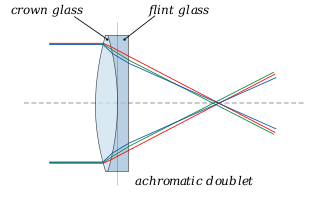
Hint: A convergent doublet of two lenses is nothing but a combination of a convex and a concave lens attached together with little or no optical distance between them. They are also called contact lenses. An image of one such example of contact lenses is shown below.
Complete step by step answer:
First, we must consider the fact that the combination of two lenses would give out the power of the combination as the algebraic sum of powers of individual lenses.
\[{\text{P }} = \sum {{P_i}} \]
Hence, the combination of a lens as shown above would result in the overall power being the sum of the convergent and divergent lenses. Let Pc be the power of the convergent or convex lens, which is given in the question as +5D and Pd be the power of the divergent or convex lens. Now as per the above equation, the power of the combination is given as:
\[{\text{P }} = {\text{ }}{{\text{P}}_{\mathbf{c}}} + {\text{ }}{{\text{P}}_{\mathbf{d}}}\]
Substituting the values given in the question, we get:
\[ + 2D{\text{ }} = {\text{ }} + 5D{\text{ }} + {\text{ }}{P_d}\]
\[{P_d} = {\text{ }}2D{\text{ }} - {\text{ }}5D{\text{ }} = {\text{ }} - 3D\]
Now, as per the question, we require the ratio of dispersive powers of convergent to that of divergent, which is given by:
\[\dfrac{{{\omega _1}}}{{{\omega _2}}} = \dfrac{{ - {f_1}}}{{ - {f_2}}} = \dfrac{{ - {P_2}}}{{ - {P_1}}}\] (Since \[f = \dfrac{1}{P}\] )
Therefore,
\[\dfrac{{{P_2}}}{{{P_1}}} = \dfrac{{ - {P_d}}}{{{P_c}}} = - \dfrac{{\left( { - 3} \right)}}{5} = 3:5\]
The ratio of dispersive powers of convergent and divergent is $3:5$.
Note:
The power of a lens is defined as the reciprocal of the focal length of the lens. An achromatic doublet is one of the most common optical structures. They are used to correct aberrations. Chromatic aberration is the effect produced by the refraction of different wavelengths of light through slightly different angles, resulting in a failure to focus.
Complete step by step answer:
First, we must consider the fact that the combination of two lenses would give out the power of the combination as the algebraic sum of powers of individual lenses.
\[{\text{P }} = \sum {{P_i}} \]
Hence, the combination of a lens as shown above would result in the overall power being the sum of the convergent and divergent lenses. Let Pc be the power of the convergent or convex lens, which is given in the question as +5D and Pd be the power of the divergent or convex lens. Now as per the above equation, the power of the combination is given as:
\[{\text{P }} = {\text{ }}{{\text{P}}_{\mathbf{c}}} + {\text{ }}{{\text{P}}_{\mathbf{d}}}\]
Substituting the values given in the question, we get:
\[ + 2D{\text{ }} = {\text{ }} + 5D{\text{ }} + {\text{ }}{P_d}\]
\[{P_d} = {\text{ }}2D{\text{ }} - {\text{ }}5D{\text{ }} = {\text{ }} - 3D\]
Now, as per the question, we require the ratio of dispersive powers of convergent to that of divergent, which is given by:
\[\dfrac{{{\omega _1}}}{{{\omega _2}}} = \dfrac{{ - {f_1}}}{{ - {f_2}}} = \dfrac{{ - {P_2}}}{{ - {P_1}}}\] (Since \[f = \dfrac{1}{P}\] )
Therefore,
\[\dfrac{{{P_2}}}{{{P_1}}} = \dfrac{{ - {P_d}}}{{{P_c}}} = - \dfrac{{\left( { - 3} \right)}}{5} = 3:5\]
The ratio of dispersive powers of convergent and divergent is $3:5$.
Note:
The power of a lens is defined as the reciprocal of the focal length of the lens. An achromatic doublet is one of the most common optical structures. They are used to correct aberrations. Chromatic aberration is the effect produced by the refraction of different wavelengths of light through slightly different angles, resulting in a failure to focus.
Recently Updated Pages
Master Class 12 Economics: Engaging Questions & Answers for Success

Master Class 12 Physics: Engaging Questions & Answers for Success
Master Class 12 English: Engaging Questions & Answers for Success
Master Class 12 Social Science: Engaging Questions & Answers for Success
Master Class 12 Maths: Engaging Questions & Answers for Success
Master Class 12 Business Studies: Engaging Questions & Answers for Success
Trending doubts
Which are the Top 10 Largest Countries of the World?
What are the major means of transport Explain each class 12 social science CBSE
Draw a labelled sketch of the human eye class 12 physics CBSE
What is a transformer Explain the principle construction class 12 physics CBSE
Why cannot DNA pass through cell membranes class 12 biology CBSE
Differentiate between insitu conservation and exsitu class 12 biology CBSE