




Among the following species, the most stable carbonium ion is:
A) ${C_6}{H_5}{C^+ }H{C_6}{H_5}$
B) ${C_6}{H_5}{C^+ }{H_2}$
C) $C{H_3}C{H_2}^+ $
D) ${C_6}{H_5}C{H_2}{C^+ }{H_2}$
Answer
 Verified
619.8k+ views
Hint:Carbocations are positively charged carbon atoms which have only six electrons in its outermost shell. When a heterocyclic fission of C-X bond in an organic molecule, generates negatively charged anion and positively charged species carbocation. Stability of carbocation increases when electron donating groups are present.
Complete answer:
The reason for the alkyl carbocation stability is simply as inductive stabilization of the positively charged carbon by its attached electron releasing alkyl substituents and by hyperconjugation or no bond resonance. And therefore in alkyl carbocation tertiary carbocations are more stable than secondary which is more stable than primary alkyl carbocation.
But the presence of electron withdrawing groups like nitro and carboxyl groups adjacent to carbon atoms bearing positive charge makes the carbocation less stable.
The resonance effect can further stabilize the carbocations. By resonance effect, positive charge on carbocation atoms gets displaced over other carbon atoms and hence give stability to the carbocation. The more canonical structures of carbocation, the more will be the stability.Here in question, in option C we have alkyl carbocation and there is no possibility of conjugation, hence alkyl carbocations are least stable.
Next we have option D. in this carbocation, the carbon bearing positive charge is alkyl, hence no possibility of resonance. Hence is less stable than aromatic carbocation.
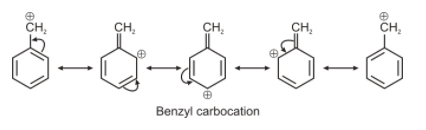
For option B. the carbon bearing positive charge is attached directly to the aromatic system. Hence resonance can occur and this carbocation will have 4 canonical structures. This carbocation is also known as benzyl carbocation.
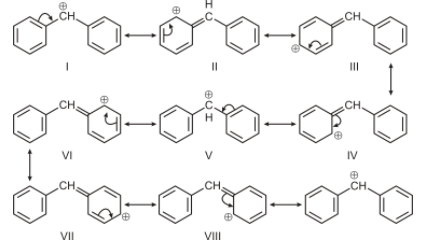
For option A, the carbon bearing positive charge is attached to 2 aromatic systems, therefore resonance will occur but since it has 2 benzene rings attached to the carbocation, hence it will have more canonical structure than the benzyl carbocation. Therefore it is most stable among all.
Hence the correct answer is option ‘A’.
Note:The carbocation stability also increases by the presence of heteroatoms having an unshared pair of electrons for example nitrogen, oxygen adjacent to the cation. Such carbocations are also stabilized by resonance. The triphenylmethyl carbocation is more stable than option A above, because it has 3 benzene rings, hence it will have more canonical structure.
Complete answer:
The reason for the alkyl carbocation stability is simply as inductive stabilization of the positively charged carbon by its attached electron releasing alkyl substituents and by hyperconjugation or no bond resonance. And therefore in alkyl carbocation tertiary carbocations are more stable than secondary which is more stable than primary alkyl carbocation.
But the presence of electron withdrawing groups like nitro and carboxyl groups adjacent to carbon atoms bearing positive charge makes the carbocation less stable.
The resonance effect can further stabilize the carbocations. By resonance effect, positive charge on carbocation atoms gets displaced over other carbon atoms and hence give stability to the carbocation. The more canonical structures of carbocation, the more will be the stability.Here in question, in option C we have alkyl carbocation and there is no possibility of conjugation, hence alkyl carbocations are least stable.
Next we have option D. in this carbocation, the carbon bearing positive charge is alkyl, hence no possibility of resonance. Hence is less stable than aromatic carbocation.
For option B. the carbon bearing positive charge is attached directly to the aromatic system. Hence resonance can occur and this carbocation will have 4 canonical structures. This carbocation is also known as benzyl carbocation.
For option A, the carbon bearing positive charge is attached to 2 aromatic systems, therefore resonance will occur but since it has 2 benzene rings attached to the carbocation, hence it will have more canonical structure than the benzyl carbocation. Therefore it is most stable among all.
Hence the correct answer is option ‘A’.
Note:The carbocation stability also increases by the presence of heteroatoms having an unshared pair of electrons for example nitrogen, oxygen adjacent to the cation. Such carbocations are also stabilized by resonance. The triphenylmethyl carbocation is more stable than option A above, because it has 3 benzene rings, hence it will have more canonical structure.
Recently Updated Pages
Basicity of sulphurous acid and sulphuric acid are

Master Class 12 Economics: Engaging Questions & Answers for Success
Master Class 12 Biology: Engaging Questions & Answers for Success
Master Class 11 English: Engaging Questions & Answers for Success
Master Class 11 Physics: Engaging Questions & Answers for Success
Master Class 11 Computer Science: Engaging Questions & Answers for Success
Trending doubts
Draw a labelled sketch of the human eye class 12 physics CBSE
The chemical formula of tear gas is A CO Cl 2 B C 10 class 12 chemistry CBSE
Draw ray diagrams each showing i myopic eye and ii class 12 physics CBSE
Which are the Top 10 Largest Countries of the World?
Differentiate between homogeneous and heterogeneous class 12 chemistry CBSE
Which is the correct genotypic ratio of mendel dihybrid class 12 biology CBSE