




Among the following metal carbonyls the $C - O$ bond order is lowest in
A. $[Mn{\left( {CO{)_6}} \right]^ + }$
B. $\left[ {{\text{Fe}}{{\left( {{\text{CO}}} \right)}_5}} \right]$
C. $\left[ {Cr{{\left( {CO} \right)}_6}} \right]$
D. ${\left[ {V\left( {CO} \right)6} \right]^ - }$
Answer
 Verified
592.2k+ views
Hint: We know that higher the strength of metal carbonyl, weaker the $C - O$ bond will be. We also know that $CO$ is a strong field ligand and this gives a lot of stability to the complexes.
Complete step by step answer:
(a) For $[Mn{\left( {CO{)_6}} \right]^ + }$ we know that the charge for Carbon monoxide $(CO)$ is zero.
Therefore, the charge for $Mn$ will be +1.
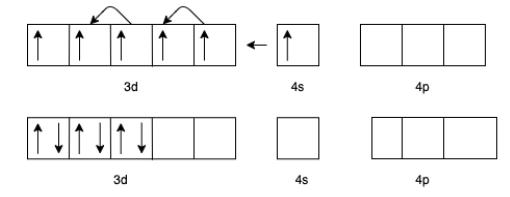
The electron configuration of $M{n^ + }$ will be $3{d^5}4{s^1}$
But in the presence of $CO$ the effective configuration will be $3{d^6}4{s^0}$. This gives us three lone pairs for back bonding with a vacant orbital of $C$ In $CO$.
(b) For $\left[ {{\text{Fe}}{{\left( {{\text{CO}}} \right)}_5}} \right]$ the charge of $Fe$ is zero.
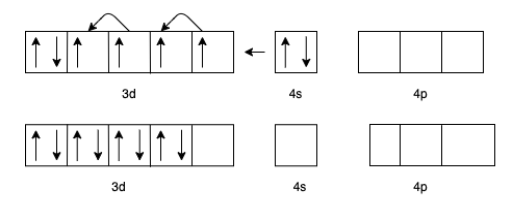
The electron configuration of $Fe$ will be $3{d^6}4{s^2}$
But in presence of $CO$ the effective configuration will be $3{d^8}$. This gives us 4 lone pairs for backing bonding with a vacant orbital of $C$ In $CO$.
(c) For $\left[ {Cr{{\left( {CO} \right)}_6}} \right]$ the charge of $Cr$ is zero.
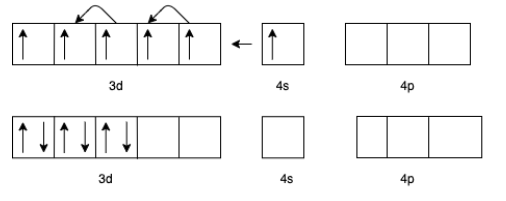
The electron configuration of $Cr$ will be $3{d^5}4{s^1}$
But in presence of $CO$ the effective configuration will be $3{d^6}$. This gives us 3 lone pair for backing bonding with a vacant orbital of $C$ In $CO$.
(d) For ${\left[ {V\left( {CO} \right)6} \right]^ - }$ we know that the charge for Carbon monoxide $(CO)$ is zero.
Therefore, the charge for $V$ will be -1.
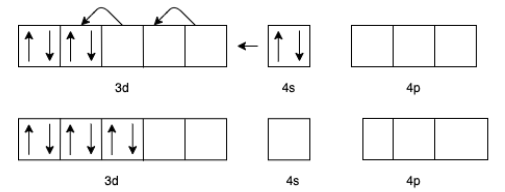
The electron configuration of ${V^ - }$ will be $3{d^4}4{s^2}$
But in presence of $CO$ the effective configuration will be $3{d^6}$. This gives us 3 lone pair for backing bonding with a vacant orbital of $C$ In $CO$.
From this we can observe that the $\left[ {{\text{Fe}}{{\left( {{\text{CO}}} \right)}_5}} \right]$ is having the maximum back bonding, hence the bond order will also be lowest for $\left[ {{\text{Fe}}{{\left( {{\text{CO}}} \right)}_5}} \right]$.
Note:
For solving this problem, we can use a shortcut also.
As we said that higher the strength of metal carbonyl, weaker the $C - O$ bond will be. From the options we can see that all of them has a coordination number of 6 except $\left[ {{\text{Fe}}{{\left( {{\text{CO}}} \right)}_5}} \right]$. In $\left[ {{\text{Fe}}{{\left( {{\text{CO}}} \right)}_5}} \right]$ we can see that the bond between $Fe$ and carbonyl group is distributed among 5 carbonyl group whereas the rest of them Is distributed among 6 carbonyl group. So the per bond strength of the $Fe$ will be greatest, which implies that $C - O$ bond will be weaker
Complete step by step answer:
(a) For $[Mn{\left( {CO{)_6}} \right]^ + }$ we know that the charge for Carbon monoxide $(CO)$ is zero.
Therefore, the charge for $Mn$ will be +1.
The electron configuration of $M{n^ + }$ will be $3{d^5}4{s^1}$
But in the presence of $CO$ the effective configuration will be $3{d^6}4{s^0}$. This gives us three lone pairs for back bonding with a vacant orbital of $C$ In $CO$.
(b) For $\left[ {{\text{Fe}}{{\left( {{\text{CO}}} \right)}_5}} \right]$ the charge of $Fe$ is zero.
The electron configuration of $Fe$ will be $3{d^6}4{s^2}$
But in presence of $CO$ the effective configuration will be $3{d^8}$. This gives us 4 lone pairs for backing bonding with a vacant orbital of $C$ In $CO$.
(c) For $\left[ {Cr{{\left( {CO} \right)}_6}} \right]$ the charge of $Cr$ is zero.
The electron configuration of $Cr$ will be $3{d^5}4{s^1}$
But in presence of $CO$ the effective configuration will be $3{d^6}$. This gives us 3 lone pair for backing bonding with a vacant orbital of $C$ In $CO$.
(d) For ${\left[ {V\left( {CO} \right)6} \right]^ - }$ we know that the charge for Carbon monoxide $(CO)$ is zero.
Therefore, the charge for $V$ will be -1.
The electron configuration of ${V^ - }$ will be $3{d^4}4{s^2}$
But in presence of $CO$ the effective configuration will be $3{d^6}$. This gives us 3 lone pair for backing bonding with a vacant orbital of $C$ In $CO$.
From this we can observe that the $\left[ {{\text{Fe}}{{\left( {{\text{CO}}} \right)}_5}} \right]$ is having the maximum back bonding, hence the bond order will also be lowest for $\left[ {{\text{Fe}}{{\left( {{\text{CO}}} \right)}_5}} \right]$.
Note:
For solving this problem, we can use a shortcut also.
As we said that higher the strength of metal carbonyl, weaker the $C - O$ bond will be. From the options we can see that all of them has a coordination number of 6 except $\left[ {{\text{Fe}}{{\left( {{\text{CO}}} \right)}_5}} \right]$. In $\left[ {{\text{Fe}}{{\left( {{\text{CO}}} \right)}_5}} \right]$ we can see that the bond between $Fe$ and carbonyl group is distributed among 5 carbonyl group whereas the rest of them Is distributed among 6 carbonyl group. So the per bond strength of the $Fe$ will be greatest, which implies that $C - O$ bond will be weaker
Recently Updated Pages
Three beakers labelled as A B and C each containing 25 mL of water were taken A small amount of NaOH anhydrous CuSO4 and NaCl were added to the beakers A B and C respectively It was observed that there was an increase in the temperature of the solutions contained in beakers A and B whereas in case of beaker C the temperature of the solution falls Which one of the following statements isarecorrect i In beakers A and B exothermic process has occurred ii In beakers A and B endothermic process has occurred iii In beaker C exothermic process has occurred iv In beaker C endothermic process has occurred

Master Class 12 Social Science: Engaging Questions & Answers for Success
Master Class 12 Physics: Engaging Questions & Answers for Success
Master Class 12 Maths: Engaging Questions & Answers for Success
Master Class 12 Economics: Engaging Questions & Answers for Success
Master Class 12 Chemistry: Engaging Questions & Answers for Success
Three beakers labelled as A B and C each containing 25 mL of water were taken A small amount of NaOH anhydrous CuSO4 and NaCl were added to the beakers A B and C respectively It was observed that there was an increase in the temperature of the solutions contained in beakers A and B whereas in case of beaker C the temperature of the solution falls Which one of the following statements isarecorrect i In beakers A and B exothermic process has occurred ii In beakers A and B endothermic process has occurred iii In beaker C exothermic process has occurred iv In beaker C endothermic process has occurred
Master Class 12 Social Science: Engaging Questions & Answers for Success
Master Class 12 Physics: Engaging Questions & Answers for Success
Trending doubts
Which are the Top 10 Largest Countries of the World?
Draw a labelled sketch of the human eye class 12 physics CBSE
Explain the structure of megasporangium class 12 biology CBSE
What are the major means of transport Explain each class 12 social science CBSE
Differentiate between homogeneous and heterogeneous class 12 chemistry CBSE
Sulphuric acid is known as the king of acids State class 12 chemistry CBSE