




Alveoli are present in
(a)Lungs
(b)Kidney
(c)Liver
(d)Brain
Answer
 Verified
653.7k+ views
Hint: This is a pair of spongy, air-filled organs located on either side of the chest (thorax). The trachea (windpipe) conducts inhaled air into this organ through its tubular branches, called bronchi. The bronchi then divides them into smaller and smaller branches (bronchioles), finally becoming microscopic.
Complete answer:
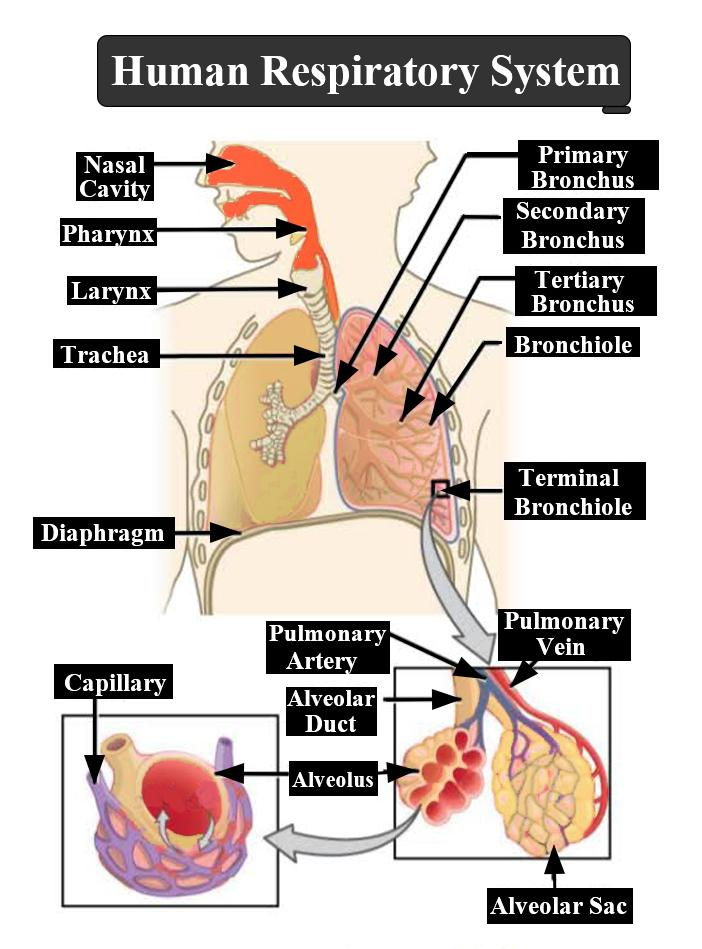
The alveoli are present in the lungs. They are branching from either alveolar sacs or alveolar ducts. Gaseous exchange of oxygen and carbon dioxide takes place in the alveoli. Oxygen which is inhaled from the air diffuses from the walls of the alveoli and enters the adjacent capillaries into the red blood cells. The oxygen is then carried by the blood to the various parts of the body tissues. Similarly, carbon dioxide diffuses into the wall of the alveoli and is exhaled out.
Additional Information: The respiratory system in a human being is a respiratory tract which starts at the nostril and ends at the alveoli. There are two parts of the respiratory tract: the conducting part and the respiratory part. Lungs communicate to the outside through a respiratory tract formed of nostrils, nasal chambers, pharynx, larynx, trachea, and primary bronchi. Lungs are soft, spongy, and very elastic pairs of organs present in the thoracic cavity. Each bronchus, after entering into the lung, terminates finally into alveoli or air sacs, which are the main structures of the lungs. There are about 750 million alveoli in both the lungs of man, which provide about 100 sq.m. surface area of respiration. Each alveolus is lined by a thin cover of flat cells of glandular epithelium, which is immediately surrounded by blood capillaries. The alveolar wall shows small alveolar pores. Lungs are well protected in the thoracic chamber bounded dorsally by the vertebral column, ventral by the sternum, laterally by ribs, and on the lower side by the diaphragm.
So, the correct answer is, ‘Lungs.’
Note: The function of the Respiratory System are:
-Inhalation and Exhalation Are Pulmonary Ventilation-That's Breathing.
-External Respiration Exchanges Gases between the Lungs and therefore the Bloodstream.
-Internal Respiration Exchanges Gases in between the Bloodstream and Body Tissues.
-Air vibrating the vocal cords produces sounds.
-The term lung disease refers to several disorders affecting the lungs, like asthma, COPD, infections like influenza, pneumonia and tuberculosis, lung cancer, and lots of other breathing problems. Some lung diseases can cause respiratory failure.
Complete answer:
The alveoli are present in the lungs. They are branching from either alveolar sacs or alveolar ducts. Gaseous exchange of oxygen and carbon dioxide takes place in the alveoli. Oxygen which is inhaled from the air diffuses from the walls of the alveoli and enters the adjacent capillaries into the red blood cells. The oxygen is then carried by the blood to the various parts of the body tissues. Similarly, carbon dioxide diffuses into the wall of the alveoli and is exhaled out.
Additional Information: The respiratory system in a human being is a respiratory tract which starts at the nostril and ends at the alveoli. There are two parts of the respiratory tract: the conducting part and the respiratory part. Lungs communicate to the outside through a respiratory tract formed of nostrils, nasal chambers, pharynx, larynx, trachea, and primary bronchi. Lungs are soft, spongy, and very elastic pairs of organs present in the thoracic cavity. Each bronchus, after entering into the lung, terminates finally into alveoli or air sacs, which are the main structures of the lungs. There are about 750 million alveoli in both the lungs of man, which provide about 100 sq.m. surface area of respiration. Each alveolus is lined by a thin cover of flat cells of glandular epithelium, which is immediately surrounded by blood capillaries. The alveolar wall shows small alveolar pores. Lungs are well protected in the thoracic chamber bounded dorsally by the vertebral column, ventral by the sternum, laterally by ribs, and on the lower side by the diaphragm.
So, the correct answer is, ‘Lungs.’
Note: The function of the Respiratory System are:
-Inhalation and Exhalation Are Pulmonary Ventilation-That's Breathing.
-External Respiration Exchanges Gases between the Lungs and therefore the Bloodstream.
-Internal Respiration Exchanges Gases in between the Bloodstream and Body Tissues.
-Air vibrating the vocal cords produces sounds.
-The term lung disease refers to several disorders affecting the lungs, like asthma, COPD, infections like influenza, pneumonia and tuberculosis, lung cancer, and lots of other breathing problems. Some lung diseases can cause respiratory failure.
Recently Updated Pages
If x a + bt + ct2 where x is in meters and t is in class 11 physics CBSE

A car covers the first half distance between two places class 11 physics CBSE
The resultant of two vectors overrightarrow P and overrightarrow class 11 physics CBSE
Find the value of cos 135 class 11 maths CBSE
A mass M is held in place by an applied force F and class 11 physics CBSE
A solution of glucose in water is labelled as 10 dfracwv class 11 chemistry CBSE
Trending doubts
Find the value of the expression given below sin 30circ class 11 maths CBSE
One Metric ton is equal to kg A 10000 B 1000 C 100 class 11 physics CBSE
Draw a diagram of nephron and explain its structur class 11 biology CBSE
10 examples of friction in our daily life
Proton was discovered by A Thomson B Rutherford C Chadwick class 11 chemistry CBSE
Bond order ofO2 O2+ O2 and O22 is in order A O2 langle class 11 chemistry CBSE