




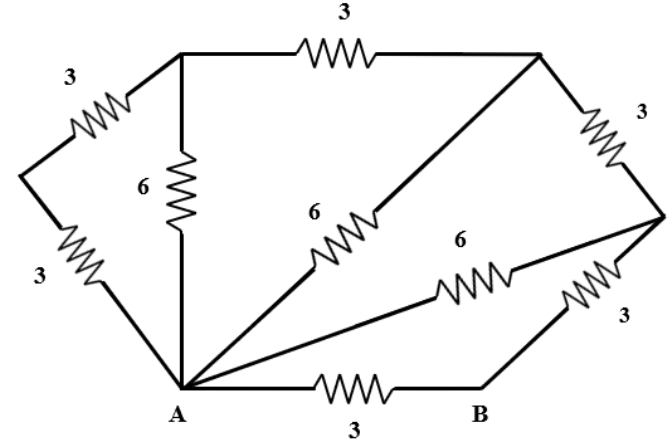
All the resistance in the figure is in ohms. The effective resistance between points A and B is
A. 6 ohms
B. 3 ohms
C. 9 ohms
D. 2 ohms
Answer
 Verified
606.3k+ views
Hint: To solve this problem, use the formula for equivalent resistance when resistors are connected in series and also the formula for equivalent resistance when resistors are connected in parallel. Find the equivalent resistance of the first network then combine it with resistance of another network. Find the equivalent resistance of both the networks combined. Similarly, find the equivalent resistance of each network and find the effective resistance between points A and B.
Formula used:
$ \dfrac {1}{{R}_{eq}}= \dfrac {1} {{R}_{1}} + \dfrac {1}{{R}_{2}}+ \dfrac {1}{{R}_{3}}+ …+\dfrac {1}{{R}_{N}}$
${R}_{eq}= {R}_{1}+{R}_{2}+{R}_{3}+…+{R}_{N}$
Complete step-by-step solution:
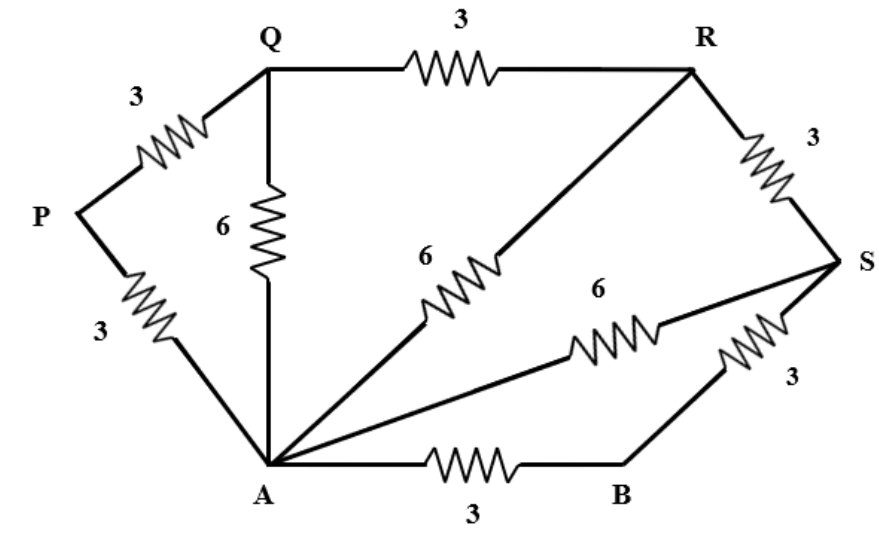
In the above labelled diagram, we can see the resistors AP and PQ are in series. So, their equivalent resistance will be,
${R}_{eq1}= 3 + 3$
$\Rightarrow {R}_{eq1}= 6\Omega$
Now, the ${R}_{eq1}$ connected in parallel with the resistor AQ. So, their equivalent resistance is given by,
$\dfrac {1}{{R}_{eq2}}= \dfrac {1}{{R}_{eq1}}+ \dfrac {1}{{R}_{AQ}}$
Substituting values in above equation we get,
$\dfrac {1}{{R}_{eq2}}= \dfrac {1}{6}+ \dfrac {1}{6}$
$\Rightarrow \dfrac {1}{{R}_{eq2}}=\dfrac {12}{36}$
$\Rightarrow {R}_{eq2}= \dfrac {36}{12}$
$\Rightarrow {R}_{eq2}= 3\Omega$
Now, ${R}_{eq2}$ is in series with the resistor QR. So, their equivalent resistance is given by,
${R}_{eq3}= {R}_{eq2}+ {R}_{QR}$
Substituting the values in above equation we get,
${R}_{eq3}= 3 + 3$
$\Rightarrow {R}_{eq3}= 6\Omega$
Now, the ${R}_{eq3}$ connected in parallel with the resistor AR. So, their equivalent resistance is given by,
$\dfrac {1}{{R}_{eq4}}= \dfrac {1}{{R}_{eq3}}+ \dfrac {1}{{R}_{AR}}$
Substituting values in above equation we get,
$\dfrac {1}{{R}_{eq4}}= \dfrac {1}{6}+ \dfrac {1}{6}$
$\Rightarrow \dfrac {1}{{R}_{eq4}}=\dfrac {12}{36}$
$\Rightarrow {R}_{eq4}= \dfrac {36}{12}$
$\Rightarrow {R}_{eq4}= 3\Omega$
Now, ${R}_{eq4}$ is in series with the resistor RS. So, their equivalent resistance is given by,
${R}_{eq5}= {R}_{eq4}+ {R}_{RS}$
Substituting the values in above equation we get,
${R}_{eq5}= 3 + 3$
$\Rightarrow {R}_{eq5}= 6\Omega$
Now, the ${R}_{eq5}$ connected in parallel with the resistor AS. So, their equivalent resistance is given by,
$\dfrac {1}{{R}_{eq6}}= \dfrac {1}{{R}_{eq5}}+ \dfrac {1}{{R}_{AS}}$
Substituting values in above equation we get,
$\dfrac {1}{{R}_{eq6}}= \dfrac {1}{6}+ \dfrac {1}{6}$
$\Rightarrow \dfrac {1}{{R}_{eq6}}=\dfrac {12}{36}$
$\Rightarrow {R}_{eq6}= \dfrac {36}{12}$
$\Rightarrow {R}_{eq6}= 3\Omega$
Now, ${R}_{eq6}$ is in series with the resistor SB. So, their equivalent resistance is given by,
${R}_{eq7}= {R}_{eq6}+ {R}_{SB}$
Substituting the values in above equation we get,
${R}_{eq7}= 3 + 3$
$\Rightarrow {R}_{eq7}= 6\Omega$
Now, the ${R}_{eq7}$ connected in parallel with the resistor AB. So, their equivalent resistance is given by,
$\dfrac {1}{{R}_{eq8}}= \dfrac {1}{{R}_{eq7}}+ \dfrac {1}{{R}_{AB}}$
Substituting values in above equation we get,
$\dfrac {1}{{R}_{eq8}}= \dfrac {1}{6}+ \dfrac {1}{3}$
$\Rightarrow \dfrac {1}{{R}_{eq8}}=\dfrac {9}{18}$
$\Rightarrow {R}_{eq8}= \dfrac {18}{9}$
$\Rightarrow {R}_{eq8}= 2\Omega$
Hence, the effective resistance between points A and B is 2 ohms. So, the correct answer is option D i.e. 2 ohms.
Note: Students should remember that the equivalent resistance of a combination is always less than the smallest resistance in the parallel network. As we add more resistors in the network, the total resistance of the circuit will always decrease. While, in a series network, the equivalent resistance of the network is greater than the value of the largest resistor in the chain. The current flowing through each parallel branch may not be the same. But the voltage across each resistor in a parallel network is always the same.
Formula used:
$ \dfrac {1}{{R}_{eq}}= \dfrac {1} {{R}_{1}} + \dfrac {1}{{R}_{2}}+ \dfrac {1}{{R}_{3}}+ …+\dfrac {1}{{R}_{N}}$
${R}_{eq}= {R}_{1}+{R}_{2}+{R}_{3}+…+{R}_{N}$
Complete step-by-step solution:
In the above labelled diagram, we can see the resistors AP and PQ are in series. So, their equivalent resistance will be,
${R}_{eq1}= 3 + 3$
$\Rightarrow {R}_{eq1}= 6\Omega$
Now, the ${R}_{eq1}$ connected in parallel with the resistor AQ. So, their equivalent resistance is given by,
$\dfrac {1}{{R}_{eq2}}= \dfrac {1}{{R}_{eq1}}+ \dfrac {1}{{R}_{AQ}}$
Substituting values in above equation we get,
$\dfrac {1}{{R}_{eq2}}= \dfrac {1}{6}+ \dfrac {1}{6}$
$\Rightarrow \dfrac {1}{{R}_{eq2}}=\dfrac {12}{36}$
$\Rightarrow {R}_{eq2}= \dfrac {36}{12}$
$\Rightarrow {R}_{eq2}= 3\Omega$
Now, ${R}_{eq2}$ is in series with the resistor QR. So, their equivalent resistance is given by,
${R}_{eq3}= {R}_{eq2}+ {R}_{QR}$
Substituting the values in above equation we get,
${R}_{eq3}= 3 + 3$
$\Rightarrow {R}_{eq3}= 6\Omega$
Now, the ${R}_{eq3}$ connected in parallel with the resistor AR. So, their equivalent resistance is given by,
$\dfrac {1}{{R}_{eq4}}= \dfrac {1}{{R}_{eq3}}+ \dfrac {1}{{R}_{AR}}$
Substituting values in above equation we get,
$\dfrac {1}{{R}_{eq4}}= \dfrac {1}{6}+ \dfrac {1}{6}$
$\Rightarrow \dfrac {1}{{R}_{eq4}}=\dfrac {12}{36}$
$\Rightarrow {R}_{eq4}= \dfrac {36}{12}$
$\Rightarrow {R}_{eq4}= 3\Omega$
Now, ${R}_{eq4}$ is in series with the resistor RS. So, their equivalent resistance is given by,
${R}_{eq5}= {R}_{eq4}+ {R}_{RS}$
Substituting the values in above equation we get,
${R}_{eq5}= 3 + 3$
$\Rightarrow {R}_{eq5}= 6\Omega$
Now, the ${R}_{eq5}$ connected in parallel with the resistor AS. So, their equivalent resistance is given by,
$\dfrac {1}{{R}_{eq6}}= \dfrac {1}{{R}_{eq5}}+ \dfrac {1}{{R}_{AS}}$
Substituting values in above equation we get,
$\dfrac {1}{{R}_{eq6}}= \dfrac {1}{6}+ \dfrac {1}{6}$
$\Rightarrow \dfrac {1}{{R}_{eq6}}=\dfrac {12}{36}$
$\Rightarrow {R}_{eq6}= \dfrac {36}{12}$
$\Rightarrow {R}_{eq6}= 3\Omega$
Now, ${R}_{eq6}$ is in series with the resistor SB. So, their equivalent resistance is given by,
${R}_{eq7}= {R}_{eq6}+ {R}_{SB}$
Substituting the values in above equation we get,
${R}_{eq7}= 3 + 3$
$\Rightarrow {R}_{eq7}= 6\Omega$
Now, the ${R}_{eq7}$ connected in parallel with the resistor AB. So, their equivalent resistance is given by,
$\dfrac {1}{{R}_{eq8}}= \dfrac {1}{{R}_{eq7}}+ \dfrac {1}{{R}_{AB}}$
Substituting values in above equation we get,
$\dfrac {1}{{R}_{eq8}}= \dfrac {1}{6}+ \dfrac {1}{3}$
$\Rightarrow \dfrac {1}{{R}_{eq8}}=\dfrac {9}{18}$
$\Rightarrow {R}_{eq8}= \dfrac {18}{9}$
$\Rightarrow {R}_{eq8}= 2\Omega$
Hence, the effective resistance between points A and B is 2 ohms. So, the correct answer is option D i.e. 2 ohms.
Note: Students should remember that the equivalent resistance of a combination is always less than the smallest resistance in the parallel network. As we add more resistors in the network, the total resistance of the circuit will always decrease. While, in a series network, the equivalent resistance of the network is greater than the value of the largest resistor in the chain. The current flowing through each parallel branch may not be the same. But the voltage across each resistor in a parallel network is always the same.
Recently Updated Pages
Master Class 12 Business Studies: Engaging Questions & Answers for Success

Master Class 12 Chemistry: Engaging Questions & Answers for Success
Master Class 12 Biology: Engaging Questions & Answers for Success
Class 12 Question and Answer - Your Ultimate Solutions Guide
Master Class 11 Social Science: Engaging Questions & Answers for Success
Master Class 11 Chemistry: Engaging Questions & Answers for Success
Trending doubts
Which are the Top 10 Largest Countries of the World?
Draw a labelled sketch of the human eye class 12 physics CBSE
Name the crygenes that control cotton bollworm and class 12 biology CBSE
Differentiate between homogeneous and heterogeneous class 12 chemistry CBSE
How many molecules of ATP and NADPH are required information class 12 biology CBSE
In a transcription unit the promoter is said to be class 12 biology CBSE