




All protozoans have
A. Pseudopodia
B. Eukaryotic organisation
C. Contractile vacuole
D. Holozoic nutrition
Answer
 Verified
598.5k+ views
Hint:- One or more cells are made of all living organisms. All living cells can be split into two classes on the basis of the arrangement of their cellular structures: prokaryotic and eukaryotic (also called prokaryotic & eukaryotic).
Complete answer:
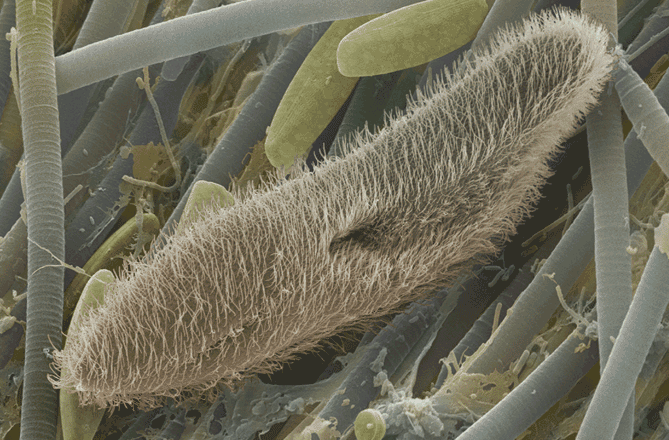
Living organisms defined as protozoa include a large variety of organisms, most of which are single-celled eukaryotes that are free-living. Therefore, protozoa are part of the Eukarya Domain. Although the distinct phyla of the Protista kingdom are not closely related, due to their wide differences from the other kingdoms of plants, animals and fungi, they are still grouped together. The word "protozoa" has a complex history, involving only the "animal-like" single-celled forms of life at one time. These heterotrophic protozoa, along with the autotrophic algae and other basic life forms, are now lumped into the Protista Kingdom. While all protozoa are eukaryotes, not all of them replicate with the typical mitosis model seen in higher cells of animals. Many have complex cellular division, on a larger scale, that resembles binary fission in bacteria. Some phyla are autotrophic cells in the Kingdom Protista, which contain chloroplasts that can generate sugars from sunlight.
Hence, Option B is the right answer.
Additional Information:
In Eukaryotic cell:
a. A nuclear membrane with pores linking it to the endoplasmic reticulum borders the nuclear body.
b. It comprises one or more paired, linear chromosomes composed of histone protein-associated deoxyribonucleic acid (DNA).
c. There is a nucleolus present. Ribosomal RNA (rRNA) in the nucleolus is transcribed and assembled.
d. A nucleus is called the nuclear body.
Note:- While protozoa have traditionally been known to be only heterotrophic species, this article will present many of the phyla within Protista that can photosynthesize sugars.
Complete answer:
Living organisms defined as protozoa include a large variety of organisms, most of which are single-celled eukaryotes that are free-living. Therefore, protozoa are part of the Eukarya Domain. Although the distinct phyla of the Protista kingdom are not closely related, due to their wide differences from the other kingdoms of plants, animals and fungi, they are still grouped together. The word "protozoa" has a complex history, involving only the "animal-like" single-celled forms of life at one time. These heterotrophic protozoa, along with the autotrophic algae and other basic life forms, are now lumped into the Protista Kingdom. While all protozoa are eukaryotes, not all of them replicate with the typical mitosis model seen in higher cells of animals. Many have complex cellular division, on a larger scale, that resembles binary fission in bacteria. Some phyla are autotrophic cells in the Kingdom Protista, which contain chloroplasts that can generate sugars from sunlight.
Hence, Option B is the right answer.
Additional Information:
In Eukaryotic cell:
a. A nuclear membrane with pores linking it to the endoplasmic reticulum borders the nuclear body.
b. It comprises one or more paired, linear chromosomes composed of histone protein-associated deoxyribonucleic acid (DNA).
c. There is a nucleolus present. Ribosomal RNA (rRNA) in the nucleolus is transcribed and assembled.
d. A nucleus is called the nuclear body.
Note:- While protozoa have traditionally been known to be only heterotrophic species, this article will present many of the phyla within Protista that can photosynthesize sugars.
Recently Updated Pages
Master Class 12 Business Studies: Engaging Questions & Answers for Success

Master Class 12 Biology: Engaging Questions & Answers for Success
Master Class 12 Chemistry: Engaging Questions & Answers for Success
Class 12 Question and Answer - Your Ultimate Solutions Guide
Master Class 11 Social Science: Engaging Questions & Answers for Success
Master Class 11 English: Engaging Questions & Answers for Success
Trending doubts
Which are the Top 10 Largest Countries of the World?
Draw a labelled sketch of the human eye class 12 physics CBSE
Differentiate between homogeneous and heterogeneous class 12 chemistry CBSE
Sulphuric acid is known as the king of acids State class 12 chemistry CBSE
Why is the cell called the structural and functional class 12 biology CBSE
Which is the correct genotypic ratio of mendel dihybrid class 12 biology CBSE