




Algal bloom results in
(a)Global warming
(b)Salinization
(c)Eutrophication
(d)Biomagnification
Answer
 Verified
613.8k+ views
Hint: An algal bloom or marine bloom or water bloom in an aquatic system represents a rapid increase in the algae population. Algal blooms are the result of enrichment of a nutrient-rich water body, usually with excess nutrients, thus causing dense algae growth.
Complete answer:
The excess accumulation of nutrients in water is termed eutrophication. Eutrophication is the process of aging the water body by building up the substratum as the organic mass increases due to the gradual deaths of the aquatic animals. However, releasing fertilizers from the agricultural run-off has accelerated this process by causing the algal bloom and increasing the rate of decomposition by the bacteria of the resulting organic mass. Excessive use of the dissolved oxygen occurs and there is no mixing of the atmospheric oxygen due to the thick layer of the growth of the algals. As a result, aquatic animals are dying rapidly.
Additional Information: Algal blooms are likely to grow and proliferate due to the combination of environmental factors, including available nutrients such as temperature, ecosystem disturbance (Examples are stable / mixing conditions, turbidity), sunlight, hydrology, and water chemistry (pH, conductivity, salinity, carbon availability).
So, the correct answer is, ‘Eutrophication’.
Note: Algal blooms can occur in both the freshwater and marine ecosystems. Usually, only one or a few species of phytoplankton are involved and some blooms can be identified by water discoloration resulting from the high density of pigmented cells. While there is no officially accepted threshold stage, algae, depending on the causative organisms, can be considered to grow at concentrations of hundreds to thousands of cells per milliliter.
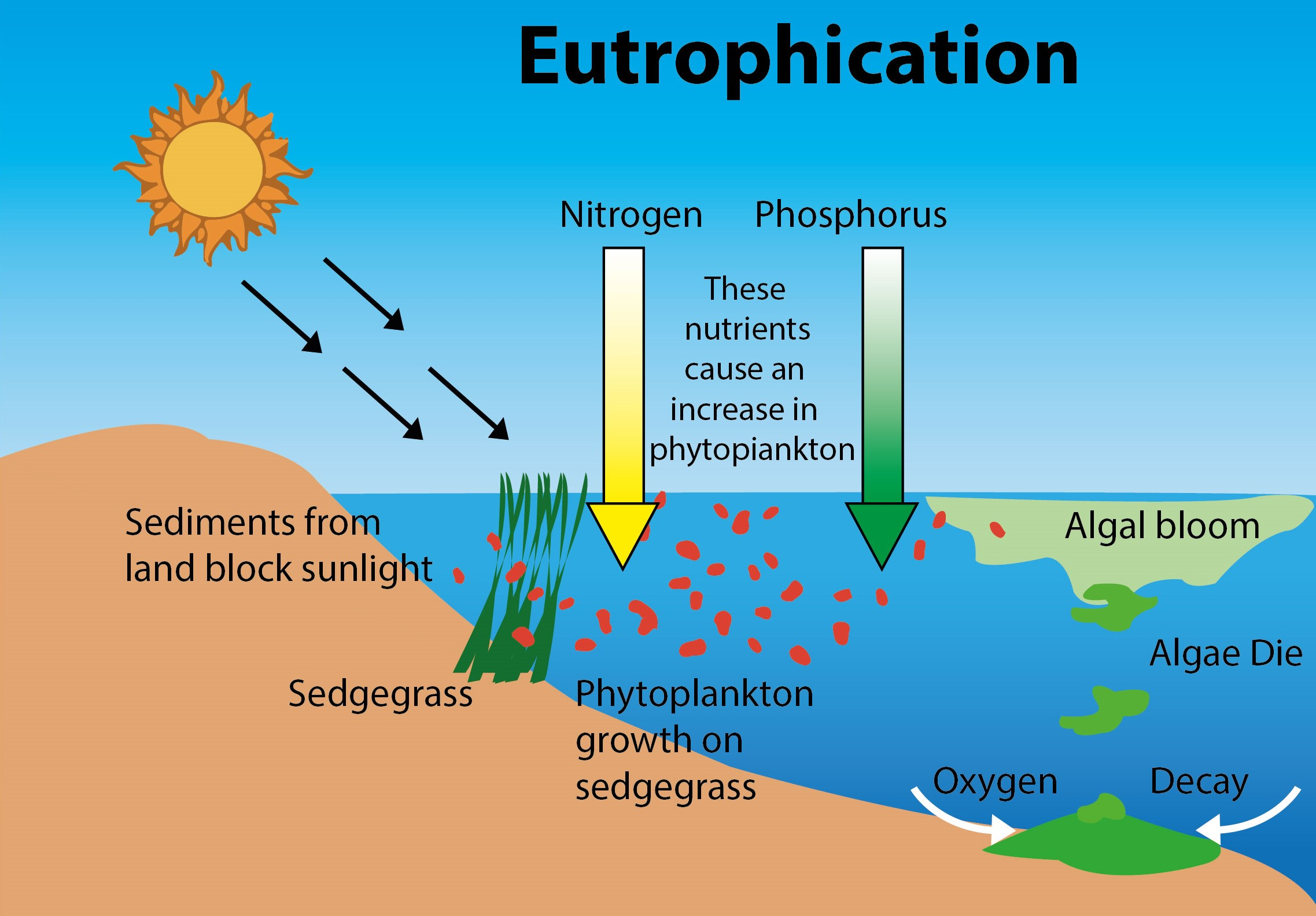
Complete answer:
The excess accumulation of nutrients in water is termed eutrophication. Eutrophication is the process of aging the water body by building up the substratum as the organic mass increases due to the gradual deaths of the aquatic animals. However, releasing fertilizers from the agricultural run-off has accelerated this process by causing the algal bloom and increasing the rate of decomposition by the bacteria of the resulting organic mass. Excessive use of the dissolved oxygen occurs and there is no mixing of the atmospheric oxygen due to the thick layer of the growth of the algals. As a result, aquatic animals are dying rapidly.
Additional Information: Algal blooms are likely to grow and proliferate due to the combination of environmental factors, including available nutrients such as temperature, ecosystem disturbance (Examples are stable / mixing conditions, turbidity), sunlight, hydrology, and water chemistry (pH, conductivity, salinity, carbon availability).
So, the correct answer is, ‘Eutrophication’.
Note: Algal blooms can occur in both the freshwater and marine ecosystems. Usually, only one or a few species of phytoplankton are involved and some blooms can be identified by water discoloration resulting from the high density of pigmented cells. While there is no officially accepted threshold stage, algae, depending on the causative organisms, can be considered to grow at concentrations of hundreds to thousands of cells per milliliter.
Recently Updated Pages
Master Class 12 Business Studies: Engaging Questions & Answers for Success

Master Class 12 Biology: Engaging Questions & Answers for Success
Master Class 12 Chemistry: Engaging Questions & Answers for Success
Class 12 Question and Answer - Your Ultimate Solutions Guide
Master Class 11 Social Science: Engaging Questions & Answers for Success
Master Class 11 English: Engaging Questions & Answers for Success
Trending doubts
Which are the Top 10 Largest Countries of the World?
Draw a labelled sketch of the human eye class 12 physics CBSE
Differentiate between homogeneous and heterogeneous class 12 chemistry CBSE
Sulphuric acid is known as the king of acids State class 12 chemistry CBSE
Why is the cell called the structural and functional class 12 biology CBSE
Which is the correct genotypic ratio of mendel dihybrid class 12 biology CBSE