



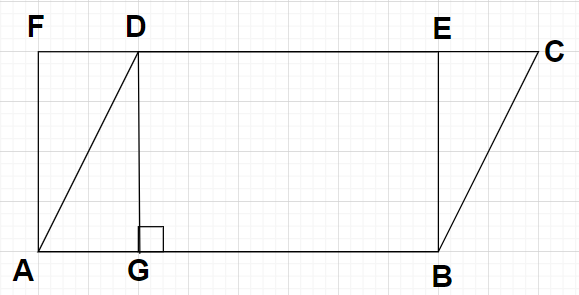
ABCD is a parallelogram and ABEF is a rectangle and DG is perpendicular on AB.
Prove that
$\left( {\text{i}} \right)$ ar(ABCD) = ar(ABEF)
$\left( {{\text{ii}}} \right)$ ar(ABCD) = AB$ \times $DG
Answer
 Verified
650.4k+ views
Hint: Here, we will proceed by using the concept that a rectangle is a special case of parallelogram having pairs of opposite sides equal. After that we will apply the concept that the areas of the two parallelograms having equal height and between the same parallels are always equal.
Complete step-by-step answer:
As shown in the figure, ABCD is a parallelogram with side AB parallel to side CD and side BC parallel to AD.
Also given that ABEF is a rectangle with AB = EF and BE = AF
$\left( {\text{i}} \right)$ To prove: ar(ABCD) = ar(ABEF)
Rectangle is also a parallelogram having the pair of opposite sides equal. So, ABEF is also a parallelogram.
As we know that the areas of the two parallelograms having equal height and between the same parallels are always equal.
Since, the height of both the parallelograms i.e., ABCD and ABEF are equal and they are between the same parallels i.e., AB and FC. So, the areas of both these parallelograms will be equal.
Therefore, Area of ABCD = Area of ABEF i.e., ar(ABCD) = ar(ABEF) $ \to \left( 1 \right)$
The above equation is the same equation which we needed to prove.
$\left( {{\text{ii}}} \right)$ To prove: ar(ABCD) = AB$ \times $DG
As we know that the area of any rectangle is given by
Area of the rectangle = (Length of the rectangle)$ \times $(Breadth of the rectangle)
Using the above formula, we have
Area of rectangle ABEF = (AB)$ \times $(BE) $ \to \left( 2 \right)$
Clearly from the figure, we can write
BE = DG$ \to \left( 3 \right)$
Using equations (1) and (3) in equation (2), we get
ar(ABCD) = AB$ \times $DG
The above equation is the same equation which we needed to prove.
Note: In this particular problem, in parallelogram ABCD, AB$\parallel $FC and in rectangle ABEF, again AB$\parallel $FC. Also, the interior angles of rectangle ABEF at the vertices are all equal to ${90^0}$ and also, DG is a perpendicular to the length AB so $\angle {\text{DGE}} = {90^0}$, that’s why we have written that the side BE is equal to side DG i.e., BE = DG.
Complete step-by-step answer:
As shown in the figure, ABCD is a parallelogram with side AB parallel to side CD and side BC parallel to AD.
Also given that ABEF is a rectangle with AB = EF and BE = AF
$\left( {\text{i}} \right)$ To prove: ar(ABCD) = ar(ABEF)
Rectangle is also a parallelogram having the pair of opposite sides equal. So, ABEF is also a parallelogram.
As we know that the areas of the two parallelograms having equal height and between the same parallels are always equal.
Since, the height of both the parallelograms i.e., ABCD and ABEF are equal and they are between the same parallels i.e., AB and FC. So, the areas of both these parallelograms will be equal.
Therefore, Area of ABCD = Area of ABEF i.e., ar(ABCD) = ar(ABEF) $ \to \left( 1 \right)$
The above equation is the same equation which we needed to prove.
$\left( {{\text{ii}}} \right)$ To prove: ar(ABCD) = AB$ \times $DG
As we know that the area of any rectangle is given by
Area of the rectangle = (Length of the rectangle)$ \times $(Breadth of the rectangle)
Using the above formula, we have
Area of rectangle ABEF = (AB)$ \times $(BE) $ \to \left( 2 \right)$
Clearly from the figure, we can write
BE = DG$ \to \left( 3 \right)$
Using equations (1) and (3) in equation (2), we get
ar(ABCD) = AB$ \times $DG
The above equation is the same equation which we needed to prove.
Note: In this particular problem, in parallelogram ABCD, AB$\parallel $FC and in rectangle ABEF, again AB$\parallel $FC. Also, the interior angles of rectangle ABEF at the vertices are all equal to ${90^0}$ and also, DG is a perpendicular to the length AB so $\angle {\text{DGE}} = {90^0}$, that’s why we have written that the side BE is equal to side DG i.e., BE = DG.
Recently Updated Pages
Master Class 11 English: Engaging Questions & Answers for Success

Master Class 11 Social Science: Engaging Questions & Answers for Success
Master Class 11 Maths: Engaging Questions & Answers for Success
Master Class 11 Chemistry: Engaging Questions & Answers for Success
Master Class 11 Biology: Engaging Questions & Answers for Success
Master Class 11 Physics: Engaging Questions & Answers for Success
Trending doubts
Find the sum of series 1 + 2 + 3 + 4 + 5 + + 100 class 9 maths CBSE
Difference Between Plant Cell and Animal Cell
Fill the blanks with the suitable prepositions 1 The class 9 english CBSE
What is pollution? How many types of pollution? Define it
What is the Full Form of ICSE / ISC ?
Name 10 Living and Non living things class 9 biology CBSE