




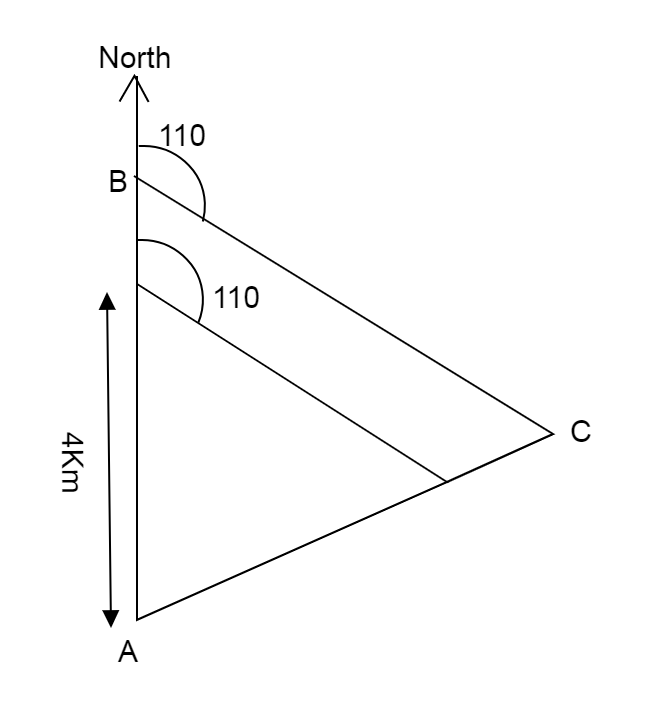
AB = BC = 6Km. Junior students follow a similar path but they only walk 4Km North from A, then 4Km on a bearing \[{110^ \circ }\]before returning to A.
Senior students walk to a total of 18.9Km
Calculate the distance walked by junior students.
Answer
 Verified
620.1k+ views
Hint: Since the bigger triangle represents the path covered by senior students and the smaller triangle represents the path covered by junior students. We use the given sides of the triangle given and the total distance covered by senior students to calculate the missing side of the triangle. Use the exterior angle property to calculate the opposite angles along with the property of isosceles triangle in smaller triangles. Now we calculate the length of the third side using sine law.
* Exterior angle of a triangle is equal to the sum of opposite interior angles of the triangle.
* Law of sine states that in a triangle ABC the ratio of side of a triangle to the sine of opposite angle is same for all the sides of the triangle, i.e. if side a has opposite angle A, side b has opposite angle B and side c has opposite angle C, then we can write \[\dfrac{a}{{\sin A}} = \dfrac{b}{{\sin B}} = \dfrac{c}{{\sin C}} = k\]where k is some constant term.
* Isosceles triangle has two sides of equal length and the angles opposite to equal sides are equal in measure.
Complete step by step answer:
We firstly name the third point of the smaller triangle formed as D
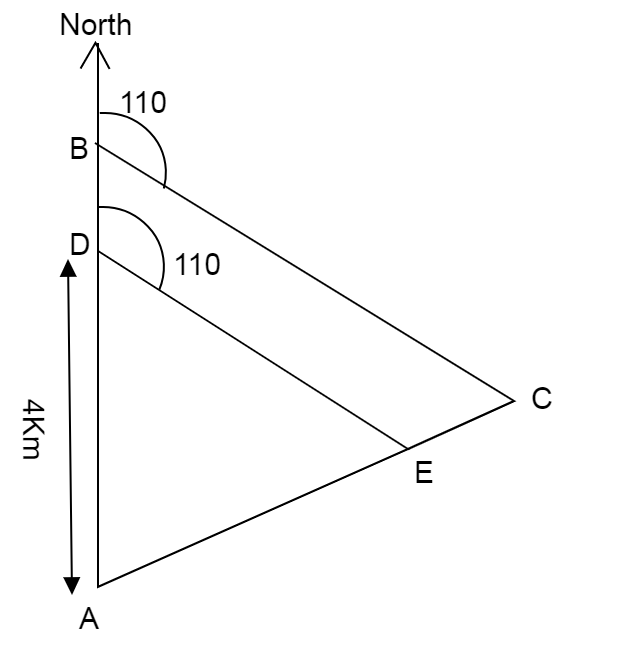
We are given that senior students travel from A to B and then B to C and back from C to A.
So the total distance covered by senior students is perimeter of triangle ABC.
We are given \[AB = BC = 6\]Km and the total distance covered by senior students is 18.9Km
\[ \Rightarrow \]Perimeter of \[\vartriangle ABC = 18.9\]
Now we apply the formula of perimeter of triangle i.e. sum of all three sides of triangle.
\[ \Rightarrow AB + BC + CA = 18.9\]
Substitute the values of\[AB = BC = 6\]
\[ \Rightarrow 6 + 6 + CA = 18.9\]
Shift all constant values to RHS
\[ \Rightarrow CA = 18.9 - 12\]
\[ \Rightarrow CA = 6.9\]Km … (1)
We are given that junior students travel from A to D and then D to E and back from E to A.
So the total distance covered by senior students is the perimeter of triangle ADE.
We are given junior students follow a similar path but 4Km to north and then 4Km after turning \[{110^ \circ }\].
i.e. \[AD = DE = 4\]Km
\[ \Rightarrow \]Perimeter of \[\vartriangle ADE = AD + DE + EA\]
Substitute the values of\[AD = DE = 4\]
\[ \Rightarrow \]Perimeter of \[\vartriangle ADE = 4 + 4 + EA\]
\[ \Rightarrow \]Perimeter of \[\vartriangle ADE = 8 + EA\] … (2)
Now we know \[\angle BDE\]is an exterior angle of \[\vartriangle ADE\].
Apply property of exterior angles to the \[\angle BDE\]
\[ \Rightarrow \angle BDE = \angle AED + \angle DAE\]
Substitute the value of \[\angle BDE = {110^ \circ }\]
\[ \Rightarrow {110^ \circ } = \angle AED + \angle DAE\]
Now we know \[\vartriangle ADE\]is an isosceles triangle since two sides are equal in length, then the opposite angles to equal sides will be equal i.e. \[\angle AED = \angle DAE\]
\[ \Rightarrow {110^ \circ } = \angle AED + \angle AED\]
\[ \Rightarrow {110^ \circ } = 2\angle AED\]
Divide both sides by 2
\[ \Rightarrow \dfrac{{{{110}^ \circ }}}{2} = \dfrac{{2\angle AED}}{2}\]
Cancel same factors from numerator and denominator on both sides of the equation
\[ \Rightarrow {55^ \circ } = \angle AED\]
Then \[\angle AED = \angle DAE = {55^ \circ }\]
Since \[\angle ADE,\angle EDB\]are supplementary angles then their sum should be equal to\[{180^ \circ }\].
\[ \Rightarrow \angle ADE + \angle BDE = {180^ \circ }\]
Substitute the value of \[\angle BDE = {110^ \circ }\]
\[ \Rightarrow \angle ADE + {110^ \circ } = {180^ \circ }\]
Shift all constant values to RHS of the equation
\[ \Rightarrow \angle ADE = {180^ \circ } - {110^ \circ }\]
\[ \Rightarrow \angle ADE = {70^ \circ }\] … (3)
Now we draw the triangle ADE with all its dimensions
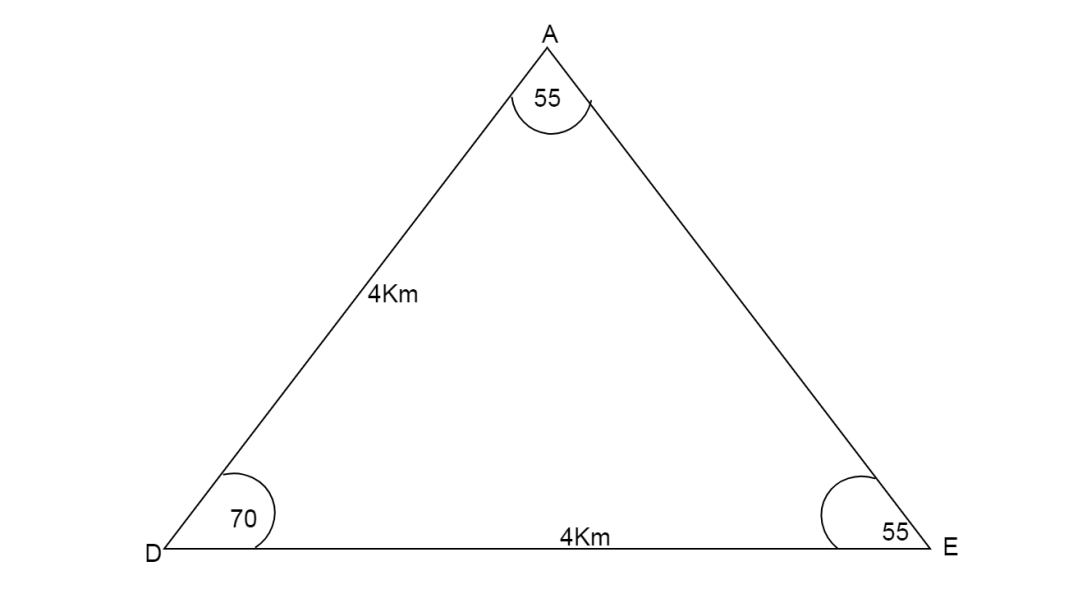
Now we apply sine rule in triangle ABD,
\[\dfrac{{AD}}{{\sin E}} = \dfrac{{DE}}{{\sin A}} = \dfrac{{EA}}{{\sin D}}\]
Substitute the values of sides and angles.
\[ \Rightarrow \dfrac{4}{{\sin {{55}^ \circ }}} = \dfrac{4}{{\sin {{55}^ \circ }}} = \dfrac{{EA}}{{\sin {{70}^ \circ }}}\]
Now we equate last two fractions
\[ \Rightarrow \dfrac{4}{{\sin {{55}^ \circ }}} = \dfrac{{EA}}{{\sin {{70}^ \circ }}}\]
\[ \Rightarrow \dfrac{{4 \times \sin {{70}^ \circ }}}{{\sin {{55}^ \circ }}} = EA\]
Substitute the value of \[\sin {55^ \circ } = 0.819;\sin {70^ \circ } = 0.939\]
\[ \Rightarrow \dfrac{{4 \times 0.939}}{{0.819}} = EA\]
Cancel the same factors and divide the numerator by denominator.
\[ \Rightarrow 4.586 = EA\]---(4)
Substitute the value of EA in equation (2)
\[ \Rightarrow \]Perimeter of \[\vartriangle ADE = 8 + 4.586\]
\[ \Rightarrow \]Perimeter of \[\vartriangle ADE = 12.586\]
\[\therefore \] The distance walked by junior students is 12.586Km
Note: Many students make the mistake of solving for the value of the third side of the triangle by constructing an altitude and then applying Pythagoras theorem which is a long procedure, instead students can opt for sine rule. Also, while calculating the sum of opposite angles in exterior angles property always take the angles that are on opposite edges to that of the given edge of exterior angle.
* Exterior angle of a triangle is equal to the sum of opposite interior angles of the triangle.
* Law of sine states that in a triangle ABC the ratio of side of a triangle to the sine of opposite angle is same for all the sides of the triangle, i.e. if side a has opposite angle A, side b has opposite angle B and side c has opposite angle C, then we can write \[\dfrac{a}{{\sin A}} = \dfrac{b}{{\sin B}} = \dfrac{c}{{\sin C}} = k\]where k is some constant term.
* Isosceles triangle has two sides of equal length and the angles opposite to equal sides are equal in measure.
Complete step by step answer:
We firstly name the third point of the smaller triangle formed as D
We are given that senior students travel from A to B and then B to C and back from C to A.
So the total distance covered by senior students is perimeter of triangle ABC.
We are given \[AB = BC = 6\]Km and the total distance covered by senior students is 18.9Km
\[ \Rightarrow \]Perimeter of \[\vartriangle ABC = 18.9\]
Now we apply the formula of perimeter of triangle i.e. sum of all three sides of triangle.
\[ \Rightarrow AB + BC + CA = 18.9\]
Substitute the values of\[AB = BC = 6\]
\[ \Rightarrow 6 + 6 + CA = 18.9\]
Shift all constant values to RHS
\[ \Rightarrow CA = 18.9 - 12\]
\[ \Rightarrow CA = 6.9\]Km … (1)
We are given that junior students travel from A to D and then D to E and back from E to A.
So the total distance covered by senior students is the perimeter of triangle ADE.
We are given junior students follow a similar path but 4Km to north and then 4Km after turning \[{110^ \circ }\].
i.e. \[AD = DE = 4\]Km
\[ \Rightarrow \]Perimeter of \[\vartriangle ADE = AD + DE + EA\]
Substitute the values of\[AD = DE = 4\]
\[ \Rightarrow \]Perimeter of \[\vartriangle ADE = 4 + 4 + EA\]
\[ \Rightarrow \]Perimeter of \[\vartriangle ADE = 8 + EA\] … (2)
Now we know \[\angle BDE\]is an exterior angle of \[\vartriangle ADE\].
Apply property of exterior angles to the \[\angle BDE\]
\[ \Rightarrow \angle BDE = \angle AED + \angle DAE\]
Substitute the value of \[\angle BDE = {110^ \circ }\]
\[ \Rightarrow {110^ \circ } = \angle AED + \angle DAE\]
Now we know \[\vartriangle ADE\]is an isosceles triangle since two sides are equal in length, then the opposite angles to equal sides will be equal i.e. \[\angle AED = \angle DAE\]
\[ \Rightarrow {110^ \circ } = \angle AED + \angle AED\]
\[ \Rightarrow {110^ \circ } = 2\angle AED\]
Divide both sides by 2
\[ \Rightarrow \dfrac{{{{110}^ \circ }}}{2} = \dfrac{{2\angle AED}}{2}\]
Cancel same factors from numerator and denominator on both sides of the equation
\[ \Rightarrow {55^ \circ } = \angle AED\]
Then \[\angle AED = \angle DAE = {55^ \circ }\]
Since \[\angle ADE,\angle EDB\]are supplementary angles then their sum should be equal to\[{180^ \circ }\].
\[ \Rightarrow \angle ADE + \angle BDE = {180^ \circ }\]
Substitute the value of \[\angle BDE = {110^ \circ }\]
\[ \Rightarrow \angle ADE + {110^ \circ } = {180^ \circ }\]
Shift all constant values to RHS of the equation
\[ \Rightarrow \angle ADE = {180^ \circ } - {110^ \circ }\]
\[ \Rightarrow \angle ADE = {70^ \circ }\] … (3)
Now we draw the triangle ADE with all its dimensions
Now we apply sine rule in triangle ABD,
\[\dfrac{{AD}}{{\sin E}} = \dfrac{{DE}}{{\sin A}} = \dfrac{{EA}}{{\sin D}}\]
Substitute the values of sides and angles.
\[ \Rightarrow \dfrac{4}{{\sin {{55}^ \circ }}} = \dfrac{4}{{\sin {{55}^ \circ }}} = \dfrac{{EA}}{{\sin {{70}^ \circ }}}\]
Now we equate last two fractions
\[ \Rightarrow \dfrac{4}{{\sin {{55}^ \circ }}} = \dfrac{{EA}}{{\sin {{70}^ \circ }}}\]
\[ \Rightarrow \dfrac{{4 \times \sin {{70}^ \circ }}}{{\sin {{55}^ \circ }}} = EA\]
Substitute the value of \[\sin {55^ \circ } = 0.819;\sin {70^ \circ } = 0.939\]
\[ \Rightarrow \dfrac{{4 \times 0.939}}{{0.819}} = EA\]
Cancel the same factors and divide the numerator by denominator.
\[ \Rightarrow 4.586 = EA\]---(4)
Substitute the value of EA in equation (2)
\[ \Rightarrow \]Perimeter of \[\vartriangle ADE = 8 + 4.586\]
\[ \Rightarrow \]Perimeter of \[\vartriangle ADE = 12.586\]
\[\therefore \] The distance walked by junior students is 12.586Km
Note: Many students make the mistake of solving for the value of the third side of the triangle by constructing an altitude and then applying Pythagoras theorem which is a long procedure, instead students can opt for sine rule. Also, while calculating the sum of opposite angles in exterior angles property always take the angles that are on opposite edges to that of the given edge of exterior angle.
Recently Updated Pages
Master Class 10 Computer Science: Engaging Questions & Answers for Success

Differentiate between voluntary action and reflex class 10 biology CBSE
The uses of bleaching powder are A It is used bleaching class 10 chemistry CBSE
Fill in the blanks with abstract nouns of the words class 10 english CBSE
How many threedigit numbers are there class 10 maths CBSE
What is a reflex arc class 10 biology CBSE
Trending doubts
Explain the Treaty of Vienna of 1815 class 10 social science CBSE
10 examples of evaporation in daily life with explanations
What is the full form of POSCO class 10 social science CBSE
Make a sketch of the human nerve cell What function class 10 biology CBSE
GST is a direct or indirect tax?
The sum of all even numbers between 21 and 51 is a class 10 maths CBSE