




(a) With the help of a suitable circuit diagram prove that the reciprocal of the equivalent resistance of a group of resistance joined is parallel is equal to the sum of the reciprocal of the individual resistances.
(b) In an electric circuit two resistors of 12 \[\Omega \] each are joined in parallel to a 6 V battery. Find the current drawn from the battery.
Answer
 Verified
550k+ views
Hint: In this question we have been asked to prove that, equivalent resistance of resistors in parallel, is equal to the sum of reciprocal of individual resistance of each resistor. Therefore, we shall use Ohm's Law to prove the same.
(b) We have been asked to calculate the voltage drawn from the battery of given readings. We shall use the Ohm's law, as it gives the relation of current, voltage applied and resistance.
Formula used:
\[V=IR\]
Complete answer:
(a) We have been asked to calculate the equivalent resistance of three resistors in parallel.
Therefore, let us consider three resistors with resistance connected in parallel as shown in the figure below.
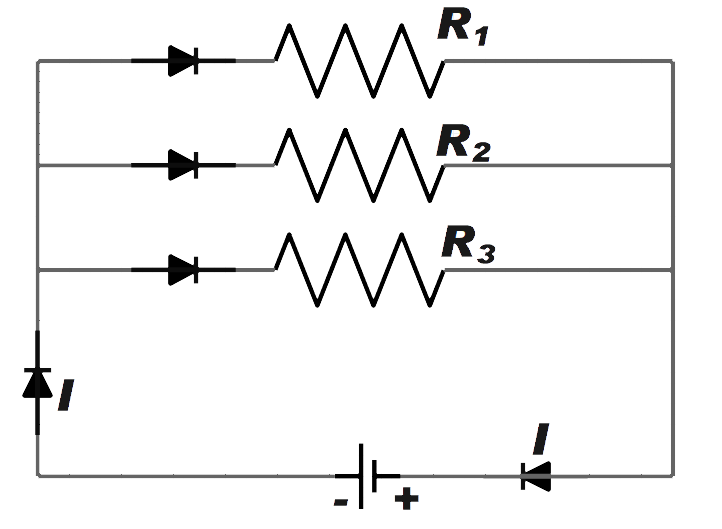
Let the total current in the circuit be I. The current through each branch will be \[{{I}_{1}},{{I}_{2}}\] and \[{{I}_{3}}\] .
Now we know that,
\[I={{I}_{1}}+{{I}_{2}}+{{I}_{3}}\] …………………. (1)
We also know that voltage across each resistor in parallel connection is the same.
Therefore,
\[{{V}_{1}}={{V}_{2}}={{V}_{3}}=V\]
From Ohms law we can say that,
\[{{I}_{1}}=\dfrac{{{V}_{1}}}{{{R}_{1}}}\] ……………………. (2)
Similarly,
\[{{I}_{2}}=\dfrac{{{V}_{2}}}{{{R}_{2}}}\] ………………….. (3)
Also,
\[{{I}_{3}}=\dfrac{{{V}_{3}}}{{{R}_{3}}}\] …………………. (4)
Now, from (1), (2), (3) and (4)
We get,
\[I=\dfrac{{{V}_{1}}}{{{R}_{1}}}+\dfrac{{{V}_{2}}}{{{R}_{2}}}+\dfrac{{{V}_{3}}}{{{R}_{3}}}\]
But we know, \[{{V}_{1}}={{V}_{2}}={{V}_{3}}=V\]
Therefore,
\[\dfrac{V}{{{R}_{eq}}}=\dfrac{V}{{{R}_{1}}}+\dfrac{V}{{{R}_{2}}}+\dfrac{V}{{{R}_{3}}}\]
On solving,
We get,
\[\dfrac{1}{{{R}_{eq}}}=\dfrac{1}{{{R}_{1}}}+\dfrac{1}{{{R}_{2}}}+\dfrac{1}{{{R}_{3}}}\]
Therefore, the reciprocal of the equivalent resistance of a group of resistance joined is parallel is equal to the sum of the reciprocal of the individual resistances.
Hence proved.
(b) It is given that two resistors are connected in parallel with a battery with voltage 6 V as shown in the figure below.
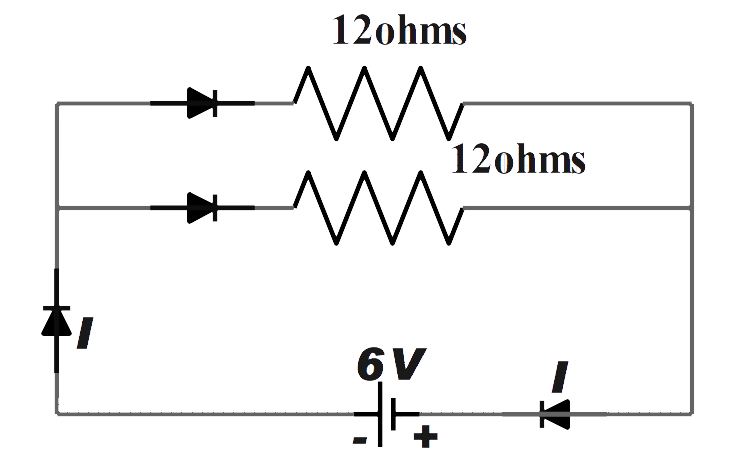
We have been asked to calculate the current flowing through the circuit.
Therefore, from Ohm's Law
We know
\[I=\dfrac{V}{{{\operatorname{R}}_{eq}}}\] ……………….. (A)
Therefore, calculating equivalent resistance
We know for parallel connections
\[\dfrac{1}{{{R}_{eq}}}=\dfrac{1}{{{R}_{1}}}+\dfrac{1}{{{R}_{2}}}\]
Substituting values
\[\dfrac{1}{{{R}_{eq}}}=\dfrac{1}{12}+\dfrac{1}{12}\]
On solving,
\[\dfrac{1}{{{R}_{eq}}}=\dfrac{2}{12}\]
\[{{R}_{eq}}=6\Omega \]
Therefore, substituting values in (A)
We get,
\[I=\dfrac{6}{6}\]
Therefore,
\[I=1A\]
Therefore, the current through the resistor is 1 ampere.
Note:
Ohm's law states that current flowing through a circuit between two points is directly proportional to voltage across two points. The ohm's law is used to calculate the relation between voltage, current and resistance of the circuit. It states that current is directly proportional to voltage applied and inversely proportional to the resistance of the circuit.
(b) We have been asked to calculate the voltage drawn from the battery of given readings. We shall use the Ohm's law, as it gives the relation of current, voltage applied and resistance.
Formula used:
\[V=IR\]
Complete answer:
(a) We have been asked to calculate the equivalent resistance of three resistors in parallel.
Therefore, let us consider three resistors with resistance connected in parallel as shown in the figure below.
Let the total current in the circuit be I. The current through each branch will be \[{{I}_{1}},{{I}_{2}}\] and \[{{I}_{3}}\] .
Now we know that,
\[I={{I}_{1}}+{{I}_{2}}+{{I}_{3}}\] …………………. (1)
We also know that voltage across each resistor in parallel connection is the same.
Therefore,
\[{{V}_{1}}={{V}_{2}}={{V}_{3}}=V\]
From Ohms law we can say that,
\[{{I}_{1}}=\dfrac{{{V}_{1}}}{{{R}_{1}}}\] ……………………. (2)
Similarly,
\[{{I}_{2}}=\dfrac{{{V}_{2}}}{{{R}_{2}}}\] ………………….. (3)
Also,
\[{{I}_{3}}=\dfrac{{{V}_{3}}}{{{R}_{3}}}\] …………………. (4)
Now, from (1), (2), (3) and (4)
We get,
\[I=\dfrac{{{V}_{1}}}{{{R}_{1}}}+\dfrac{{{V}_{2}}}{{{R}_{2}}}+\dfrac{{{V}_{3}}}{{{R}_{3}}}\]
But we know, \[{{V}_{1}}={{V}_{2}}={{V}_{3}}=V\]
Therefore,
\[\dfrac{V}{{{R}_{eq}}}=\dfrac{V}{{{R}_{1}}}+\dfrac{V}{{{R}_{2}}}+\dfrac{V}{{{R}_{3}}}\]
On solving,
We get,
\[\dfrac{1}{{{R}_{eq}}}=\dfrac{1}{{{R}_{1}}}+\dfrac{1}{{{R}_{2}}}+\dfrac{1}{{{R}_{3}}}\]
Therefore, the reciprocal of the equivalent resistance of a group of resistance joined is parallel is equal to the sum of the reciprocal of the individual resistances.
Hence proved.
(b) It is given that two resistors are connected in parallel with a battery with voltage 6 V as shown in the figure below.
We have been asked to calculate the current flowing through the circuit.
Therefore, from Ohm's Law
We know
\[I=\dfrac{V}{{{\operatorname{R}}_{eq}}}\] ……………….. (A)
Therefore, calculating equivalent resistance
We know for parallel connections
\[\dfrac{1}{{{R}_{eq}}}=\dfrac{1}{{{R}_{1}}}+\dfrac{1}{{{R}_{2}}}\]
Substituting values
\[\dfrac{1}{{{R}_{eq}}}=\dfrac{1}{12}+\dfrac{1}{12}\]
On solving,
\[\dfrac{1}{{{R}_{eq}}}=\dfrac{2}{12}\]
\[{{R}_{eq}}=6\Omega \]
Therefore, substituting values in (A)
We get,
\[I=\dfrac{6}{6}\]
Therefore,
\[I=1A\]
Therefore, the current through the resistor is 1 ampere.
Note:
Ohm's law states that current flowing through a circuit between two points is directly proportional to voltage across two points. The ohm's law is used to calculate the relation between voltage, current and resistance of the circuit. It states that current is directly proportional to voltage applied and inversely proportional to the resistance of the circuit.
Recently Updated Pages
Master Class 12 Business Studies: Engaging Questions & Answers for Success

Master Class 12 Biology: Engaging Questions & Answers for Success
Master Class 12 Chemistry: Engaging Questions & Answers for Success
Class 12 Question and Answer - Your Ultimate Solutions Guide
Master Class 11 Social Science: Engaging Questions & Answers for Success
Master Class 11 English: Engaging Questions & Answers for Success
Trending doubts
Which is more stable and why class 12 chemistry CBSE
What are the major means of transport Explain each class 12 social science CBSE
Sulphuric acid is known as the king of acids State class 12 chemistry CBSE
The value of constant k in coulombs law is beginalign class 12 physics CBSE
Why should a magnesium ribbon be cleaned before burning class 12 chemistry CBSE
Suicide bags of cells are aEndoplasmic reticulum bLysosome class 12 biology CBSE