




A wire of resistance 5 ohm is bent in the form of a closed circle. What is the resistance between 2 points at the ends of any diameter of the circle?
Answer
 Verified
600k+ views
Hint – Net resistance in parallel combination is $\dfrac{1}{R} = \dfrac{1}{{{R_1}}} + \dfrac{1}{{{R_2}}} + \dfrac{1}{{{R_3}}}....$ potential across each resistor is same. And in series combination is $R = {R_1} + {R_2} + {R_3}...$ in series combination the current is flowing constant through each element.
Complete answer:
Formula used - $\dfrac{1}{R} = \dfrac{1}{{{R_1}}} + \dfrac{1}{{{R_2}}} + \dfrac{1}{{{R_3}}}....$
Given, initial resistance= $5\Omega $
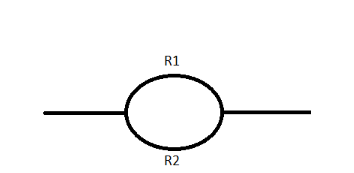
On dividing across diameter the length of the resistor halves and we know that $R$ is directly proportional to length of the element, hence the resistor on each side equals to $2.5\Omega $.Moreover, across the diameter they form parallel combinations.
$
\dfrac{1}{{{R_{eq}}}} = \dfrac{1}{{{R_1}}} + \dfrac{1}{{{R_2}}} \\
{R_1} = {R_2} = R \\
$
Since the same resistance is divided into two equal parts so those are equal.
So, the equation is,
$
\dfrac{1}{{{R_{eq}}}} = \dfrac{2}{R} \\
{\text{so,}} \\
{R_{eq}} = \dfrac{R}{2} \\
$
$
R = 2.5\Omega \\
{R_{eq}} = \dfrac{{2.5}}{2}\Omega = 1.25\Omega \\
$
Hence, the answer to this question is$1.25\Omega $.
Note – In these types of questions each resistance of the same value and n such resistors are connected in parallel combination, the net resistance is equal to $\dfrac{1}{n}$ times the resistance of a single resistor.
Complete answer:
Formula used - $\dfrac{1}{R} = \dfrac{1}{{{R_1}}} + \dfrac{1}{{{R_2}}} + \dfrac{1}{{{R_3}}}....$
Given, initial resistance= $5\Omega $
On dividing across diameter the length of the resistor halves and we know that $R$ is directly proportional to length of the element, hence the resistor on each side equals to $2.5\Omega $.Moreover, across the diameter they form parallel combinations.
$
\dfrac{1}{{{R_{eq}}}} = \dfrac{1}{{{R_1}}} + \dfrac{1}{{{R_2}}} \\
{R_1} = {R_2} = R \\
$
Since the same resistance is divided into two equal parts so those are equal.
So, the equation is,
$
\dfrac{1}{{{R_{eq}}}} = \dfrac{2}{R} \\
{\text{so,}} \\
{R_{eq}} = \dfrac{R}{2} \\
$
$
R = 2.5\Omega \\
{R_{eq}} = \dfrac{{2.5}}{2}\Omega = 1.25\Omega \\
$
Hence, the answer to this question is$1.25\Omega $.
Note – In these types of questions each resistance of the same value and n such resistors are connected in parallel combination, the net resistance is equal to $\dfrac{1}{n}$ times the resistance of a single resistor.
Recently Updated Pages
Master Class 12 Economics: Engaging Questions & Answers for Success

Master Class 12 Physics: Engaging Questions & Answers for Success
Master Class 12 English: Engaging Questions & Answers for Success
Master Class 12 Social Science: Engaging Questions & Answers for Success
Master Class 12 Maths: Engaging Questions & Answers for Success
Master Class 12 Business Studies: Engaging Questions & Answers for Success
Trending doubts
Which are the Top 10 Largest Countries of the World?
What are the major means of transport Explain each class 12 social science CBSE
Draw a labelled sketch of the human eye class 12 physics CBSE
What is a transformer Explain the principle construction class 12 physics CBSE
Why cannot DNA pass through cell membranes class 12 biology CBSE
Differentiate between insitu conservation and exsitu class 12 biology CBSE