




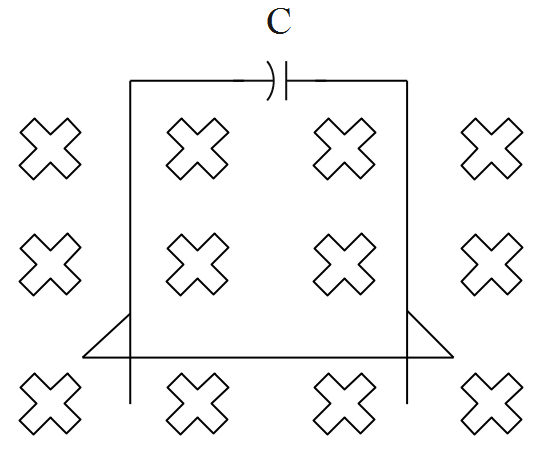
A wire of mass m and length l can slide freely on a pair of smooth, vertical rails. A magnetic field B exists in the region in the direction perpendicular to the plane of the rails. The rails are connected at the top end by the capacitor of capacitance C. Find the acceleration of the wire neglecting any electric resistance.
Answer
 Verified
562.2k+ views
Hint: The emf induced in the rod gives the relation between the magnetic field, the length of the rod and the velocity of the electron. The potential difference across the terminals of the capacitor and the ends of the rod will be the same, as they are in parallel. The current in the circuit is the rate of change of charge. The force on the rod due to the magnetic field and its weight are in the opposite directions. Using these equations, we can find the acceleration.
Complete step-by-step solution:
The emf induced in the rod gives the relation between the magnetic field, the length of the rod and the velocity of the electron.
\[e=Blv\]
The potential difference across the terminals of the capacitor and the ends of the rod will be the same, as they are in parallel.
\[\begin{align}
& \dfrac{q}{C}=Blv \\
& \therefore q=CBlv \\
\end{align}\]
The current in the circuit is the rate of change of charge, in turn, this charge equals the product of the capacitance of the capacitor, the magnetic field, the length of the rod and the velocity of the electrons.
\[\begin{align}
& i=\dfrac{dq}{dt} \\
& \Rightarrow i=\dfrac{d(CBlv)}{dt} \\
& \Rightarrow i=CBl\dfrac{dv}{dt} \\
& \therefore i=CBla \\
\end{align}\]
The force on the rod due to the magnetic field and its weight are in the opposite directions.
\[mg-ilB=ma\]
Substitute the expression of the current in the above equation.
\[\begin{align}
& mg-CBla\times lB=ma \\
& \Rightarrow ma+C{{B}^{2}}{{l}^{2}}a=mg \\
& \Rightarrow a(m+C{{B}^{2}}{{l}^{2}})=mg \\
& \therefore a=\dfrac{mg}{m+C{{B}^{2}}{{l}^{2}}} \\
\end{align}\]
\[\therefore \] The acceleration of the wire neglecting the electric resistance is,\[a=\dfrac{mg}{m+C{{B}^{2}}{{l}^{2}}}\].
Note: The potential difference across the terminals of the capacitor and the ends of the rod will be the same, as they are in parallel. The current in the circuit is the rate of change of product of the capacitance of the capacitor, the magnetic field, the length of the rod and the velocity of the electrons. The force on the rod due to the magnetic field and its weight are in the opposite directions.
Complete step-by-step solution:
The emf induced in the rod gives the relation between the magnetic field, the length of the rod and the velocity of the electron.
\[e=Blv\]
The potential difference across the terminals of the capacitor and the ends of the rod will be the same, as they are in parallel.
\[\begin{align}
& \dfrac{q}{C}=Blv \\
& \therefore q=CBlv \\
\end{align}\]
The current in the circuit is the rate of change of charge, in turn, this charge equals the product of the capacitance of the capacitor, the magnetic field, the length of the rod and the velocity of the electrons.
\[\begin{align}
& i=\dfrac{dq}{dt} \\
& \Rightarrow i=\dfrac{d(CBlv)}{dt} \\
& \Rightarrow i=CBl\dfrac{dv}{dt} \\
& \therefore i=CBla \\
\end{align}\]
The force on the rod due to the magnetic field and its weight are in the opposite directions.
\[mg-ilB=ma\]
Substitute the expression of the current in the above equation.
\[\begin{align}
& mg-CBla\times lB=ma \\
& \Rightarrow ma+C{{B}^{2}}{{l}^{2}}a=mg \\
& \Rightarrow a(m+C{{B}^{2}}{{l}^{2}})=mg \\
& \therefore a=\dfrac{mg}{m+C{{B}^{2}}{{l}^{2}}} \\
\end{align}\]
\[\therefore \] The acceleration of the wire neglecting the electric resistance is,\[a=\dfrac{mg}{m+C{{B}^{2}}{{l}^{2}}}\].
Note: The potential difference across the terminals of the capacitor and the ends of the rod will be the same, as they are in parallel. The current in the circuit is the rate of change of product of the capacitance of the capacitor, the magnetic field, the length of the rod and the velocity of the electrons. The force on the rod due to the magnetic field and its weight are in the opposite directions.
Recently Updated Pages
Master Class 12 Business Studies: Engaging Questions & Answers for Success

Master Class 12 Chemistry: Engaging Questions & Answers for Success
Master Class 12 Biology: Engaging Questions & Answers for Success
Class 12 Question and Answer - Your Ultimate Solutions Guide
Master Class 11 English: Engaging Questions & Answers for Success
Master Class 11 Social Science: Engaging Questions & Answers for Success
Trending doubts
Which are the Top 10 Largest Countries of the World?
Draw a labelled sketch of the human eye class 12 physics CBSE
Differentiate between homogeneous and heterogeneous class 12 chemistry CBSE
Differentiate between Pyramid of energy and pyramid class 12 biology CBSE
Why is the cell called the structural and functional class 12 biology CBSE
Draw the diagram of the pyramid of energy Explain In class 12 biology CBSE