




(A) What do you understand by the term "potential difference” ?
(B) What is meant by saying that the potential difference between two points is $ 1volt $ ?
(C) What is the potential difference between the terminals of the battery if $ 250joules $ of work is required to transfer $ 20coulombs $ of charge from one terminal of the battery to the other?
(D) What is a voltmeter? How is a voltmeter connected in the circuit to measure the potential difference between two points. Explain with the help of a diagram.
(E) State whether a voltmeter has a high resistance or a low resistance. Give reason for your answer
Answer
 Verified
543k+ views
Hint :From the definition of potential difference explain the terms. The relation between potential difference charge and work done is given by, $ W = qV $ where $ q $ is the total charge, $ V $ is the potential difference between the points , $ W $ is the work done on moving the charge $ q $ .
Complete Step By Step Answer:
(a)We know, the potential difference between two points in an electrical circuit is defined as the total work done to move a unit positive charge from one point to the other point is called the potential difference between the points.
(b) From the definition of potential difference we can say, potential between two points is $ 1volt $ means,
The amount of work done on moving $ 1C $ of charge between the points is $ 1J $ .
(c ) We know that , the relation between potential difference charge and work done is given by, $ W = qV $ where $ q $ is the total charge, $ V $ is the potential difference between the points , $ W $ is the work done on moving the charge $ q $ .
Here, we have, $ q = 20C $ and $ W = 250J $
So, putting the values we get,
$ 250 = 20V $
Or, $ V = \dfrac{{250}}{{20}} = 12.5V $
Hence, the potential difference between the terminals of the battery will be $ 12.5V $ .
(d ) We know, A voltmeter is a device which can measure the potential difference between two points in an electrical circuit .A voltmeter is always connected in parallel with the electric component in the circuit to measure the potential difference. Since, the voltage drop is the same in a circuit when connected in parallel.
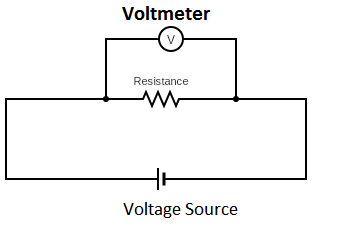
(e)Since, we know, the voltmeter is used to measure the voltage drop across any component in the circuit and it is connected in parallel. So, the current through the voltmeter and the component divides. Now, if the resistance of the voltmeter is high then only less current will flow through the voltmeter and nearly the original circuit current will flow through the component hence, the voltage drop of the component across which the voltage is being measured will be the same as when the voltmeter was not connected. If the resistance of the voltmeter was low then large current will flow through the voltmeter and the actual voltage drop of the component will be different to what is measured with the voltmeter.
Hence, the resistance of the voltage meter is kept high.
Note :
A voltmeter is connected in parallel in circuit and an ammeter is connected in series in circuit, since, in series connection the current through the component is the same .So, the ammeter is connected in series to measure the current. Also, the resistance of the ammeter is kept low so that the current flowing through the component must be the same as when the ammeter was not connected in the circuit to measure the current accurately.
Complete Step By Step Answer:
(a)We know, the potential difference between two points in an electrical circuit is defined as the total work done to move a unit positive charge from one point to the other point is called the potential difference between the points.
(b) From the definition of potential difference we can say, potential between two points is $ 1volt $ means,
The amount of work done on moving $ 1C $ of charge between the points is $ 1J $ .
(c ) We know that , the relation between potential difference charge and work done is given by, $ W = qV $ where $ q $ is the total charge, $ V $ is the potential difference between the points , $ W $ is the work done on moving the charge $ q $ .
Here, we have, $ q = 20C $ and $ W = 250J $
So, putting the values we get,
$ 250 = 20V $
Or, $ V = \dfrac{{250}}{{20}} = 12.5V $
Hence, the potential difference between the terminals of the battery will be $ 12.5V $ .
(d ) We know, A voltmeter is a device which can measure the potential difference between two points in an electrical circuit .A voltmeter is always connected in parallel with the electric component in the circuit to measure the potential difference. Since, the voltage drop is the same in a circuit when connected in parallel.
(e)Since, we know, the voltmeter is used to measure the voltage drop across any component in the circuit and it is connected in parallel. So, the current through the voltmeter and the component divides. Now, if the resistance of the voltmeter is high then only less current will flow through the voltmeter and nearly the original circuit current will flow through the component hence, the voltage drop of the component across which the voltage is being measured will be the same as when the voltmeter was not connected. If the resistance of the voltmeter was low then large current will flow through the voltmeter and the actual voltage drop of the component will be different to what is measured with the voltmeter.
Hence, the resistance of the voltage meter is kept high.
Note :
A voltmeter is connected in parallel in circuit and an ammeter is connected in series in circuit, since, in series connection the current through the component is the same .So, the ammeter is connected in series to measure the current. Also, the resistance of the ammeter is kept low so that the current flowing through the component must be the same as when the ammeter was not connected in the circuit to measure the current accurately.
Recently Updated Pages
Master Class 12 Business Studies: Engaging Questions & Answers for Success

Master Class 12 Biology: Engaging Questions & Answers for Success
Master Class 12 Chemistry: Engaging Questions & Answers for Success
Class 12 Question and Answer - Your Ultimate Solutions Guide
Master Class 11 Social Science: Engaging Questions & Answers for Success
Master Class 11 English: Engaging Questions & Answers for Success
Trending doubts
Which are the Top 10 Largest Countries of the World?
Draw a labelled sketch of the human eye class 12 physics CBSE
Differentiate between homogeneous and heterogeneous class 12 chemistry CBSE
Sulphuric acid is known as the king of acids State class 12 chemistry CBSE
Why is the cell called the structural and functional class 12 biology CBSE
Which is the correct genotypic ratio of mendel dihybrid class 12 biology CBSE