




A uniform electric field $'E'$ exist between two parallel plates having opposite charge on each plate. An electron enters the field between the plates with speed ${v_0}$ as shown in the figure. If length of each plates is$1$ then angle with which electrons deviates from its initial path is (m is the mass of electrons)
Answer
 Verified
536.1k+ views
Hint: The presence of an electric charge causes an alteration in space known as the electric field. The electric force between a source charge and a test charge is mediated by the electric field. The field is a vector, so it points away from positive charges and toward negative charges by definition.
Complete step-by-step solution:
A continuous charge delivery system is one in which the charge is distributed evenly through the conductor. In a continuous charge device, an infinite number of charges are packed tightly together with just a small gap between them.
Now, coming to the given question;
Uniform Electric field = $E$
Speed of electron entering = ${v_0}$
Length of each plate =$l$
Mass of electron =$m$
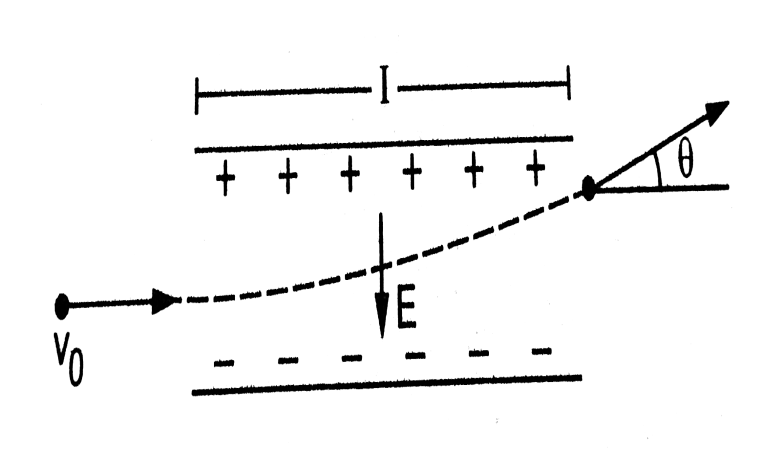
The acceleration of electron is = $\dfrac{{eE}}{m}$
The horizontal velocity remains ${v_0}$ as there is no acceleration in this direction.
Thus, the time taken in crossing field $t = \dfrac{l}{{{v_0}}}$
The upward component of velocity of electron as it emerges from the field region is
$ \Rightarrow {V_y} = \alpha t = \dfrac{{eEl}}{{m{v_0}}}$
The horizontal component of velocity remains,
${v_y} = {v_0}$
The angle =$0$, made by the resultant velocity with the original direction is given by,
$\tan \theta = \dfrac{{{v_y}}}{{{v_x}}} = \dfrac{{eEl}}{{m{v_0}x{v_0}}}$
Thus, the electron deviates by an angle $\theta = {\tan ^{ - 1}}\left( {\dfrac{{eEl}}{{m{v_0}^2}}} \right)$
Note:Positive or negative charges pass through the electric field lines. Surface applications such as wound healing, corneal repair, and even brain and spinal stimulation with closely spaced, implanted electrodes are well suited for such sources.
Complete step-by-step solution:
A continuous charge delivery system is one in which the charge is distributed evenly through the conductor. In a continuous charge device, an infinite number of charges are packed tightly together with just a small gap between them.
Now, coming to the given question;
Uniform Electric field = $E$
Speed of electron entering = ${v_0}$
Length of each plate =$l$
Mass of electron =$m$
The acceleration of electron is = $\dfrac{{eE}}{m}$
The horizontal velocity remains ${v_0}$ as there is no acceleration in this direction.
Thus, the time taken in crossing field $t = \dfrac{l}{{{v_0}}}$
The upward component of velocity of electron as it emerges from the field region is
$ \Rightarrow {V_y} = \alpha t = \dfrac{{eEl}}{{m{v_0}}}$
The horizontal component of velocity remains,
${v_y} = {v_0}$
The angle =$0$, made by the resultant velocity with the original direction is given by,
$\tan \theta = \dfrac{{{v_y}}}{{{v_x}}} = \dfrac{{eEl}}{{m{v_0}x{v_0}}}$
Thus, the electron deviates by an angle $\theta = {\tan ^{ - 1}}\left( {\dfrac{{eEl}}{{m{v_0}^2}}} \right)$
Note:Positive or negative charges pass through the electric field lines. Surface applications such as wound healing, corneal repair, and even brain and spinal stimulation with closely spaced, implanted electrodes are well suited for such sources.
Recently Updated Pages
Three beakers labelled as A B and C each containing 25 mL of water were taken A small amount of NaOH anhydrous CuSO4 and NaCl were added to the beakers A B and C respectively It was observed that there was an increase in the temperature of the solutions contained in beakers A and B whereas in case of beaker C the temperature of the solution falls Which one of the following statements isarecorrect i In beakers A and B exothermic process has occurred ii In beakers A and B endothermic process has occurred iii In beaker C exothermic process has occurred iv In beaker C endothermic process has occurred

Master Class 12 Social Science: Engaging Questions & Answers for Success
Master Class 12 Physics: Engaging Questions & Answers for Success
Master Class 12 Maths: Engaging Questions & Answers for Success
Master Class 12 Economics: Engaging Questions & Answers for Success
Master Class 12 Chemistry: Engaging Questions & Answers for Success
Three beakers labelled as A B and C each containing 25 mL of water were taken A small amount of NaOH anhydrous CuSO4 and NaCl were added to the beakers A B and C respectively It was observed that there was an increase in the temperature of the solutions contained in beakers A and B whereas in case of beaker C the temperature of the solution falls Which one of the following statements isarecorrect i In beakers A and B exothermic process has occurred ii In beakers A and B endothermic process has occurred iii In beaker C exothermic process has occurred iv In beaker C endothermic process has occurred
Master Class 12 Social Science: Engaging Questions & Answers for Success
Master Class 12 Physics: Engaging Questions & Answers for Success
Trending doubts
Which are the Top 10 Largest Countries of the World?
Draw a labelled sketch of the human eye class 12 physics CBSE
Explain the structure of megasporangium class 12 biology CBSE
What are the major means of transport Explain each class 12 social science CBSE
Differentiate between homogeneous and heterogeneous class 12 chemistry CBSE
Sulphuric acid is known as the king of acids State class 12 chemistry CBSE