



A thin wire has a length of 21.7 cm and a radius of 0.46 mm. The volume of the wire to correct significant figures is
A. $1.4c{m^3}$
B. $0.14c{m^3}$
C. $0.14m{m^3}$
D. None of these
Answer
 Verified
587.1k+ views
Hint: We have the radius and the length of the wire. Firstly, we can convert the units of one of the quantities to match the other for uniformity in the calculation. We can consider the wire to be a cylinder and find the volume of the wire. Once we have the volume, we can round up the digits to three significant figures as all the options are given in three significant figures.
Formula used:
$V = \pi {r^2}l$
Complete step-by-step solution:
In the question, they’ve given a wire whose radius is 0.46 mm and length is 21.7 cm. We can consider the wire to be a thin cylinder. Then it would look something like this.
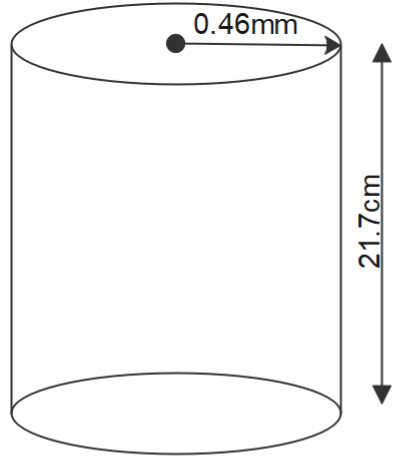
Now, the volume of the cylinder is given by
$V = \pi {r^2}l$
Where,
V is the volume of the cylinder
r is the radius of the cylinder
l is the length of the cylinder
We already have the radius of the cylinder in millimeters, which can be converted into centimeters as follows
$\eqalign{
& 1mm = {10^{ - 1}}cm \cr
& \Rightarrow 0.46mm = 0.46 \times {10^{ - 1}}cm \cr} $
So, we have the radius of the cylinder to be $r = 0.46 \times {10^{ - 3}}cm$ and the length of the cylinder to be $l = 21.7cm$. Substituting these values in the formula we have
$\eqalign{
& V = \pi {r^2}l \cr
& \Rightarrow V = \pi \times {\left( {0.46 \times {{10}^{ - 1}}cm} \right)^2} \times 21.7cm \cr
& \Rightarrow V = {\text{14}}{\text{.4253}} \times {10^{ - 2}}c{m^3} \cr
& \Rightarrow V = {\text{14}}{\text{.4253}} \times 0.01c{m^3} \cr
& \Rightarrow V = 0.{\text{144253c}}{m^3} \cr
& \Rightarrow V = 0.14c{m^3} \cr} $
Here, we have rounded the number to three significant figures.
The rounding is done in the following steps:
$0.{\text{144253}} \to 0.14425 \to 0.1443 \to 0.144 \to 0.14$
Therefore, the volume of the wire to the correct significant figures would be 0.14cm3.
Thus, the correct option is B.
Note: We can round up any value to the precision we like based on the need. The rules for rounding up a digit to certain precision is that if the preceding value is a digit greater than or equal to 5, we’ll add 1 to the succeeding digit. If the preceding value is less than 5, we can simply write the succeeding digit as it is.
Formula used:
$V = \pi {r^2}l$
Complete step-by-step solution:
In the question, they’ve given a wire whose radius is 0.46 mm and length is 21.7 cm. We can consider the wire to be a thin cylinder. Then it would look something like this.
Now, the volume of the cylinder is given by
$V = \pi {r^2}l$
Where,
V is the volume of the cylinder
r is the radius of the cylinder
l is the length of the cylinder
We already have the radius of the cylinder in millimeters, which can be converted into centimeters as follows
$\eqalign{
& 1mm = {10^{ - 1}}cm \cr
& \Rightarrow 0.46mm = 0.46 \times {10^{ - 1}}cm \cr} $
So, we have the radius of the cylinder to be $r = 0.46 \times {10^{ - 3}}cm$ and the length of the cylinder to be $l = 21.7cm$. Substituting these values in the formula we have
$\eqalign{
& V = \pi {r^2}l \cr
& \Rightarrow V = \pi \times {\left( {0.46 \times {{10}^{ - 1}}cm} \right)^2} \times 21.7cm \cr
& \Rightarrow V = {\text{14}}{\text{.4253}} \times {10^{ - 2}}c{m^3} \cr
& \Rightarrow V = {\text{14}}{\text{.4253}} \times 0.01c{m^3} \cr
& \Rightarrow V = 0.{\text{144253c}}{m^3} \cr
& \Rightarrow V = 0.14c{m^3} \cr} $
Here, we have rounded the number to three significant figures.
The rounding is done in the following steps:
$0.{\text{144253}} \to 0.14425 \to 0.1443 \to 0.144 \to 0.14$
Therefore, the volume of the wire to the correct significant figures would be 0.14cm3.
Thus, the correct option is B.
Note: We can round up any value to the precision we like based on the need. The rules for rounding up a digit to certain precision is that if the preceding value is a digit greater than or equal to 5, we’ll add 1 to the succeeding digit. If the preceding value is less than 5, we can simply write the succeeding digit as it is.
Recently Updated Pages
Basicity of sulphurous acid and sulphuric acid are

Master Class 11 Business Studies: Engaging Questions & Answers for Success
Master Class 11 Computer Science: Engaging Questions & Answers for Success
Master Class 11 Economics: Engaging Questions & Answers for Success
Master Class 12 English: Engaging Questions & Answers for Success
Master Class 12 Social Science: Engaging Questions & Answers for Success
Trending doubts
Fill the blanks with the suitable prepositions 1 The class 9 english CBSE
Difference Between Plant Cell and Animal Cell
What is the color of ferrous sulphate crystals? How does this color change after heating? Name the products formed on strongly heating ferrous sulphate crystals. What type of chemical reaction occurs in this type of change.
What is the Full Form of ICSE / ISC ?
What is pollution? How many types of pollution? Define it
Explain the importance of pH in everyday life class 9 chemistry CBSE
Fill the blanks with the suitable prepositions 1 The class 9 english CBSE
Difference Between Plant Cell and Animal Cell
What is the color of ferrous sulphate crystals? How does this color change after heating? Name the products formed on strongly heating ferrous sulphate crystals. What type of chemical reaction occurs in this type of change.