




A thin lens of focal length $f$ and aperture diameter $d$ forms an image of intensity $I$ . If the central part of the aperture up to diameter $\dfrac{d}{2}$ is covered by an opaque paper, then find the new focal length and intensity of the image:
A) $\dfrac{f}{2}{\text{, }}\dfrac{I}{2}$
B) $\dfrac{f}{2}{\text{, }}\dfrac{3}{4}I$
C) $f{\text{, }}\dfrac{I}{2}$
D) $f{\text{, }}\dfrac{3}{4}I$
Answer
 Verified
619.8k+ views
Hint: Covering up any portion of a lens by an opaque paper does not affect its focal length. However, the intensity of the image formed will decrease.
Complete step by step answer.
Step 1: Sketch a rough diagram to represent the problem at hand.
$\dfrac{d}{2}$
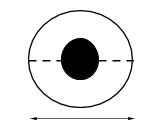
$d$
Step 2: List the data given in the question.
We have the focal length of the lens as $f$, its aperture diameter is $d$ and the intensity of the image formed is $I$.
Step 3: Find the area of the aperture when the central part of the aperture up to diameter $\dfrac{d}{2}$ is covered by an opaque paper.
Let ${A_1}$ denote the initial area of the aperture and ${A_2}$ denote the area once the aperture is covered by opaque paper.
Since the aperture is spherical, we have ${A_1} = \pi {\left( {\dfrac{d}{2}} \right)^2} = \dfrac{{\pi {d^2}}}{4}$ , where $\dfrac{d}{2}$ is the radius of the aperture.
The central part of the aperture up to diameter $\dfrac{d}{2}$ is now covered by an opaque paper.
Then the area will be, ${A_2} = \dfrac{{\pi {d^2}}}{4} - \dfrac{{\pi {{\left( {\dfrac{d}{2}} \right)}^2}}}{4}$
On simplifying we get, ${A_2} = \dfrac{{\pi {d^2}}}{4} - \dfrac{{\pi {d^2}}}{{16}}$ or, ${A_2} = \dfrac{{\pi {d^2}}}{4}\left( {1 - \dfrac{1}{4}} \right)$
Finally, we have ${A_2} = \dfrac{3}{4}\left( {\dfrac{{\pi {d^2}}}{4}} \right)$ .
Step 4: As intensity is proportional to the area, find the new intensity.
We have ${A_1} = \dfrac{{\pi {d^2}}}{4}$ and ${A_2} = \dfrac{3}{4}\left( {\dfrac{{\pi {d^2}}}{4}} \right)$ .
Express ${A_2}$ in terms of ${A_1}$ .
Now we have, ${A_2} = \dfrac{3}{4}{A_1}$ .
The intensity of the image is directly proportional to the area of the aperture of the lens.
Let ${I_1}$ be the initial intensity and ${I_2}$ be the intensity when the central part of the aperture was covered by an opaque paper.
i.e., $\dfrac{{{I_1}}}{{{I_2}}} = \dfrac{{{A_1}}}{{{A_2}}}$
Substituting ${A_1}$ and ${A_2}$ in the above relation and cancelling out the similar terms, we have $\dfrac{{{I_1}}}{{{I_2}}} = \dfrac{4}{3}$ or, ${I_2} = \dfrac{3}{4}{I_1} = \dfrac{3}{4}I$ .
Therefore, the new intensity is $\dfrac{3}{4}I$. The intensity decreased as some light rays were blocked by the opaque paper.
Step 5: Discuss what happened to the focal length.
The focal remains the same when the central part of the aperture up to diameter $\dfrac{d}{2}$ was blocked by an opaque paper because the entire image will be formed by the light rays that were not blocked by the opaque paper.
Therefore, the focal length is $f$ .
The correct option is D) $f{\text{, }}\dfrac{3}{4}I$ .
Note: Focal length of the lens tells you how close one needs to be to the object that is to be captured. Far away objects demand a longer focal length while objects in front of you demand a smaller focal length.
Complete step by step answer.
Step 1: Sketch a rough diagram to represent the problem at hand.
$\dfrac{d}{2}$
$d$
Step 2: List the data given in the question.
We have the focal length of the lens as $f$, its aperture diameter is $d$ and the intensity of the image formed is $I$.
Step 3: Find the area of the aperture when the central part of the aperture up to diameter $\dfrac{d}{2}$ is covered by an opaque paper.
Let ${A_1}$ denote the initial area of the aperture and ${A_2}$ denote the area once the aperture is covered by opaque paper.
Since the aperture is spherical, we have ${A_1} = \pi {\left( {\dfrac{d}{2}} \right)^2} = \dfrac{{\pi {d^2}}}{4}$ , where $\dfrac{d}{2}$ is the radius of the aperture.
The central part of the aperture up to diameter $\dfrac{d}{2}$ is now covered by an opaque paper.
Then the area will be, ${A_2} = \dfrac{{\pi {d^2}}}{4} - \dfrac{{\pi {{\left( {\dfrac{d}{2}} \right)}^2}}}{4}$
On simplifying we get, ${A_2} = \dfrac{{\pi {d^2}}}{4} - \dfrac{{\pi {d^2}}}{{16}}$ or, ${A_2} = \dfrac{{\pi {d^2}}}{4}\left( {1 - \dfrac{1}{4}} \right)$
Finally, we have ${A_2} = \dfrac{3}{4}\left( {\dfrac{{\pi {d^2}}}{4}} \right)$ .
Step 4: As intensity is proportional to the area, find the new intensity.
We have ${A_1} = \dfrac{{\pi {d^2}}}{4}$ and ${A_2} = \dfrac{3}{4}\left( {\dfrac{{\pi {d^2}}}{4}} \right)$ .
Express ${A_2}$ in terms of ${A_1}$ .
Now we have, ${A_2} = \dfrac{3}{4}{A_1}$ .
The intensity of the image is directly proportional to the area of the aperture of the lens.
Let ${I_1}$ be the initial intensity and ${I_2}$ be the intensity when the central part of the aperture was covered by an opaque paper.
i.e., $\dfrac{{{I_1}}}{{{I_2}}} = \dfrac{{{A_1}}}{{{A_2}}}$
Substituting ${A_1}$ and ${A_2}$ in the above relation and cancelling out the similar terms, we have $\dfrac{{{I_1}}}{{{I_2}}} = \dfrac{4}{3}$ or, ${I_2} = \dfrac{3}{4}{I_1} = \dfrac{3}{4}I$ .
Therefore, the new intensity is $\dfrac{3}{4}I$. The intensity decreased as some light rays were blocked by the opaque paper.
Step 5: Discuss what happened to the focal length.
The focal remains the same when the central part of the aperture up to diameter $\dfrac{d}{2}$ was blocked by an opaque paper because the entire image will be formed by the light rays that were not blocked by the opaque paper.
Therefore, the focal length is $f$ .
The correct option is D) $f{\text{, }}\dfrac{3}{4}I$ .
Note: Focal length of the lens tells you how close one needs to be to the object that is to be captured. Far away objects demand a longer focal length while objects in front of you demand a smaller focal length.
Recently Updated Pages
Master Class 12 Economics: Engaging Questions & Answers for Success

Master Class 12 English: Engaging Questions & Answers for Success
Master Class 12 Social Science: Engaging Questions & Answers for Success
Master Class 12 Maths: Engaging Questions & Answers for Success
Master Class 12 Physics: Engaging Questions & Answers for Success
Master Class 12 Business Studies: Engaging Questions & Answers for Success
Trending doubts
Which are the Top 10 Largest Countries of the World?
Draw a labelled sketch of the human eye class 12 physics CBSE
Differentiate between homogeneous and heterogeneous class 12 chemistry CBSE
Why is the cell called the structural and functional class 12 biology CBSE
Draw ray diagrams each showing i myopic eye and ii class 12 physics CBSE
Which is the correct genotypic ratio of mendel dihybrid class 12 biology CBSE