




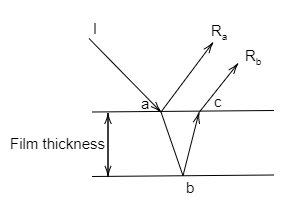
A thin film of liquid polymer, $n = 1.25$ coats a slab of Pyrex, $n = 1.50$. White light is incident perpendicularly on the film. In the reflection, full destructive interference occurs for $\lambda = 600\,nm$ and full constructive interference occurs for $\lambda = 700\,nm$. What is the thickness of the polymer film?
(A) $120\,nm$
(B) $280\,nm$
(C) $460\,nm$
(D) $840\,nm$
Answer
 Verified
610.5k+ views
Hint: This problem is related to thin film interference, if the light is incident from one medium to another medium, the reflection is full destructive interference will occur at $\lambda = 600\,nm$ and the full constructive interference occurs for $\lambda = 700\,nm$, then the thickness of the film is determined by using the thin film interference formula.
Formulae Used:
By thin film interference, the thickness of the film is given by,
For constructive interference,
$2t = \dfrac{{m\lambda }}{n}$
Where, $t$ is the thickness of the film, $m$ is the order of the interference, $\lambda $ is the wavelength for constructive interference and $n$ is the refractive index.
Complete step-by-step solution:
Given that,
Refractive index of liquid polymer, ${n_1} = 1.25$
Refractive index of slab of Pyrex, ${n_2} = 1.50$
Wavelength for destructive interference, ${\lambda _1} = 600\,nm$
Wavelength for constructive interference, ${\lambda _2} = 700\,nm$
Thin-film interference is the interference of light waves reflecting off the top surface of a film with the waves reflecting from the bottom surface.
By thin film interference, the thickness of the film is given by,
For constructive interference,
$2t = \dfrac{{m{\lambda _2}}}{{{n_1}}}\,..................\left( 1 \right)$
For constructive interference, the wavelength is ${\lambda _2}$ and we have to find the thickness of the polymer film, so take the refractive index of polymer ${n_1}$.
By substituting the wavelength and refractive index value in the equation (1), then
$2t = \dfrac{{m \times 700}}{{1.25}}$
Here, $m$ is the order of interference, so take $m = 3$, and substitute in the above equation, then
$2t = \dfrac{{3 \times 700}}{{1.25}}$
On multiplying the numerator in the above equation, then
$2t = \dfrac{{2100}}{{1.25}}$
Now dividing the RHS, then the above equation is written as,
$2t = 1680$
By keeping the term $t$ in one side and the other terms in other side, then
$t = \dfrac{{1680}}{2}$
By dividing the terms, then
$t = 840\,nm$
Thus, the above equation shows the thickness of the polymer film.
Hence, the option (D) is the correct answer.
Note:- The thickness of the thin film is also determined by using the thin film interference formula for destructive interference. And the formula for destructive interference is $2t = \left( {m + \dfrac{1}{2}} \right)\left( {\dfrac{\lambda }{n}} \right)$ by using this formula the thickness of the thin film can be determined.
Formulae Used:
By thin film interference, the thickness of the film is given by,
For constructive interference,
$2t = \dfrac{{m\lambda }}{n}$
Where, $t$ is the thickness of the film, $m$ is the order of the interference, $\lambda $ is the wavelength for constructive interference and $n$ is the refractive index.
Complete step-by-step solution:
Given that,
Refractive index of liquid polymer, ${n_1} = 1.25$
Refractive index of slab of Pyrex, ${n_2} = 1.50$
Wavelength for destructive interference, ${\lambda _1} = 600\,nm$
Wavelength for constructive interference, ${\lambda _2} = 700\,nm$
Thin-film interference is the interference of light waves reflecting off the top surface of a film with the waves reflecting from the bottom surface.
By thin film interference, the thickness of the film is given by,
For constructive interference,
$2t = \dfrac{{m{\lambda _2}}}{{{n_1}}}\,..................\left( 1 \right)$
For constructive interference, the wavelength is ${\lambda _2}$ and we have to find the thickness of the polymer film, so take the refractive index of polymer ${n_1}$.
By substituting the wavelength and refractive index value in the equation (1), then
$2t = \dfrac{{m \times 700}}{{1.25}}$
Here, $m$ is the order of interference, so take $m = 3$, and substitute in the above equation, then
$2t = \dfrac{{3 \times 700}}{{1.25}}$
On multiplying the numerator in the above equation, then
$2t = \dfrac{{2100}}{{1.25}}$
Now dividing the RHS, then the above equation is written as,
$2t = 1680$
By keeping the term $t$ in one side and the other terms in other side, then
$t = \dfrac{{1680}}{2}$
By dividing the terms, then
$t = 840\,nm$
Thus, the above equation shows the thickness of the polymer film.
Hence, the option (D) is the correct answer.
Note:- The thickness of the thin film is also determined by using the thin film interference formula for destructive interference. And the formula for destructive interference is $2t = \left( {m + \dfrac{1}{2}} \right)\left( {\dfrac{\lambda }{n}} \right)$ by using this formula the thickness of the thin film can be determined.
Recently Updated Pages
Master Class 12 Economics: Engaging Questions & Answers for Success

Master Class 12 English: Engaging Questions & Answers for Success
Master Class 12 Social Science: Engaging Questions & Answers for Success
Master Class 12 Maths: Engaging Questions & Answers for Success
Master Class 12 Physics: Engaging Questions & Answers for Success
Master Class 9 General Knowledge: Engaging Questions & Answers for Success
Trending doubts
Which are the Top 10 Largest Countries of the World?
Draw a labelled sketch of the human eye class 12 physics CBSE
Differentiate between homogeneous and heterogeneous class 12 chemistry CBSE
Sulphuric acid is known as the king of acids State class 12 chemistry CBSE
Why is the cell called the structural and functional class 12 biology CBSE
A dentist uses a small mirror that gives a magnification class 12 physics CBSE