




A straw 6 cm long floats on water. The water film on one side has surface tension of 50 dyn/cm. On the other side, camphor reduces the surface tension to 40 dyn/cm. The resultant force acting on the straw is
A. $(50\times 6-40\times 6)dyn$
B. 10dyn
C. $(\dfrac{50}{6}-\dfrac{40}{6})dyn$
D. 90dyn
Answer
 Verified
585.9k+ views
Hint: At first we have to draw the diagram according to the question. Now we know that there are two sides of a straw and on both the sides there is a thin film of water, which is exerting a force normal to its surface. We need to calculate the net force. For that we need to know the force exerted by both the films and then calculate the net force.
Formula Used:
${{F}_{net}}={{F}_{1}}-{{F}_{2}}$
$F=T\times L$
Complete step by step answer:
According to the question, we see a straw which is floating on the water , because it is floating on the water the water made two films of water on both the openings of the straw. On Film A there is only water and so it has a surface tension of 50 dyn/cm and on the other side there was a bit of camphor so, the surface tension of the film B became 40 dyn/cm. The forces acting on due to the films would be acting normally.
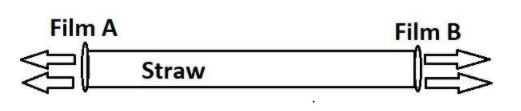
We can see that the forces that are acting both are in the opposite direction, and we are asked to find the net force.
So, we can calculate the net force by,
${{F}_{net}}={{F}_{A}}-{{F}_{B}}$
Now, to calculate force due to surface tension for the film A,
${{F}_{A}}=T\times L$
${{F}_{A}}=50\times 6$cm
Now, to calculate force due to surface tension for the film B,
${{F}_{B}}=T\times L$
${{F}_{B}}=40\times 6$cm.
Therefore according to the formula,
${{F}_{net}}=(50\times 6-40\times 6)$ dyne.
Therefore option A is the correct option.
Note:
In the formula $F=T\times L$, here ‘T’ is the surface tension and ‘L’ is the length of the object whose surface tension is taken. For calculating net force we have to find the difference between the forces exerted by both ends of the straw as the forces are acting in the opposite direction. Camphor is a substance which can reduce the surface tension so that’s why the surface tension at Film B is less.
Formula Used:
${{F}_{net}}={{F}_{1}}-{{F}_{2}}$
$F=T\times L$
Complete step by step answer:
According to the question, we see a straw which is floating on the water , because it is floating on the water the water made two films of water on both the openings of the straw. On Film A there is only water and so it has a surface tension of 50 dyn/cm and on the other side there was a bit of camphor so, the surface tension of the film B became 40 dyn/cm. The forces acting on due to the films would be acting normally.
We can see that the forces that are acting both are in the opposite direction, and we are asked to find the net force.
So, we can calculate the net force by,
${{F}_{net}}={{F}_{A}}-{{F}_{B}}$
Now, to calculate force due to surface tension for the film A,
${{F}_{A}}=T\times L$
${{F}_{A}}=50\times 6$cm
Now, to calculate force due to surface tension for the film B,
${{F}_{B}}=T\times L$
${{F}_{B}}=40\times 6$cm.
Therefore according to the formula,
${{F}_{net}}=(50\times 6-40\times 6)$ dyne.
Therefore option A is the correct option.
Note:
In the formula $F=T\times L$, here ‘T’ is the surface tension and ‘L’ is the length of the object whose surface tension is taken. For calculating net force we have to find the difference between the forces exerted by both ends of the straw as the forces are acting in the opposite direction. Camphor is a substance which can reduce the surface tension so that’s why the surface tension at Film B is less.
Recently Updated Pages
Master Class 12 Economics: Engaging Questions & Answers for Success

Master Class 12 Physics: Engaging Questions & Answers for Success
Master Class 12 English: Engaging Questions & Answers for Success
Master Class 12 Social Science: Engaging Questions & Answers for Success
Master Class 12 Maths: Engaging Questions & Answers for Success
Master Class 12 Business Studies: Engaging Questions & Answers for Success
Trending doubts
Which are the Top 10 Largest Countries of the World?
What are the major means of transport Explain each class 12 social science CBSE
Draw a labelled sketch of the human eye class 12 physics CBSE
What is a transformer Explain the principle construction class 12 physics CBSE
Why cannot DNA pass through cell membranes class 12 biology CBSE
Differentiate between insitu conservation and exsitu class 12 biology CBSE