




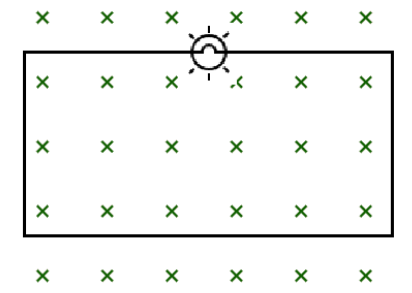
A square wire loop of $10.0\,cm$ side lies at right angles to a uniform magnetic field of $20T$. A $10\,V$ light bulb is in a series with the loop as shown in the fig. The magnetic field is decreasing steadily to zero over a time interval $\Delta t$. The bulb will shine with full brightness if $\Delta t$ is equal to $k\times 10\,ms$. Find the value of $k$.
Answer
 Verified
573.9k+ views
Hint: In this question, we need to use the formula of magnetic field and electromotive force to get the value of time interval, such that in that time interval the bulb will shine with full brightness. We also need to be careful after getting the time interval value, as we need to get a specific value from it.
Formula used:
$\begin{align}
& Magnetic\,Field\,(\phi )=BA \\
& ElectroMotive\,Force\,(EMF)=\dfrac{d\phi }{dt} \\
\end{align}$
Complete step by step answer:
According to the question, the length of the square wire is $10.0\,cm\,or\,0.1\,m$ and since it is a square loop so,
\[Area\,(A)={{(length)}^{2}}\]
$\Rightarrow A={{(0.1)}^{2}}=0.01\,{{m}^{2}}$
And, the given magnetic field is $20\,T$, which means:
$B=20\,T$
Now, we know that,
\[\begin{align}
& \phi =BA \\
& E=\dfrac{d\phi }{dt} \\
\end{align}\]
Then,
$\begin{align}
& E=A\dfrac{dB}{dt} \\
& E=A\dfrac{B}{t} \\
\end{align}$
Since, $E=10\,V$ and $B=20\,T$ is given in the question and we have got the value of $A$, so:
$\begin{align}
& 10=0.01\times \dfrac{20}{t} \\
& t=0.02\,s \\
& t=20\,ms\,(\because 1\,s=1000\,ms) \\
\end{align}$
Hence,
$t$ can also be written as:
$t=2\times 10\,ms$,
Which implies that $k=2$.
Therefore, the correct value of $k$ is $2$.
Note:
The thing to note in this question is that we don’t need to find the time interval value, but we need the value of a multiple of the time interval value, so before writing the final answer confirm what is the final result that is expected in the question. Usually, the students mark the time interval value as the final answer, which leads to wrong answers.
Formula used:
$\begin{align}
& Magnetic\,Field\,(\phi )=BA \\
& ElectroMotive\,Force\,(EMF)=\dfrac{d\phi }{dt} \\
\end{align}$
Complete step by step answer:
According to the question, the length of the square wire is $10.0\,cm\,or\,0.1\,m$ and since it is a square loop so,
\[Area\,(A)={{(length)}^{2}}\]
$\Rightarrow A={{(0.1)}^{2}}=0.01\,{{m}^{2}}$
And, the given magnetic field is $20\,T$, which means:
$B=20\,T$
Now, we know that,
\[\begin{align}
& \phi =BA \\
& E=\dfrac{d\phi }{dt} \\
\end{align}\]
Then,
$\begin{align}
& E=A\dfrac{dB}{dt} \\
& E=A\dfrac{B}{t} \\
\end{align}$
Since, $E=10\,V$ and $B=20\,T$ is given in the question and we have got the value of $A$, so:
$\begin{align}
& 10=0.01\times \dfrac{20}{t} \\
& t=0.02\,s \\
& t=20\,ms\,(\because 1\,s=1000\,ms) \\
\end{align}$
Hence,
$t$ can also be written as:
$t=2\times 10\,ms$,
Which implies that $k=2$.
Therefore, the correct value of $k$ is $2$.
Note:
The thing to note in this question is that we don’t need to find the time interval value, but we need the value of a multiple of the time interval value, so before writing the final answer confirm what is the final result that is expected in the question. Usually, the students mark the time interval value as the final answer, which leads to wrong answers.
Recently Updated Pages
Master Class 12 Economics: Engaging Questions & Answers for Success

Master Class 12 Physics: Engaging Questions & Answers for Success
Master Class 12 English: Engaging Questions & Answers for Success
Master Class 12 Social Science: Engaging Questions & Answers for Success
Master Class 12 Maths: Engaging Questions & Answers for Success
Master Class 12 Business Studies: Engaging Questions & Answers for Success
Trending doubts
Why cannot DNA pass through cell membranes class 12 biology CBSE
Differentiate between insitu conservation and exsitu class 12 biology CBSE
Draw a neat and well labeled diagram of TS of ovary class 12 biology CBSE
In a human foetus the limbs and digits develop after class 12 biology CBSE
AABbCc genotype forms how many types of gametes a 4 class 12 biology CBSE
The correct structure of ethylenediaminetetraacetic class 12 chemistry CBSE