



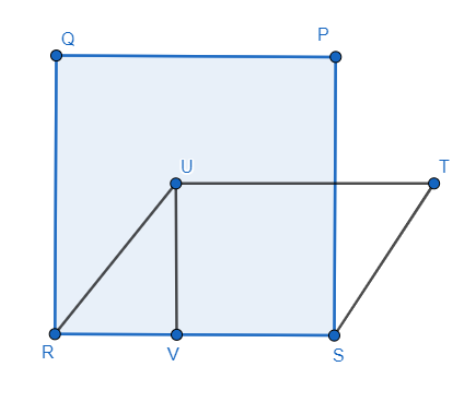
A square PQRS and a rhombus RSTU lie on the same base RS. What is the relation between their areas?
A. \[ar\left( PQRS \right)=ar\left( RSTU \right)\]
B. \[ar\left( PQRS \right) < ar\left( RSTU \right)\]
C. \[ar\left( PQRS \right) > ar\left( RSTU \right)\]
D. \[ar\left( PQRS \right)=\dfrac{1}{2}ar\left( RSTU \right)\]
Answer
 Verified
506.1k+ views
Hint: We find the formula of finding the area of \[ar\left( PQRS \right)\] and \[ar\left( RSTU \right)\]. We compare their heights and find a relation. This gives the relation between the area of the square and the rhombus when multiplied by the length of the common base RS.
Complete step by step solution:
A square PQRS and a rhombus RSTU lie on the same base RS.
We know the formulas to find the areas for square and rhombus.
For square it is the square value of one side and for rhombus it is the multiplication of one side and the height.
For square PQRS, we find the area with respect to the sides’ length.
So, \[ar\left( PQRS \right)=RS\times PS\]. Both are sides of the square.
We take the intersection of PS and UT as a point of O.
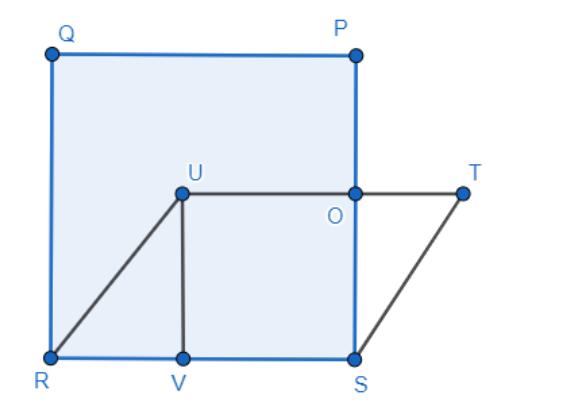
We now try to prove that quadrilateral UVSO is a square.
We know that $\angle UVR=\angle UVS=\angle OSV={{90}^{\circ }}$. Therefore, $UV||OS$.
Also, as RSTU is a rhombus we have $UT||RS$ which gives $UO||VS$.
Therefore, UVSO is a square for having opposite sides as parallel and all angles being equal to ${{90}^{\circ }}$. This gives $UV=OS$. These lines become the height of the rhombus.
The area of the rhombus becomes \[ar\left( RSTU \right)=RS\times OS\].
We can clearly see that $OS < PS$. Therefore, $RS\times OS < RS\times PS$.
This gives \[ar\left( PQRS \right) > ar\left( RSTU \right)\]. The correct option is C.
So, the correct answer is “Option C”.
Note: We need to be careful about the proof of the parallelogram. The proof gives us a relation between the heights. The height for the square is the side as that creates the right angle on the base.
Complete step by step solution:
A square PQRS and a rhombus RSTU lie on the same base RS.
We know the formulas to find the areas for square and rhombus.
For square it is the square value of one side and for rhombus it is the multiplication of one side and the height.
For square PQRS, we find the area with respect to the sides’ length.
So, \[ar\left( PQRS \right)=RS\times PS\]. Both are sides of the square.
We take the intersection of PS and UT as a point of O.
We now try to prove that quadrilateral UVSO is a square.
We know that $\angle UVR=\angle UVS=\angle OSV={{90}^{\circ }}$. Therefore, $UV||OS$.
Also, as RSTU is a rhombus we have $UT||RS$ which gives $UO||VS$.
Therefore, UVSO is a square for having opposite sides as parallel and all angles being equal to ${{90}^{\circ }}$. This gives $UV=OS$. These lines become the height of the rhombus.
The area of the rhombus becomes \[ar\left( RSTU \right)=RS\times OS\].
We can clearly see that $OS < PS$. Therefore, $RS\times OS < RS\times PS$.
This gives \[ar\left( PQRS \right) > ar\left( RSTU \right)\]. The correct option is C.
So, the correct answer is “Option C”.
Note: We need to be careful about the proof of the parallelogram. The proof gives us a relation between the heights. The height for the square is the side as that creates the right angle on the base.

Recently Updated Pages
Master Class 8 Social Science: Engaging Questions & Answers for Success

Master Class 8 English: Engaging Questions & Answers for Success
Class 8 Question and Answer - Your Ultimate Solutions Guide
Master Class 8 Maths: Engaging Questions & Answers for Success
Master Class 8 Science: Engaging Questions & Answers for Success
Master Class 9 General Knowledge: Engaging Questions & Answers for Success
Trending doubts
What is BLO What is the full form of BLO class 8 social science CBSE
Citizens of India can vote at the age of A 18 years class 8 social science CBSE
Full form of STD, ISD and PCO
Advantages and disadvantages of science
Right to vote is a AFundamental Right BFundamental class 8 social science CBSE
What are the 12 elements of nature class 8 chemistry CBSE