




A spherical iron ball of radius $10cm$ is coated with a layer of ice of uniform thickness that melts at a rate of $50c{{m}^{3}}/\min $ . When the thickness of the ice is $5cm$ , then the rate at which the thickness (in cm/min) of the ice decreases is:
A. $\dfrac{1}{9\pi }$
B. $\dfrac{5}{6\pi }$
C. $\dfrac{1}{18\pi }$
D. $\dfrac{1}{36\pi }$
Answer
 Verified
585.9k+ views
Hint: We will start by analyzing the question, we will find that we are given the rate of change of volume, we will then calculate the total volume of sphere, we will consider the radius of sphere plus the thickness of the ice and then, we will differentiate the volume with respect to time. In this way we will get the rate of change of thickness with respect to time. Finally, we will put the thickness as 5 cm as given in the question.
Complete step by step answer:
In the question it is given that the ice melts at a rate of $50c{{m}^{3}}/\min $ , this means that the volume of sphere in equation 2 decreases with respect to time at this rate, Therefore: $\dfrac{dV}{dt}=50c{{m}^{3}}/\min \text{ }........\text{Equation 1}$ and we have to find the rate at which the thickness of ice decreases, let the thickness of ice initially be: $x$. Therefore we have to find $\dfrac{dx}{dt}$ that is the rate of change of change thickness with respect to time
Now, we have been given that the radius of spherical iron ball as 10 cm, let $r=10$, and it is given that there is a uniform coating of ice on the ball, we have assumed the thickness of ice initially: $x$
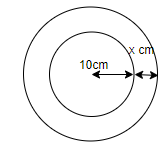
So the total radius of the ball becomes: $R=r+x\Rightarrow 10+x.......\text{ Equation 2}$
We already know that volume of a sphere is : $V=\dfrac{4}{3}\pi {{R}^{3}}$ , We will find out the total volume of given sphere and the thickness of ice coated, therefore, we will use the total radius in equation 2:
$\therefore V=\dfrac{4}{3}\pi {{\left( 10+x \right)}^{3}}$
We will start differentiating this equation with respect to the time t.
\[~\] $\begin{align}
& \dfrac{d\left( V \right)}{dt}=\dfrac{d\left( \dfrac{4}{3}\pi {{\left( 10+x \right)}^{3}} \right)}{dt} \\
& \Rightarrow \dfrac{dV}{dt}=\dfrac{4}{3}\pi \dfrac{d\left( {{\left( 10+x \right)}^{3}} \right)}{dt} \\
\end{align}$
We will differentiate the Right Hand Side by applying power rule that is: $f\left( x \right)={{x}^{n}}\Rightarrow f'\left( x \right)=n{{x}^{\left( n-1 \right)}}$
This rule can be applied with respect to any variable, now we have: $\dfrac{dV}{dt}=\dfrac{4}{3}\pi \dfrac{d\left( {{\left( 10+x \right)}^{3}} \right)}{dt}$ , here as we see we will differentiate the right hand side with respect to the variable $t$ , therefore at the end $\dfrac{dx}{dt}$ will be included.
We have:
\[\begin{align}
& \Rightarrow \dfrac{dV}{dt}=\dfrac{4}{3}\pi \dfrac{d\left( {{\left( 10+x \right)}^{3}} \right)}{dt} \\
& \Rightarrow \dfrac{dV}{dt}=\dfrac{4}{3}\pi \times \left( 3 \right)\times {{\left( 10+x \right)}^{2}}\dfrac{dx}{dt} \\
& \Rightarrow \dfrac{dV}{dt}=4\pi {{\left( 10+x \right)}^{2}}\dfrac{dx}{dt}\text{ }..........\text{Equation 3}\text{.} \\
\end{align}\]
From equation 1 we will put $\dfrac{dV}{dt}=50$ in equation 3, therefore equation 3 will become:
\[\begin{align}
& \Rightarrow \dfrac{dV}{dt}=4\pi {{\left( 10+x \right)}^{2}}\dfrac{dx}{dt}\Rightarrow 50=4\pi {{\left( 10+x \right)}^{2}}\dfrac{dx}{dt} \\
& \Rightarrow \dfrac{dx}{dt}=\dfrac{50}{4\pi {{\left( 10+x \right)}^{2}}}\text{ }...........\text{Equation 4}\text{.} \\
\end{align}\]
Now, in the question it is given that we have to find the rate of change of thickness of ice when the thickness is 5 cm, therefore now we will put $x=5$ in Equation 4:
\[\begin{align}
& \dfrac{dx}{dt}=\dfrac{50}{4\pi {{\left( 10+x \right)}^{2}}}\text{ }\Rightarrow \dfrac{dx}{dt}=\dfrac{50}{4\pi {{\left( 10+5 \right)}^{2}}}\text{ }\Rightarrow \dfrac{dx}{dt}=\dfrac{50}{4\pi {{\left( 15 \right)}^{2}}}\text{ } \\
& \Rightarrow \dfrac{dx}{dt}=\dfrac{25}{2\pi \times 225}\text{ }\Rightarrow \dfrac{dx}{dt}=\dfrac{1}{2\pi \times 9}\text{ } \\
& \Rightarrow \dfrac{dx}{dt}=\dfrac{1}{18\pi } \\
\end{align}\]
Therefore the rate of change of thickness of the ice is $\dfrac{1}{18\pi }cm/\min $ .
So, the correct answer is “Option C”.
Note: In these types of word problems, since we are not given the terms like $\dfrac{dV}{dt}$ in the question, always describe why we are taking these terms. This will help the examiner to understand your solution in a better way. And since it is asking us the rate of change, don’t forget to mention the units in the answer.
Complete step by step answer:
In the question it is given that the ice melts at a rate of $50c{{m}^{3}}/\min $ , this means that the volume of sphere in equation 2 decreases with respect to time at this rate, Therefore: $\dfrac{dV}{dt}=50c{{m}^{3}}/\min \text{ }........\text{Equation 1}$ and we have to find the rate at which the thickness of ice decreases, let the thickness of ice initially be: $x$. Therefore we have to find $\dfrac{dx}{dt}$ that is the rate of change of change thickness with respect to time
Now, we have been given that the radius of spherical iron ball as 10 cm, let $r=10$, and it is given that there is a uniform coating of ice on the ball, we have assumed the thickness of ice initially: $x$
So the total radius of the ball becomes: $R=r+x\Rightarrow 10+x.......\text{ Equation 2}$
We already know that volume of a sphere is : $V=\dfrac{4}{3}\pi {{R}^{3}}$ , We will find out the total volume of given sphere and the thickness of ice coated, therefore, we will use the total radius in equation 2:
$\therefore V=\dfrac{4}{3}\pi {{\left( 10+x \right)}^{3}}$
We will start differentiating this equation with respect to the time t.
\[~\] $\begin{align}
& \dfrac{d\left( V \right)}{dt}=\dfrac{d\left( \dfrac{4}{3}\pi {{\left( 10+x \right)}^{3}} \right)}{dt} \\
& \Rightarrow \dfrac{dV}{dt}=\dfrac{4}{3}\pi \dfrac{d\left( {{\left( 10+x \right)}^{3}} \right)}{dt} \\
\end{align}$
We will differentiate the Right Hand Side by applying power rule that is: $f\left( x \right)={{x}^{n}}\Rightarrow f'\left( x \right)=n{{x}^{\left( n-1 \right)}}$
This rule can be applied with respect to any variable, now we have: $\dfrac{dV}{dt}=\dfrac{4}{3}\pi \dfrac{d\left( {{\left( 10+x \right)}^{3}} \right)}{dt}$ , here as we see we will differentiate the right hand side with respect to the variable $t$ , therefore at the end $\dfrac{dx}{dt}$ will be included.
We have:
\[\begin{align}
& \Rightarrow \dfrac{dV}{dt}=\dfrac{4}{3}\pi \dfrac{d\left( {{\left( 10+x \right)}^{3}} \right)}{dt} \\
& \Rightarrow \dfrac{dV}{dt}=\dfrac{4}{3}\pi \times \left( 3 \right)\times {{\left( 10+x \right)}^{2}}\dfrac{dx}{dt} \\
& \Rightarrow \dfrac{dV}{dt}=4\pi {{\left( 10+x \right)}^{2}}\dfrac{dx}{dt}\text{ }..........\text{Equation 3}\text{.} \\
\end{align}\]
From equation 1 we will put $\dfrac{dV}{dt}=50$ in equation 3, therefore equation 3 will become:
\[\begin{align}
& \Rightarrow \dfrac{dV}{dt}=4\pi {{\left( 10+x \right)}^{2}}\dfrac{dx}{dt}\Rightarrow 50=4\pi {{\left( 10+x \right)}^{2}}\dfrac{dx}{dt} \\
& \Rightarrow \dfrac{dx}{dt}=\dfrac{50}{4\pi {{\left( 10+x \right)}^{2}}}\text{ }...........\text{Equation 4}\text{.} \\
\end{align}\]
Now, in the question it is given that we have to find the rate of change of thickness of ice when the thickness is 5 cm, therefore now we will put $x=5$ in Equation 4:
\[\begin{align}
& \dfrac{dx}{dt}=\dfrac{50}{4\pi {{\left( 10+x \right)}^{2}}}\text{ }\Rightarrow \dfrac{dx}{dt}=\dfrac{50}{4\pi {{\left( 10+5 \right)}^{2}}}\text{ }\Rightarrow \dfrac{dx}{dt}=\dfrac{50}{4\pi {{\left( 15 \right)}^{2}}}\text{ } \\
& \Rightarrow \dfrac{dx}{dt}=\dfrac{25}{2\pi \times 225}\text{ }\Rightarrow \dfrac{dx}{dt}=\dfrac{1}{2\pi \times 9}\text{ } \\
& \Rightarrow \dfrac{dx}{dt}=\dfrac{1}{18\pi } \\
\end{align}\]
Therefore the rate of change of thickness of the ice is $\dfrac{1}{18\pi }cm/\min $ .
So, the correct answer is “Option C”.
Note: In these types of word problems, since we are not given the terms like $\dfrac{dV}{dt}$ in the question, always describe why we are taking these terms. This will help the examiner to understand your solution in a better way. And since it is asking us the rate of change, don’t forget to mention the units in the answer.
Recently Updated Pages
Master Class 12 Economics: Engaging Questions & Answers for Success

Master Class 12 Physics: Engaging Questions & Answers for Success
Master Class 12 English: Engaging Questions & Answers for Success
Master Class 12 Social Science: Engaging Questions & Answers for Success
Master Class 12 Maths: Engaging Questions & Answers for Success
Master Class 12 Business Studies: Engaging Questions & Answers for Success
Trending doubts
Why cannot DNA pass through cell membranes class 12 biology CBSE
Differentiate between insitu conservation and exsitu class 12 biology CBSE
Draw a neat and well labeled diagram of TS of ovary class 12 biology CBSE
In a human foetus the limbs and digits develop after class 12 biology CBSE
AABbCc genotype forms how many types of gametes a 4 class 12 biology CBSE
The correct structure of ethylenediaminetetraacetic class 12 chemistry CBSE