




A sphere of radius 4cm is given a charge of \[16\mu C\]. If the sphere is situated in air then the electric field at a point at a distance of 2cm from the centre of the sphere is:
A. \[36 \times {10^7}N{C^{ - 1}}\]
B. \[9 \times {10^7}N{C^{ - 1}}\]
C. 0
D. \[4 \times {10^7}N{C^{ - 1}}\]
Answer
 Verified
534.3k+ views
Hint: To solve this question we first need to know about the electric field through gauss law. We will first define gauss law and then relate it to the question. We will know about the electric fields inside the sphere within the radius.
Formula Used;
\[\vec E = \dfrac{1}{{{\varepsilon _0}}}q\]
Where,
\[\vec E\]= electric field
\[q\]= charge enclosed in a Gaussian surface.
Complete step by step solution:
Let us look at gauss law first:
Gauss law: it states that the electric field inside a Gaussian surface is \[\dfrac{1}{{{\varepsilon _0}}}\]the total charge enclosed in it.
Let us now consider a sphere of radius 4cm.
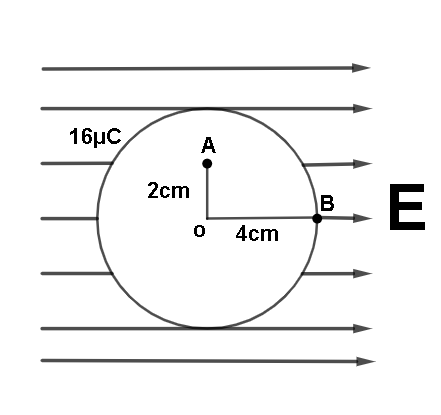
This sphere will be considered as the Gaussian surface. The Gaussian surface is placed inside an electric field . Here the electric field is constant. Outside the surface of this sphere the electric field is given by \[E = \dfrac{1}{{4\pi {\varepsilon _0}}}q\]. In this case the whole charge is supposed to be on the surface of the sphere( it means the \[16\mu C\]charge is equally distributed on the surface) To find an electric field at 2cm (2cm<4cm) it means we have to find an electric field inside the hollow sphere. Inside the sphere the electric field will be 0 as all the charge is distributed on the surface of the sphere .
Hence the correct answer to this question is option C.
Note: looking at the question you might think that it can be solved just using the formula for electric field \[E = \dfrac{1}{{4\pi {\varepsilon _0}}}q\] because charge and radius has been given. But that would be wrong because to consider an electric field we need to consider the charge on the Gaussian surface only and not anywhere else except it.
Formula Used;
\[\vec E = \dfrac{1}{{{\varepsilon _0}}}q\]
Where,
\[\vec E\]= electric field
\[q\]= charge enclosed in a Gaussian surface.
Complete step by step solution:
Let us look at gauss law first:
Gauss law: it states that the electric field inside a Gaussian surface is \[\dfrac{1}{{{\varepsilon _0}}}\]the total charge enclosed in it.
Let us now consider a sphere of radius 4cm.
This sphere will be considered as the Gaussian surface. The Gaussian surface is placed inside an electric field . Here the electric field is constant. Outside the surface of this sphere the electric field is given by \[E = \dfrac{1}{{4\pi {\varepsilon _0}}}q\]. In this case the whole charge is supposed to be on the surface of the sphere( it means the \[16\mu C\]charge is equally distributed on the surface) To find an electric field at 2cm (2cm<4cm) it means we have to find an electric field inside the hollow sphere. Inside the sphere the electric field will be 0 as all the charge is distributed on the surface of the sphere .
Hence the correct answer to this question is option C.
Note: looking at the question you might think that it can be solved just using the formula for electric field \[E = \dfrac{1}{{4\pi {\varepsilon _0}}}q\] because charge and radius has been given. But that would be wrong because to consider an electric field we need to consider the charge on the Gaussian surface only and not anywhere else except it.
Recently Updated Pages
Master Class 12 Economics: Engaging Questions & Answers for Success

Master Class 12 English: Engaging Questions & Answers for Success
Master Class 12 Social Science: Engaging Questions & Answers for Success
Master Class 12 Maths: Engaging Questions & Answers for Success
Master Class 12 Physics: Engaging Questions & Answers for Success
Master Class 12 Business Studies: Engaging Questions & Answers for Success
Trending doubts
Which are the Top 10 Largest Countries of the World?
Draw a labelled sketch of the human eye class 12 physics CBSE
Differentiate between homogeneous and heterogeneous class 12 chemistry CBSE
Why is the cell called the structural and functional class 12 biology CBSE
Draw ray diagrams each showing i myopic eye and ii class 12 physics CBSE
Which is the correct genotypic ratio of mendel dihybrid class 12 biology CBSE