




A series R - L - C \[\left( R=10\Omega ~,{{X}_{L}}=20\Omega ,{{X}_{c}}=20\Omega \right)\] circuit is supplied by \[V=\sin \omega t\text{ Volt}\] then power dissipation in circuit is,
\[\text{A}\text{. Zero Watt}\]
\[\text{B}\text{.10 Watt}\]
\[\text{C}\text{. 5 Watt}\]
\[\text{D}\text{. 2}\text{.5 Watt}\]
Answer
 Verified
597k+ views
Hint: Power dissipated in a R-L-C circuit can be expressed in terms of rms current and voltage.
When \[{{X}_{L}}={{X}_{C}}\] resonance occurs in the RLC circuit .Then the impedance of the R-L-C circuit will be equal to the value of resistance connected to that circuit.
Formula used:
\[\text{Power dissipated, P = }{{\text{i}}_{rms}}{{E}_{rms}}\cos \Phi \]
\[\tan \Phi =\dfrac{{{X}_{L}}-{{X}_{C}}}{R}\]
\[{{I}_{rms}}=\dfrac{{{I}_{o}}}{\sqrt{2}}\]
\[{{E}_{rms}}=\dfrac{{{E}_{o}}}{\sqrt{2}}\]
\[{{V}_{rms}}=\dfrac{{{V}_{o}}}{\sqrt{2}}\]
\[P=\dfrac{V_{rms}^{2}}{{{Z}^{2}}}R\]
Complete answer:
Let us draw the R-L-C diagram,
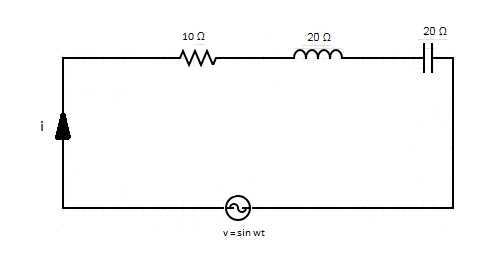
Given,
\[R=10\Omega \]
\[{{X}_{L}}=20\Omega \]
\[{{X}_{c}}=20\Omega \]
\[V=\sin \omega t\text{ Volt}\]
\[\text{Power dissipated, P = }{{\text{i}}_{rms}}{{E}_{rms}}\cos \Phi \] ------ 1
Here\[{{X}_{L}}={{X}_{c}}=20\Omega \],
Hence the impedance diagram can be drawn as
Therefore,
\[\text{Impedance, Z=R}\] ------ 2
The phase angle between the voltage and current is represented by \[\Phi \]. The tangent of this angle is given by,
\[\tan \Phi =\dfrac{{{X}_{L}}-{{X}_{C}}}{R}\]
Substitute the values of \[{{X}_{L}}\],\[{{X}_{C}}\], \[R\]
We get,
\[\tan \Phi =\dfrac{20-20}{10}=0\]
\[\Phi =0\]
Then,
\[\cos \Phi =\cos 0=1\] ------- 3
Now, we need to find the values of\[{{\text{i}}_{rms}}\text{ and }{{E}_{rms}}\].
\[{{i}_{0}}=\dfrac{{{V}_{0}}}{Z}=\dfrac{10}{R}=\dfrac{10}{10}=1A\]
Then,
\[{{\text{i}}_{rms}}\dfrac{{{I}_{o}}}{\sqrt{2}}=\dfrac{1}{\sqrt{2}}A\] --------- 4
\[{{E}_{rms}}\dfrac{{{E}_{o}}}{\sqrt{2}}=\dfrac{10}{\sqrt{2}}V\] ----------5
Substitute equations 3, 4, and 5 in equation 1
\[\text{Power dissipated, P= }{{\text{i}}_{rms}}{{E}_{rms}}\cos \Phi \]
\[P=\dfrac{1}{\sqrt{2}}\times \dfrac{10}{\sqrt{2}}\times 1=\dfrac{10}{2}=5W\]
So, the correct answer is “Option C”.
Note:
Alternate method to solve the question.
We have power dissipation,
\[P=\dfrac{V_{rms}^{2}}{{{Z}^{2}}}R\] --------- 1
\[{{V}_{rms}}=\dfrac{{{V}_{0}}}{\sqrt{2}}=\dfrac{10}{\sqrt{2}}\] ---------- 2
Here, \[Z=R=10\] --------- 3
Substituting equation 2 and 3 in equation 1.
\[P=\dfrac{{{\left( \dfrac{10}{\sqrt{2}} \right)}^{2}}}{{{10}^{2}}}\times 10=\dfrac{500}{100}=5W\]
When \[{{X}_{L}}={{X}_{C}}\] resonance occurs in the RLC circuit .Then the impedance of the R-L-C circuit will be equal to the value of resistance connected to that circuit.
Formula used:
\[\text{Power dissipated, P = }{{\text{i}}_{rms}}{{E}_{rms}}\cos \Phi \]
\[\tan \Phi =\dfrac{{{X}_{L}}-{{X}_{C}}}{R}\]
\[{{I}_{rms}}=\dfrac{{{I}_{o}}}{\sqrt{2}}\]
\[{{E}_{rms}}=\dfrac{{{E}_{o}}}{\sqrt{2}}\]
\[{{V}_{rms}}=\dfrac{{{V}_{o}}}{\sqrt{2}}\]
\[P=\dfrac{V_{rms}^{2}}{{{Z}^{2}}}R\]
Complete answer:
Let us draw the R-L-C diagram,
Given,
\[R=10\Omega \]
\[{{X}_{L}}=20\Omega \]
\[{{X}_{c}}=20\Omega \]
\[V=\sin \omega t\text{ Volt}\]
\[\text{Power dissipated, P = }{{\text{i}}_{rms}}{{E}_{rms}}\cos \Phi \] ------ 1
Here\[{{X}_{L}}={{X}_{c}}=20\Omega \],
Hence the impedance diagram can be drawn as
Therefore,
\[\text{Impedance, Z=R}\] ------ 2
The phase angle between the voltage and current is represented by \[\Phi \]. The tangent of this angle is given by,
\[\tan \Phi =\dfrac{{{X}_{L}}-{{X}_{C}}}{R}\]
Substitute the values of \[{{X}_{L}}\],\[{{X}_{C}}\], \[R\]
We get,
\[\tan \Phi =\dfrac{20-20}{10}=0\]
\[\Phi =0\]
Then,
\[\cos \Phi =\cos 0=1\] ------- 3
Now, we need to find the values of\[{{\text{i}}_{rms}}\text{ and }{{E}_{rms}}\].
\[{{i}_{0}}=\dfrac{{{V}_{0}}}{Z}=\dfrac{10}{R}=\dfrac{10}{10}=1A\]
Then,
\[{{\text{i}}_{rms}}\dfrac{{{I}_{o}}}{\sqrt{2}}=\dfrac{1}{\sqrt{2}}A\] --------- 4
\[{{E}_{rms}}\dfrac{{{E}_{o}}}{\sqrt{2}}=\dfrac{10}{\sqrt{2}}V\] ----------5
Substitute equations 3, 4, and 5 in equation 1
\[\text{Power dissipated, P= }{{\text{i}}_{rms}}{{E}_{rms}}\cos \Phi \]
\[P=\dfrac{1}{\sqrt{2}}\times \dfrac{10}{\sqrt{2}}\times 1=\dfrac{10}{2}=5W\]
So, the correct answer is “Option C”.
Note:
Alternate method to solve the question.
We have power dissipation,
\[P=\dfrac{V_{rms}^{2}}{{{Z}^{2}}}R\] --------- 1
\[{{V}_{rms}}=\dfrac{{{V}_{0}}}{\sqrt{2}}=\dfrac{10}{\sqrt{2}}\] ---------- 2
Here, \[Z=R=10\] --------- 3
Substituting equation 2 and 3 in equation 1.
\[P=\dfrac{{{\left( \dfrac{10}{\sqrt{2}} \right)}^{2}}}{{{10}^{2}}}\times 10=\dfrac{500}{100}=5W\]
Recently Updated Pages
Master Class 12 Social Science: Engaging Questions & Answers for Success

Master Class 12 Physics: Engaging Questions & Answers for Success
Master Class 12 Maths: Engaging Questions & Answers for Success
Master Class 12 Economics: Engaging Questions & Answers for Success
Master Class 12 Chemistry: Engaging Questions & Answers for Success
Master Class 12 Business Studies: Engaging Questions & Answers for Success
Trending doubts
Which are the Top 10 Largest Countries of the World?
Draw a labelled sketch of the human eye class 12 physics CBSE
Explain the structure of megasporangium class 12 biology CBSE
What are the major means of transport Explain each class 12 social science CBSE
How many chromosomes are found in human ovum a 46 b class 12 biology CBSE
The diagram of the section of a maize grain is given class 12 biology CBSE