




A sailor can row a boat 8 km downstream and return back to the starting point in 1 hr.40 min. If the speed of the stream is 2km/hr, find the speed of the boat in still water?
Answer
 Verified
632.4k+ views
Hint: We start solving the problem by assigning the variable for the speed of the boat in still water. We then find the time required for the sailor to travel downstream. We then find the time required for the sailor to travel upstream. Now, we add these both obtained times with thee given one in problem. We then make the necessary calculations to get the required value of velocity of boat in still water.
Complete step by step answer:
According to the problem, we are given that a sailor can row a boat 8 km downstream and return back to the starting point in 1 hr.40 min. We need to find the speed of the boat in still water if the speed of the stream is 2 km/hr.
Let us assume the speed of the boat in still water is x km/hr.
Let us draw the figure representing the given information.
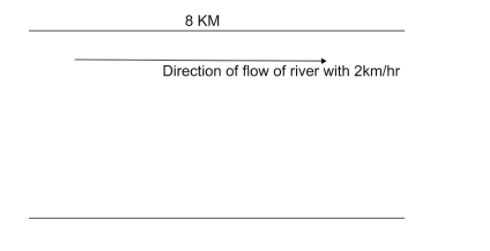
We know that while travelling downstream, the speed of the stream will add with the speed of the boat as we know that stream is supporting the movement of the boat.
We also know that $time=\dfrac{\text{distance}}{speed}$.
So, the time taken to cover 8 Km while travelling downstream will be $\dfrac{8}{x+2}hr$---(1).
Similarly, while travelling upstream, the speed of the stream will subtract from the speed of boat as we know that stream opposes the movement of boat.
So, the time taken to cover 8 Km while travelling upstream will be $\dfrac{8}{x-2}hr$---(2).
From the problem, we are given that the time taken to cover forward distance and return is 1 hr.40 min.
We know that 1 hr = 60 min. So, we get $40\min =\dfrac{40}{60}=\dfrac{2}{3}hr$.
So, we get 1hr. 40 min = $1+\dfrac{2}{3}=\dfrac{5}{3}hr$.
Now, we have $\dfrac{8}{x+2}+\dfrac{8}{x-2}=\dfrac{5}{3}$.
$\Rightarrow \dfrac{8\left( x-2 \right)+8\left( x+2 \right)}{\left( x+2 \right)\left( x-2 \right)}=\dfrac{5}{3}$.
$\Rightarrow \dfrac{8x-16+8x+16}{{{x}^{2}}-4}=\dfrac{5}{3}$.
$\Rightarrow \dfrac{16x}{{{x}^{2}}-4}=\dfrac{5}{3}$.
Cross multiplying, we get
$\Rightarrow 16x\times 3=5\times \left( {{x}^{2}}-4 \right)$.
$\Rightarrow 48x=5{{x}^{2}}-20$.
$\Rightarrow 5{{x}^{2}}-48x-20=0$.
We have got a quadratic equation in x, so we will use the factorisation method as shown below,
$\Rightarrow 5{{x}^{2}}-50x+2x-20=0$.
$\Rightarrow 5x\left( x-10 \right)+2\left( x-10 \right)=0$.
$\Rightarrow \left( 5x+2 \right)\left( x-10 \right)=0$.
Equating each term to 0, we have
$\Rightarrow 5x+2=0$ or $x-10=0$.
$\Rightarrow 5x=-2$ or $x=10$.
$\Rightarrow x=\dfrac{-2}{5}$ or $x=10$.
We know that speed cannot be negative. So, the speed of a boat in still water is 10 km/hr.
∴ The speed of a boat in still water is 10 km/hr.
Note: Whenever we get this type of problems, we first assign variables for the unknowns present in the problem. We should make sure we are not considering negative values for times, speed and distance while solving this problem. We need to know that downstream is the direction in which the river is flowing and upstream is the direction opposite to the flow of the river. Similarly, we can expect problems to find the percentage of time taken to cover the distance upstream.
Complete step by step answer:
According to the problem, we are given that a sailor can row a boat 8 km downstream and return back to the starting point in 1 hr.40 min. We need to find the speed of the boat in still water if the speed of the stream is 2 km/hr.
Let us assume the speed of the boat in still water is x km/hr.
Let us draw the figure representing the given information.
We know that while travelling downstream, the speed of the stream will add with the speed of the boat as we know that stream is supporting the movement of the boat.
We also know that $time=\dfrac{\text{distance}}{speed}$.
So, the time taken to cover 8 Km while travelling downstream will be $\dfrac{8}{x+2}hr$---(1).
Similarly, while travelling upstream, the speed of the stream will subtract from the speed of boat as we know that stream opposes the movement of boat.
So, the time taken to cover 8 Km while travelling upstream will be $\dfrac{8}{x-2}hr$---(2).
From the problem, we are given that the time taken to cover forward distance and return is 1 hr.40 min.
We know that 1 hr = 60 min. So, we get $40\min =\dfrac{40}{60}=\dfrac{2}{3}hr$.
So, we get 1hr. 40 min = $1+\dfrac{2}{3}=\dfrac{5}{3}hr$.
Now, we have $\dfrac{8}{x+2}+\dfrac{8}{x-2}=\dfrac{5}{3}$.
$\Rightarrow \dfrac{8\left( x-2 \right)+8\left( x+2 \right)}{\left( x+2 \right)\left( x-2 \right)}=\dfrac{5}{3}$.
$\Rightarrow \dfrac{8x-16+8x+16}{{{x}^{2}}-4}=\dfrac{5}{3}$.
$\Rightarrow \dfrac{16x}{{{x}^{2}}-4}=\dfrac{5}{3}$.
Cross multiplying, we get
$\Rightarrow 16x\times 3=5\times \left( {{x}^{2}}-4 \right)$.
$\Rightarrow 48x=5{{x}^{2}}-20$.
$\Rightarrow 5{{x}^{2}}-48x-20=0$.
We have got a quadratic equation in x, so we will use the factorisation method as shown below,
$\Rightarrow 5{{x}^{2}}-50x+2x-20=0$.
$\Rightarrow 5x\left( x-10 \right)+2\left( x-10 \right)=0$.
$\Rightarrow \left( 5x+2 \right)\left( x-10 \right)=0$.
Equating each term to 0, we have
$\Rightarrow 5x+2=0$ or $x-10=0$.
$\Rightarrow 5x=-2$ or $x=10$.
$\Rightarrow x=\dfrac{-2}{5}$ or $x=10$.
We know that speed cannot be negative. So, the speed of a boat in still water is 10 km/hr.
∴ The speed of a boat in still water is 10 km/hr.
Note: Whenever we get this type of problems, we first assign variables for the unknowns present in the problem. We should make sure we are not considering negative values for times, speed and distance while solving this problem. We need to know that downstream is the direction in which the river is flowing and upstream is the direction opposite to the flow of the river. Similarly, we can expect problems to find the percentage of time taken to cover the distance upstream.
Recently Updated Pages
Master Class 12 Economics: Engaging Questions & Answers for Success

Master Class 12 Social Science: Engaging Questions & Answers for Success
Master Class 12 English: Engaging Questions & Answers for Success
Master Class 12 Maths: Engaging Questions & Answers for Success
Master Class 12 Physics: Engaging Questions & Answers for Success
Master Class 12 Biology: Engaging Questions & Answers for Success
Trending doubts
The common name of Rheo leaf is A Oyster plant B Boat class 9 biology CBSE
Difference Between Plant Cell and Animal Cell
Fill the blanks with the suitable prepositions 1 The class 9 english CBSE
What is the full form of pH?
Any five important events between the years 1930 to class 9 social science CBSE
What is the Full Form of ICSE, CBSE and SSC